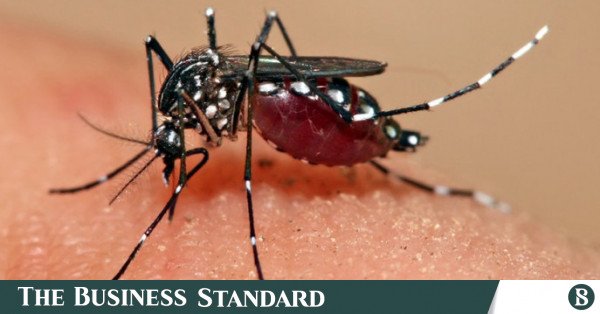
Dengue claims 5 more lives; 1,935 are hospitalised in 24 hours.
Illustration: TBS
“>

Illustration: TBS
As Bangladesh’s dengue situation continues to worsen, health experts have urged the government to approve the World Health Organisation (WHO) prequalified QDENGA vaccine, saying private imports should at least be allowed to help reduce severe infections, hospitalisations and deaths.
The dengue situation has taken an ominous turn, with 90,356 people hospitalised so far this year.
Five more people died from the disease across Bangladesh in the 24 hours until 8am yesterday, while 1,935 new patients have been admitted to hospitals. The latest deaths have raised the country’s dengue toll to 294 this year, according to a press release issued by the Health Emergency Operation Centre and Control Room of the Directorate General of Health Services (DGHS).
Experts said vaccine approval and procurement can take time, making it difficult for the government to respond at a short notice. While the government may not currently have the capacity to provide the vaccine free of charge nationwide, allowing private imports would enable eligible people who can afford it to get vaccinated.

This could also ease pressure on hospitals and reduce dengue-related deaths, they said.
While the government is open to considering a dengue vaccine, it does not want to rush the process.
State Minister for Health Dr MA Muhith told TBS, “Vaccines are available, but they are still candidate vaccines at various stages of development. We want to make an evidence-based decision after assessing how effective a vaccine would be for our population.”
He also said even if a vaccine were approved now, it would not have any immediate impact on the ongoing dengue situation. “Our most urgent task now is to tackle the dengue situation we are facing,” he said.
According to the WHO, QDENGA (TAK-003) is currently the only available vaccine for dengue prevention. WHO recommends it for children aged 6-16 in settings with high-intensity dengue transmission. The vaccine requires two doses administered three months apart.
WHO’s Strategic Advisory Group of Experts on Immunisation recommended the vaccine in September 2023, and QDENGA received WHO prequalification in May 2024.
Developed by Japan-based Takeda Pharmaceutical, QDENGA has been approved in 43 countries, including India, with more than 32 million doses distributed globally through public and private programmes.
India approved QDENGA on 20 July 2026 and is planning to launch it commercially in the first half of 2027, with the two-dose course estimated to cost Rs6,000-12,000.
‘Approval process should begin now’
Dr Fazle Rabbi Chowdhury, associate professor of internal medicine at Bangladesh Medical University and research fellow at the University of Edinburgh, told TBS that QDENGA has been approved in more than 40 countries and has WHO prequalification.
Bangladesh should therefore begin assessing the vaccine’s potential risks and effectiveness without delay, he said.
“Just because Europe, the US or other countries have approved it does not mean we have to approve it too. Our own technical committee needs to review the scientific evidence for and against the vaccine. But this process should begin now,” he said.
As the approval process itself can take time, starting it now would help the government make an informed decision later, he added.
Citing large-scale clinical trials, Dr Fazle Rabbi said QDENGA has shown more than 80% efficacy against dengue and can reduce the risk of dengue-related hospitalisation by up to around 90%.
“Getting vaccinated does not mean you will not get dengue. However, even if someone contracts dengue, the likelihood of developing severe disease and requiring hospitalisation is much lower,” he said.
The vaccine provides protection against all four dengue virus serotypes, which he said is particularly important for Bangladesh because it is difficult to predict which serotype will dominate in a particular year.
Evidence also suggests that protection can last for several years among people who develop sufficient antibody levels after vaccination, he said.
However, the vaccine is not suitable for everyone. Pregnant women, children under six, and some people with immune-related conditions cannot receive it, while age limits need to be considered for older people, he said.
Dr Fazle Rabbi said the vaccine’s high cost could make universal free vaccination difficult for the government.
“But at least allowing private imports would give eligible people who can afford it an opportunity to get vaccinated,” he said, noting that people already privately purchase vaccines against diseases such as pneumonia and influenza.
The government could also procure the vaccine through government-to-government arrangements and later decide whether to include it in the national immunisation programme or leave it to individuals to purchase privately, he added.
‘Private import should be allowed’
Public health specialist and vaccinologist Dr Tajul Islam A Bari told TBS that QDENGA has been approved in 43 countries and that Bangladesh could allow private companies to import it once the vaccine is approved locally.
He said Bangladesh may have to wait until 2028 to access dengue vaccines at lower prices through Gavi, the Vaccine Alliance, which plans to support 57 countries on dengue vaccination from that year.
Since WHO has already prequalified the vaccine and it is being used in other countries, Bangladesh should allow private imports without conducting local trials, Dr Bari said.
Conducting local trials could take another four to five years, he said, potentially delaying efforts to address the country’s worsening dengue situation.
Jamaat-e-Islami Ameer and Leader of the Opposition in Parliament Dr Shafiqur Rahman has also urged the government to allow private imports if it does not plan to procure the vaccine publicly.
Speaking at an event on Sunday, he said, “If there is no initiative to bring in the vaccine through the government, then open the way for private imports. At least then people will have the means to protect their lives.”
About The Author