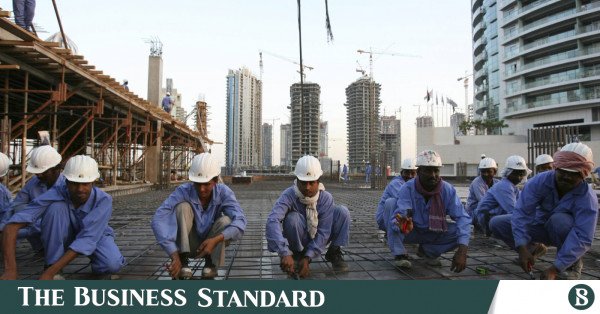
A total of 70,304 workers received country clearance for overseas employment in September, down from 99,024 in the same month last year, according to data from the Bureau of Manpower, Employment and Training (BMET)
Photo: Reuters
“>

Photo: Reuters
Highlights:
- Overseas employment clearances fell 29% year-on-year in September
- September clearances recovered 11.7% from August’s 62,924 workers
- Gulf and Malaysian labour-market restrictions continue to hurt recruitment
- Bangladesh deployed 32% fewer workers during January-September
- Government plans to create one crore overseas jobs
- September remittances fell monthly but rose 13.3% year-on-year
Bangladesh’s overseas employment market remained under severe pressure in September, with the number of workers receiving country clearance falling nearly 29% year-on-year, despite a modest recovery from the previous month.
A total of 70,304 workers received country clearance for overseas employment in September, down from 99,024 in the same month last year, according to data from the Bureau of Manpower, Employment and Training (BMET).

The figure represents a decline of 28,720 workers, or 29%, year-on-year.
However, overseas employment increased 11.7% month-on-month in September. The number of workers receiving clearance rose by 7,380 from 62,924 in August.
The overseas employment market has been under pressure due to the closure or restriction of several labour markets, including Malaysia, Oman and Bahrain, while the UAE has not been fully recruiting less-skilled Bangladeshi workers.
Infograph: TBS
“>

Infograph: TBS
The situation was further complicated by the Iran war and attacks in Saudi Arabia, which disrupted labour-market activities and contributed to uncertainty in the Middle East, according to labour recruiters.
Bangladesh sent 5,69,979 workers abroad during the first nine months of 2026, compared with 8,38,892 in the same period of 2025 – a decline of 2,68,913 workers, or around 32%, according to government data.
Saudi Arabia nevertheless remained the largest destination for Bangladeshi workers in September, with 32,915 workers receiving country clearance, up from 29,135 in August.
Singapore followed with 8,306 workers, compared with 6,944 in August. In addition, 6,282 workers received clearance for Qatar, and 5,015 for Maldives. Kuwait and the UAE accounted for 4,538 and 4,442 workers, respectively.
There was also a notable rise in employment clearances for some European destinations. Portugal received 1,249 Bangladeshi workers in September, up from 695 in August, while Italy received 1,097, compared with 828 in August.
Former Bangladesh Association of International Recruiting Agencies (Baira) joint secretary Tipu Sultan said the Middle East conflict was one of the reasons behind the decline in overseas employment this year.
“But the main problem is that we could not diversify our labour market amid shrinking job opportunities in the Gulf and Malaysia,” he told The Business Standard.
He said some potential destinations remain inaccessible to most private recruiting agencies.
“Markets such as Brunei and Jordan are solely controlled by government agency BOESL, while Singapore is handled by a limited number of agencies,” he said.
“If the private sector cannot work, you cannot create opportunities for jobs. BOESL does not have that capacity,” Tipu said, adding that all labour markets should be opened to eligible recruiting agencies rather than being controlled by any syndicate.
State Minister for Expatriates’ Welfare and Overseas Employment Md Nurul Haque Nur said the government has set a target of creating overseas employment opportunities for one crore working-age people over the next five years as part of a special five-year plan.
“The current annual deployment of 8 to 10 lakh workers will be gradually increased,” he said.
The government is also identifying labour demand in different countries and taking initiatives to train workers in the languages and technical skills required by destination countries, he added.
The state minister said the government has already started working to reopen closed labour markets and has sent memorandums of understanding proposals to several countries.
“Although a crisis has emerged around the Middle East, we hope the overseas labour market will recover soon,” he said.
Meanwhile, Bangladesh received $2.77 billion in inward remittances in September, the lowest monthly inflow in 11 months, according to Bangladesh Bank data.
The previous lowest monthly inflow was $2.56 billion in October 2025.
Despite the monthly slowdown, remittance inflows during the first quarter of the current fiscal year remained significantly higher than a year earlier. Bangladesh received $8.59 billion between 1 July and 30 September, up 13.3% from $7.59 billion during the same period of the previous fiscal year.
September’s remittance inflow was also 3% higher than the same month a year earlier, but fell from $2.97 billion in August.
Bankers said they were uncertain about the precise reason behind the slowdown. Some pointed to the ongoing conflicts in the Middle East as a possible factor, particularly amid frequent reports of Houthi attacks against Saudi Arabia during the final half of September.
They also raised concerns that a revival of the informal hundi market could be contributing to the decline.
About The Author