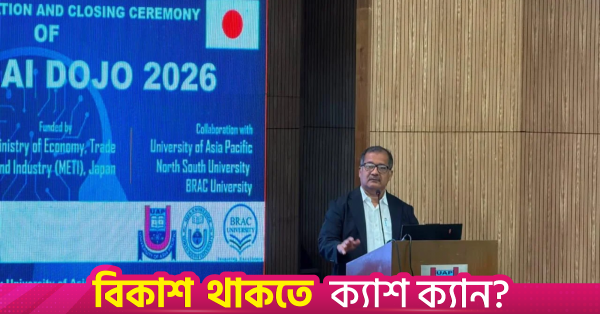
Prime minister’s political adviser Zahir Uddin Swapon urges young technologists to develop AI platforms and datasets tailored to Bangladesh’s needs.
Prime Minister Tarique Rahman’s political adviser Zahir Uddin Swapon speaks as the chief guest at the project presentation and closing ceremony of ‘Nippon AI Dojo 2026’ at the University of Asia Pacific (UAP) auditorium in Dhaka today (30 September).
“>

Prime Minister Tarique Rahman’s political adviser Zahir Uddin Swapon speaks as the chief guest at the project presentation and closing ceremony of ‘Nippon AI Dojo 2026’ at the University of Asia Pacific (UAP) auditorium in Dhaka today (30 September).
The government has pledged policy support for research in artificial intelligence (AI), semiconductors and robotics, Prime Minister Tarique Rahman’s political adviser Zahir Uddin Swapon said today (30 September).
He also urged young Bangladeshi technologists to develop locally relevant AI platforms, datasets and programming solutions alongside acquiring expertise in globally established technologies.
Swapon made the remarks as the chief guest at the project presentation and closing ceremony of ‘Nippon AI Dojo 2026’ at the University of Asia Pacific (UAP) auditorium in Dhaka this evening, according to a ministry press release.

The programme was organised jointly by UAP, Japan’s Chowa Giken Corporation and AI Samurai Japan to improve young people’s practical skills and technological capabilities and strengthen technology-based cooperation between Bangladesh and Japan.
Japanese Ambassador to Bangladesh Saida Shinichi attended the event as the guest of honour.
Speaking at the event, Swapon said AI was no longer confined to research laboratories but was transforming sectors across the economy, including agriculture, healthcare, education, manufacturing and freelancing services.
He said AI could help address technological gaps in sectors such as agriculture, which accounts for a significant share of Bangladesh’s economy, and healthcare.
However, he cautioned that ambitions to develop local AI solutions must take account of the country’s infrastructure limitations.
“Demonstrating proficiency in using foreign AI tools and achieving major success is not enough. We must develop AI tools, platforms and datasets suited to our country,” he said.
He pointed to fundamental challenges, including adequate electricity generation, the capacity to run graphics processing units (GPUs) and the shortage of extensive Bengali-language datasets.
Emphasising the need for research into electricity shortages and the effective use of natural resources, Swapon urged young technologists to combine their enthusiasm for technology with deeper research.
He said Prime Minister Tarique Rahman had already announced policy support to promote research in robotics, semiconductors and AI.
The government would provide policy backing, but technology experts would need to identify specific areas where AI could be applied effectively and develop practical roadmaps and solutions, he added.
Swapon also praised Japan’s contribution as a development partner in Bangladesh’s economic progress, describing Nippon AI Dojo 2026 as a new milestone for young people.
Special Assistant to the Prime Minister on Youth Skills Development and Employment Saiyed Abdullah, UAP Acting Vice-Chancellor Professor Abu Sayeed M Ahmed and Board of Trustees Chairman K M Mojibul Haque also spoke at the event.
The programme was chaired by Kaiyum Reza Chowdhury, a member of the university’s Board of Trustees.
During the closing session, trainees from UAP, BRAC University and North South University presented practical AI projects developed using the knowledge they had gained during the programme. Certificates and awards were also handed to the participants.
University faculty members and students, government officials, Japanese diplomatic representatives and industry representatives attended the event.
About The Author