Bangladesh’s experience in Artemia farming and genetically improved farmed tilapia (GIFT) production is being explored as a potential model for aquaculture development in Kenya and Ghana, as experts from the three countries met in Dhaka to discuss technology transfer and commercial-scale expansion.
The discussions focused on adapting Bangladesh’s experience in producing Artemia, a brine shrimp widely used as live feed in aquaculture, and disseminating GIFT tilapia to the farming conditions of Kenya and Ghana.
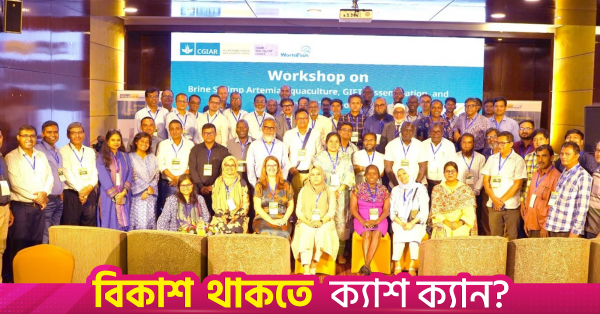
WorldFish organised the international workshop, titled “Brine Shrimp Artemia Aquaculture, GIFT Dissemination and Institutional Collaboration”, in Dhaka today (29 September).

Policymakers, researchers, development partners, private-sector representatives and aquaculture experts attended the event.
Participants reviewed Bangladesh’s experience under the EU-funded Artemia4Bangladesh initiative, including integrated salt-Artemia-aquaculture systems developed in Cox’s Bazar. The systems combine salt farming with the production of Artemia, shrimp, tilapia, crab and vegetables.
The workshop also covered Artemia cyst and biomass production, hatchery technologies and nutrition-sensitive aquaculture.
Another session focused on Bangladesh’s nearly three decades of experience in developing and disseminating GIFT tilapia, including maintaining genetic quality and establishing private-sector systems for producing and distributing quality fish seed.
“GIFT is a proven technology, but effective mechanisms are needed to transfer and scale it across countries,” said Dr Khondker Murshed-e-Jahan, senior scientist at WorldFish.
ATM Faruk-Ul Islam, country representative of WorldFish Bangladesh, said sharing knowledge, technology and practical experience among Bangladesh, Kenya and Ghana could help develop more productive and climate-resilient aquatic food systems.
The workshop also explored institutional cooperation among the three countries to support the transfer and adaptation of aquaculture technologies.
About The Author