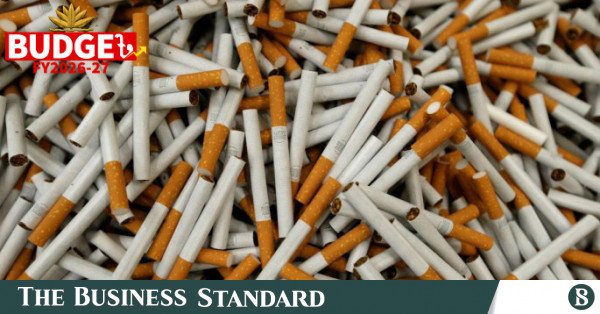
Bangladesh’s inflation-adjusted, or real, cigarette prices have declined across most price tiers despite nominal price hikes introduced in the FY2026-27 budget, according to an analysis presented by the Power and Participation Research Centre (PPRC).
The findings were presented at a media workshop on tobacco tax policy held at the PPRC office yesterday (28 September), where researchers, journalists and tobacco-control stakeholders discussed cigarette taxation, market trends, government revenue and public health implications.
Mohammad Ihtesham Hassan, senior research associate at PPRC, presented the analysis titled “Media Workshop on Tobacco Tax Policy: Lessons from FY2026–27 Budget, Market Trends, Policy Outcomes and Way Forward”.

He said the four-tier cigarette pricing structure remained unchanged in the latest budget, while the minimum retail price of low-tier cigarettes was raised from Tk60 to Tk62 and later to Tk65. The minimum prices for medium-, high- and premium-tier cigarettes were set at Tk92, Tk160 and Tk210 respectively.
However, after adjusting for inflation, real cigarette prices had declined across most tiers by August 2026, PPRC’s analysis showed.
The workshop also highlighted limitations of Bangladesh’s current ad valorem tobacco tax system, under which increases in retail prices do not necessarily translate into proportional increases in government revenue.
Participants discussed the introduction of a specific excise component as a way to make tobacco tax revenue more predictable and responsive to market changes.
PPRC data also showed a significant shift in cigarette market shares. The low-tier segment’s share fell from 77% in FY2021-22 to below 49% by May 2026, while the medium-tier segment increased from 9% to 42%.
The shift was partly attributed to brand reclassification following the January 2025 price revision, although the analysis suggested that changing consumer preferences may also have contributed.
The workshop further discussed a reported Tk3,000 crore year-on-year decline in cigarette VAT and supplementary duty revenue during July-August 2026.
PPRC cautioned that the figure should be treated as a provisional revenue gap, as the new quarterly VAT system may have affected the timing of revenue recording.
Speakers said tobacco tax policy should take into account inflation, changes in cigarette market dynamics and the government’s revenue requirements, while preventing tobacco products from becoming increasingly affordable.
Md Mostafizur Rahman, former chairman of the Bangladesh Chemical Industries Corporation (BCIC); Syed Ziauddin Ahmed, director of HR and Budget at PPRC; and Ataur Rahman, advocacy manager of Campaign for Tobacco-Free Kids (CTFK)-Bangladesh, also spoke at the workshop.
About The Author