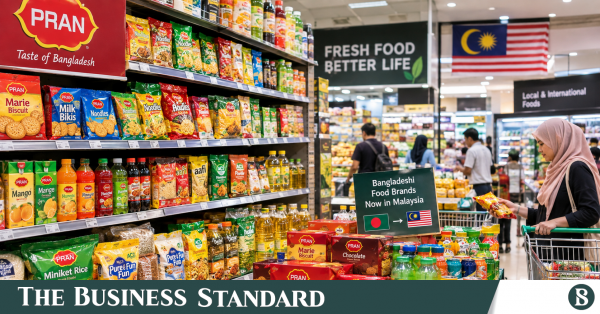
From major supermarkets to neighbourhood grocery stores, Bangladeshi food products are becoming increasingly visible in Malaysia. Biscuits, noodles, juices, snacks, spices, rice, pulses, cooking oil and other processed foods are finding space in the country’s mainstream retail market.
Among the most visible Bangladeshi brands is PRAN, which has been building its Malaysian market for around 15 years. Beyond major retail chains, the company has developed its own distribution and retail network.
Other Bangladeshi brands, including ACI Foods’ Pure and Fun, Olympic Industries’ biscuits and other food products, and Akij Food and Beverage’s Aafi, Speed and Clemon products, are also available, although on a smaller scale.

Beyond the Bangladeshi community
The initial demand for Bangladeshi products came mainly from the country’s large Bangladeshi migrant community. Malaysia has around 1.2 million Bangladeshi workers, although figures from Malaysian and Bangladeshi authorities differ.
Companies are now seeking to move beyond this customer base and reach Malaysian, Indian, Indonesian, Nepali and other migrant communities.
A vast PRAN network
PRAN said it has operated in Malaysia since 2010. Its products are marketed by Pinnacle Foods (M) Sdn, a strategic partner of PRAN-RFL Group.
Pinnacle currently markets around 850 PRAN products in Malaysia, ranging from beverages, biscuits and snacks to rice, spices, pickles, noodles and canned foods. The company says annual sales of PRAN products in the country amount to around $240–250 million.
PRAN products are available at major chains, including Mydin, KK Super Mart, Econsave, Giant, AEON, NSK, AEON Big, Lotus’s, ST Rosyam Mart, Segi Fresh and Lulu, as well as selected Petronas and Shell outlets. During visits to Kuala Lumpur, PRAN products were seen on shelves, and Malaysian customers were also seen buying them.
Building a local network
Pinnacle has developed its own distribution infrastructure rather than operating solely as an importer. Managing Director Mohammad Salim Bhuiya said the company has a five-acre central warehouse in Sungai Buloh, supported by regional warehouses in Kuala Lumpur, Kota Bharu, Johor Bahru, Ipoh, Penang, Malacca, Terengganu, Kuantan and Sabah.
Around 150 vehicles branded with the PRAN logo are utilised for distribution, while approximately 700 individuals are employed in marketing and associated operations, the majority of whom are from Bangladesh. Pinnacle also employs Malaysians, Chinese and Nepali workers in accordance with local regulations.
The company imports an average of 300 containers of products from Bangladesh each month. Salim said Pinnacle sells more than $70 million worth of products annually in Malaysia and neighbouring markets, with growth of around 30% a year.
Its operations also include regional sourcing. Products such as coconut water, beverages, energy drinks, biscuits, snacks, condensed milk, rice, pulses and cooking oil are produced under contract in Malaysia and neighbouring countries. The company also imports rice from India, hilsa from Myanmar and onions from Pakistan for repackaging and sale.
Pinnacle has also entered retail through ‘Pasar Raya Pinnacle’, with three outlets near Kuala Lumpur and plans for further expansion.
Opportunity in the halal market
Malaysia offers opportunities beyond its Bangladeshi consumer base because of its large, diverse market, modern retail network and strong halal ecosystem.
According to Malaysia’s Halal Development Corporation, the country’s halal exports increased by 10.9% year-on-year to 68.52 billion ringgit in 2025. Food and beverages accounted for 36.86 billion ringgit, or 53.8% of total halal exports.
Despite this potential, Bangladeshi food products remain a small part of overall bilateral trade. Malaysian government data show a total trade between the two countries reaching 12.18 billion ringgit in 2025, with Bangladesh exporting 2.10 billion ringgit and importing 10.08 billion ringgit. Bangladesh’s major exports remain textiles, clothing and footwear.
The Bangladesh High Commission also lists vegetables, potatoes, grains, fruit juice, fish, pharmaceuticals, plastics, tea and spices among Bangladesh’s exports to Malaysia.
Certification remains a challenge.
Halal certification and market compliance remain important hurdles for Bangladeshi food exporters.
Salim said greater access to halal certification and improved trade facilities between the two countries could significantly increase Bangladesh’s food exports to Malaysia.
But companies also need to adapt products for a wider consumer base, he said, through competitive pricing, packaging, taste, certification and supply chains rather than relying mainly on Bangladeshi customers.
For Bangladeshi students and migrants, however, the growing presence of familiar brands has an immediate appeal. Rakibul Haris, a student from Bogura who has been studying at INTI International University for about a year, said he feels good when he sees products from Bangladesh and buys PRAN products when available and needed.
He also sees wider potential for Bangladeshi products in the Malaysian market.
About The Author