From midnight, trucks loaded with chickens arrive at Kaptan Bazar, one of Dhaka’s largest wholesale poultry markets.
By dawn, vendors are haggling over prices, cages are being loaded and unloaded, and thousands of live birds are changing hands amid the crowd.
As the market winds down, the street is left covered with poultry droppings, feathers and other waste. Residents begin their workday along the same route, some covering their noses with handkerchiefs and others stepping around the waste.
The scene at Kaptan Bazar reflects the close interaction between humans and animals in Bangladesh. As such contact increases, so does the opportunity for pathogens to jump from animals to people, a risk known as zoonotic disease.

Over the past decade, Bangladesh’s livestock and poultry population has grown by roughly 24%.
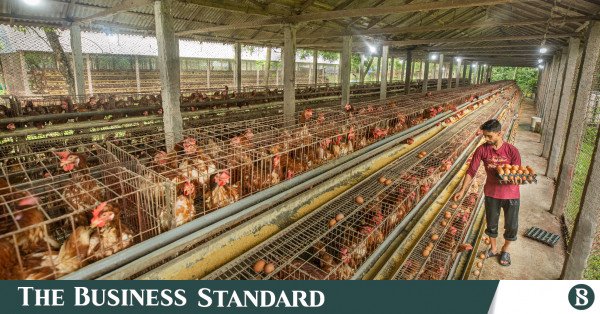
While the growth is vital for food and nutrition security, it has also increased opportunities for close human-animal contact through crowded farms, live animal markets, transport and slaughter systems.
Poultry drives livestock growth
According to the Department of Livestock Services’ (DLS) Livestock Statistics at a Glance 2025–26, the country’s total livestock and poultry population, including cattle, buffalo, goats, sheep, chickens and ducks, stood at 3,839.45 lakh in fiscal year 2016-17.
By 2025-26, the number had risen to 4,759.48 lakh, an increase of about 24%.
Much of this growth came from the poultry sector. Over the same period, the number of chickens and ducks increased from 3,292 lakh to 4,175.54 lakh, a roughly 27% rise.
Paritosh Kumar Biswas, a professor in the Department of Microbiology and Veterinary Public Health at Chattogram Veterinary and Animal Sciences University, said intensive farming practices are increasing the risk of emerging zoonotic diseases in Bangladesh and worldwide.
Raising more birds in less space, he said, increases close contact between animals and humans, creating more opportunities for pathogens to enter the human body.
He identified avian influenza as one of the biggest concerns, warning that it could trigger a major public health crisis in the future.
That concern has taken on new urgency this year. This year four children in Bangladesh have tested positive for H5N1 so far. One child from Chattogram division died, while the other three recovered.
H5N1 is a subtype of the influenza A virus that causes the disease avian influenza, also referred to as bird flu.
According to the World Health Organization, two of the children had a history of direct or family contact with poultry.
The WHO also notes that human H5N1 infections have been recorded in Bangladesh since 2008. To date, 15 human infections have been confirmed, of which two were fatal.
Multiple zoonotic threats
Avian influenza is not the only zoonotic threat. Bangladesh also faces risks from anthrax, brucellosis, leptospirosis and bovine tuberculosis.
Dr Imamul Muntasir, a scientific officer at IEDCR, said the defining feature of zoonotic diseases is transmission of infections from animals to humans.
“There’s a risk of Nipah from bats, anthrax and brucellosis from livestock, and avian influenza from poultry to humans,” he said.
Data from IEDCR’s Anthrax Surveillance Data Analysis (2020–23) shows suspected human cutaneous anthrax cases rose from 307 in 2020 to 655 in 2023.
In 2022, 62 of 85 tested samples from 464 suspected cases were positive for anthrax. In 2023, 78 of 142 tested samples were positive.
Among those infected with anthrax, 19.3% had eaten meat from an infected animal, 11.3% had cooked the meat, 10.8% had handled it and 10.3% had been involved in slaughtering.
By animal species, exposure to goats accounted for 58% of cases and cattle for 38.2%.
Live markets raise exposure
Professor Paritosh said live bird markets are among the biggest sites of human-animal contact.
“When people buy a chicken and watch it being slaughtered on the spot, they come into direct contact with faeces, urine, and other animal waste and most of the time, we are not even wearing masks,” he said.
He suggested switching to processed poultry meat or chilled meat slaughtered at designated slaughterhouses to reduce such exposure.
He also called for greater emphasis on screening programmes for bovine tuberculosis and brucellosis.
Climate change adds another layer of risk. Changes in temperature, rainfall, humidity and flooding can alter the habitats of pathogens and disease vectors, bringing wildlife, domestic animals and people into closer proximity and creating new opportunities for infection.
The UN Food and Agriculture Organization’s Bangladesh: Emergency and Resilience Plan 2026–2028 emphasises strengthening resilience in animal health and agri-food systems alongside addressing climate and environmental risks.
Implementing the plan is estimated to require $79.6 million in total funding.
Raising livestock production and containing zoonotic risk are not competing goals, Dr Paritosh said.
But keeping them aligned will require safer farms, hygienic slaughter and market systems, and greater caution wherever people and animals come into contact.
About The Author