Before the fire, more than 100 tonnes of cargo would typically remain uncleared at the airport, according to Dhaka Customs House. The daily backlog has now risen to around 400-500 tonnes
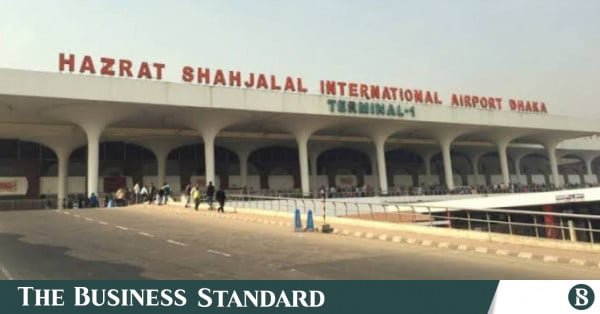
Hazrat Shahjalal International Airport, Dhaka. File Photo
“>

Hazrat Shahjalal International Airport, Dhaka. File Photo
Highlights:
- Cargo backlog has quadrupled since HSIA’s 2025 fire
- Some cargo is being stored under the open sky
- Scanner shortages have increased reliance on physical inspections
- Weekend shutdowns and ground-handling problems further delay clearance
- Export screening capacity remains limited, with two EDS machines operational
- New scanners and third-terminal facilities are expected to ease bottlenecks
Import cargo operations at Hazrat Shahjalal International Airport (HSIA) in Dhaka are yet to return to normal nearly 11 months after a fire damaged the Cargo Village.
Before the fire, more than 100 tonnes of cargo would typically remain uncleared at the airport, according to Dhaka Customs House. The daily backlog has now risen to around 400-500 tonnes, airport authorities said.

Freight forwarders and businesses said some of the current backlog is now being kept under the open sky. Clearance delays, weekend shutdowns, ground-handling issues and limited screening capacity are slowing cargo clearance, they added.
Infograph: TBS
“>

Infograph: TBS
They warn that the continuing bottlenecks expose weaknesses in the airport’s cargo management system that could become more serious if import and export volumes rise.
The biggest infrastructure gap is the lack of a functioning scanner in the main import cargo area. The scanners there became unavailable after the fire, forcing Customs to rely more heavily on document verification and physical inspection.
Authorities said the backlog has fallen sharply from more than 2,000 tonnes in the aftermath of the 18 October 2025 fire, while new scanners are expected to arrive by December.
Why cargo clearance is delayed
Kabir Ahmed, president of the International Air Express Association of Bangladesh (IAAB), said consignments become “left-over” cargo when not cleared on the day of arrival.
Import shipments must comply with various certification and documentation requirements. Delays in submitting or processing these documents can hold up consignments, he said.
Ground handling is another bottleneck. Biman sometimes fails to produce consignments on time, while cargo locations can also take time to identify, Kabir said.
Warehouse management also remains below standard, he added. “The warehouse is still not fully back to normal. It is being operated with makeshift arrangements,” he told TBS.
Many of these problems could be reduced by bringing cargo operations under an integrated online system linked to the National Single Window, Kabir said. Better coordination among Biman, Customs and other agencies involved in cargo handling is also needed.
Weekend slows clearance
Although HSIA operates round the clock, cargo clearance slows sharply on Fridays, Saturdays and public holidays as many importers and C&F agents do not operate on those days.
Airport Executive Director Ragib Samad told TBS that part of the fire-damaged area was prepared around January to store import cargo, where consignments are now being kept.
Flights and cargo continue to arrive at weekends, but clearance slows, leaving accumulated cargo to be cleared on subsequent working days, he said.
Authorities believe importers and C&F agents working on weekends could ease the pressure. However, freight forwarders said incentives, discounts or special arrangements may be needed to encourage weekend operations, which require additional manpower and costs.
Fazlee Shamim Ehsan, executive president of the Bangladesh Knitwear Manufacturers and Exporters Association (BKMEA), said importers do not intentionally leave consignments.
“Due to a lack of cooperation or complications at customs, we often cannot clear the goods quickly even after spending so much to bring them into the country,” he told TBS.
Ragib said the daily backlog has now risen to around 400-500 tonnes. He said customs should decide on uncleared consignments within seven days and establish a legal mechanism to sell goods left uncleared beyond a specified period.
Import scanner still unavailable
Muhammad Kamrul Hassan, additional commissioner at Dhaka Customs House, said two scanners had been in the main cargo area before the fire. One was operational and the other was already malfunctioning, but both became unavailable after the fire.
He said four import cargo screening machines are expected to be available by December.
However, the scanner shortage is not the main reason cargo remains at the airport, Kamrul said, adding that around 80% of consignments leave the warehouse within a day.
“There was a backlog even before the fire because importers and agents don’t have the capacity to take away all the cargo immediately. Many industries are closed and cannot store goods in their own warehouses, so they often collect them on working days,” he said.
He estimated the pre-fire backlog at more than 100 tonnes. The lower backlog before the fire was partly because the import cargo warehouse was fully operational. It is now running at only about one-third of its capacity, he said.
Daily import cargo averages around 400 tonnes, although the volume can fall to about 300 tonnes on some days, according to Dhaka Customs House.
Biman spokesperson Mohiuddin Ahmed said he was unaware of the cargo situation and would look into it, but had not responded further as of publication.
Customs relies more on physical checks
Kamrul rejected suggestions that consignments are being released without adequate inspection because of the scanner shortage. Officials review documents and physically inspect consignments when necessary to identify suspicious shipments.
He acknowledged that modern scanners would make the process faster and more efficient.
Businesses said physically examining cargo is time-consuming when volumes are high. They believe risk-based customs checks need to be supported by modern scanning technology.
Export cargo faces capacity risk
Around 400-450 tonnes of export cargo are handled daily, according to the International Air Express Association of Bangladesh. The volume is neither at peak levels nor particularly low.
This moderate volume means existing infrastructure gaps have yet to create severe pressure. But higher shipments could expose limitations in screening and handling capacity.
According to airport officials, only two of four Explosive Detection System (EDS) machines used for export cargo are operational. EDS 1 and EDS 3 are functioning, while EDS 2 has been out of service for years and EDS 4 since September 2024.
Abdul Karim Molla, director of the Central Procurement, Engineering and Store Unit at the Civil Aviation Authority of Bangladesh (CAAB), said repairing an EDS costs several crore taka.
As the current export volume can still be handled with the available machines, authorities are not planning to immediately buy or repair one, he added.
Executive Director Ragib said the new import cargo facilities at HSIA’s third terminal, along with its connected import and export terminals, would help ease the backlog.
The terminal is expected to increase annual cargo capacity from 200,000 tonnes to 546,000 tonnes, with a 36,000-square-metre dedicated cargo zone.
About The Author