A small four-wheeler resembling an autorickshaw but powered entirely by sunlight, a robot that moves through vegetable fields to diagnose crop diseases and spray pesticides automatically, and an electric motorcycle capable of travelling 80 kilometres on just Tk25 worth of electricity were among the most popular innovations at the Bangladesh Innovation Fair 2026.
Under one roof, government and private research institutions came together with 73 public and private universities, independent researchers, students, budding startups, small and medium-sized enterprises (SMEs) and global investors, putting more than 1,000 new and promising innovations on display across technology, business, education, health, agriculture and the environment.
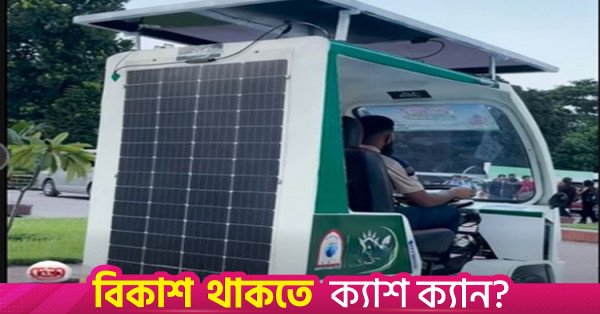
Among the standout exhibits was the “Sun Car”, a solar-powered, environment-friendly four-wheeler developed by the University of Global Village (UGV), Barishal.

Displayed at the front of the main stall beneath a banner reading, “The age of rickshaws and vans is over, this is Sun Car’s Bangladesh,” the vehicle featured solar panels on its roof and at the back, drawing constant attention from visitors throughout the fair.
Explaining the vehicle, Sagor Sharif, a lecturer at UGV, said the car does not draw any electricity from the national grid, a feature he believes could substantially ease the country’s load-shedding, or even eliminate it altogether.
“We have put solar panels on top and on the back side, so our car will get charged by sunlight and will also run on that charge,” he said.
“Our car will not need any electricity from the national grid, which will reduce load-shedding significantly, or load-shedding may not exist at all. Since we have solar panels, the car will get charged with this and the car will run. This is our main objective,” he added.
The Sun Car is essentially a three-seater, environment-friendly vehicle. The four-wheeler has a 400-watt solar panel on its roof and a 200-watt panel at the back. Building the prototype cost around Tk170,000, though the innovators aim to reduce the price further if they move to commercial production.
The vehicle also has a backup system that allows it to run without sunlight.
“We have a battery as backup. When there is no sunlight, or during rain, or in winter, how will the car run then?” Sagor Sharif said.
“For that, we will set up a separate socket system in the battery, which can be fully charged in about six hours using a 220-volt supply from home. After a full six-hour charge, our car will be able to run for another five hours,” he added.
Meanwhile, researchers at the Department of Electrical and Electronic Engineering of Independent University, Bangladesh (IUB) have developed an affordable electric power train, which is being used to build electric motorcycles capable of travelling 80 kilometres on just Tk25 worth of electricity.
Imtiaz Abedin, a lecturer and researcher at IUB, said, “The specialty of this bike is that we have used a lithium iron phosphate battery here. The battery is inside our tank, and we have replaced the entire engine, installing a motor and a gearbox here, which is connected and turns my wheel, and my motor controller is installed right here in this toolbox.”
“You can easily go up to 80 kilometres on a single charge. It basically takes us 20 to 25 minutes to charge, but we take approximately 30 minutes,” he said.
“You can charge it from the 220-volt line at home, or if solar panels are connected at your home, you can charge this battery from that solar source as well,” he added.
Another notable innovation was seen at the stall of Bangladesh University of Professionals (BUP), where an invention called “Agrobot” claims to be able to diagnose diseases in vegetable seedlings.
Isharaque, an innovator with BUP’s Agrobot team, said, “Agrobot’s job is basically to detect diseases in various crops. After detection, it has an integrated database of the pesticide needed for that particular disease, which it uses as a reference, and it simply identifies the required pesticide and sprays it.”
He added, “So since this system is fully autonomous and smart, I do not need any extra hand here, I am not doing any work, I just need to deploy it and it can do everything on its own in the field.”
Visitors from various walks of life thronged the fair alongside entrepreneurs.
One visitor said, “Students are making new inventions. I saw this one first while entering, so it felt good. I have not ridden it, maybe I will ride it on my way out.”
Another visitor said, “Artificial intelligence and nanotechnology, whatever we have, should gradually be presented to us, shown to us, then we will be able to learn new things.”
“A lot of really good projects have come here, so it felt quite good going around everything,” observed another visitor.
The three-day fair, organised by the Ministry of Science and Technology under the theme “Innovate to Market” and “Innovation Ecosystem Toward Trillion Dollar Economy,” was inaugurated on 12 September by Prime Minister Tarique Rahman at the capital’s Novo Theatre.
It aimed to bring innovators, entrepreneurs, researchers, industry, investors, policymakers, universities and development partners onto a single national platform, and to build a strong Integrated National Innovation Ecosystem (INIE) by turning ideas and research into practical applications, ventures and marketable products.
The fair featured one Innovation Hub, over 1,000 innovations, more than 15 sessions and dialogues, and participation from over 50 universities, 100-plus industry experts and 50-plus corporate organisations.
It also eyed to connect innovators with domestic and foreign industrial enterprises, investors, banks, financial institutions and government decision-makers, creating opportunities for B2B matchmaking and green transition-based partnerships.
Plenaries, sessions and roundtables over the three days covered key aspects of the innovation-driven economy, including transport and logistics, communication infrastructure, climate resilience, STEM education, green construction, health, research and development, apparel and textiles, SMEs, artificial intelligence, smart agriculture, clean and alternative energy, human resource development, intellectual property, digital economy and fintech.
About The Author