Shop workers urged stronger organisation and legal awareness to secure minimum wages and labour rights.
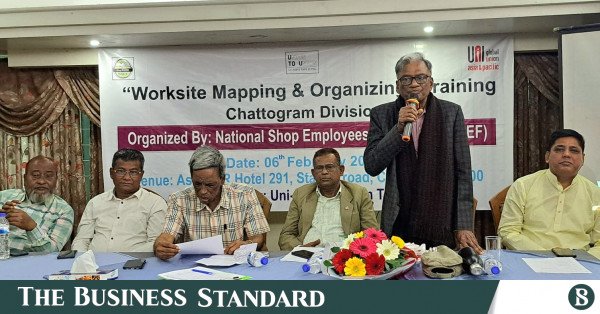
A day-long workshop titled “Worksite Mapping and Organising”, organised by the National Shop Employees Federation at a hotel in Chattogram yesterday (5 February). Photo: TBS
“>

A day-long workshop titled “Worksite Mapping and Organising”, organised by the National Shop Employees Federation at a hotel in Chattogram yesterday (5 February). Photo: TBS
As demands grow for a minimum wage and social protection in the retail and commercial sector, shop workers’ leaders have stressed the need to strengthen organisational skills and legal awareness to secure long-denied labour rights.
The call came at a day-long workshop titled “Worksite Mapping and Organising”, organised by the National Shop Employees Federation at a hotel in Chattogram yesterday. Nearly 40 shop workers from parts of the city attended the programme to discuss workplace organising, labour law compliance and collective action.
Federation President Rafiqul Islam Babul chaired the workshop, while Amirul Haque Amin moderated the sessions.

Speaking as chief guest, AM Nazim Uddin, president of the Chattogram divisional unit of Jatiyatabadi Sramik Dal, said workers in shops and commercial establishments have long remained outside formal recognition and basic labour protections.
“Organisational and legal awareness are the main strengths of workers in realising their rights,” he said, adding that employers and the administration must take greater responsibility for implementing labour laws.
Nazim assured his support of fixing a minimum wage and ensuring social security coverage for shop workers.
Special guest Tapan Dutta, a member of the Labour Reform Commission and president of the Chattogram divisional committee of the Bangladesh Trade Union Centre (TUC), said labour laws are ineffective if they exist only on paper.
He noted that working hours, weekly holidays and wage structures in the sector remain largely unregulated and called for forming a minimum wage board and regular monitoring.
A key session focused on the Bangladesh Labour Act. Fazlul Kabir Mintu, TUC central organiser and coordinator of the Bangladesh Institute of Labour Studies, outlined the federation’s 15-point demand and explained relevant legal provisions.
He said Section 138 of the Labour Act allows for forming a minimum wage board.
The federation has demanded a minimum monthly wage of Tk20,000, two annual festival bonuses and service benefits upon termination.
About The Author