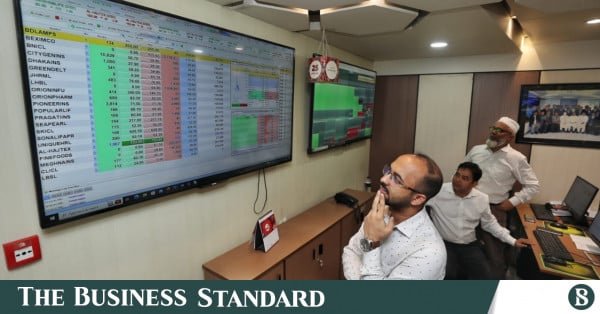
Overall market capitalisation contracted significantly, wiping out Tk5,400 crore over the week.
People look at stock market data. File Photo: TBS
“>

People look at stock market data. File Photo: TBS
The country’s equity market suffered a sharp pullback last week as persistent concerns over an ongoing energy crisis, a weakening corporate earnings outlook, and fragile investor sentiment continued to weigh heavily on trading activity.
The benchmark DSEX index of the Dhaka Stock Exchange plummeted by 146 points, or 2.59%, to settle at 5,515. Mirroring the broader market slump, the blue-chip DS30 index dropped 45 points, or 2.12%, to close at 2,095. Overall market capitalisation contracted significantly, wiping out Tk5,400 crore over the week.
Broad-based selling pressure dominated the floor, resulting in 310 issues declining against only 60 advancing, while 16 remained unchanged.

Daily average turnover on the Dhaka bourse dropped 9% to Tk554 crore, reflecting cautious participation from both institutional and retail investors.
According to a weekly market review by EBL Securities, the capital bourse ended the week in negative territory as investors remained wary of the adverse impact of persistent gas and electricity shortages on industrial production and corporate profitability.
The week opened on a subdued note, with the prolonged bearish trend dragging the intraday DSEX index below the 5,500-point mark. Although bargain hunters attempted to stage a reversal mid-week as declining stock valuations offered attractive entry points, broader concerns over macroeconomic uncertainty quickly outweighed buying interest, sustaining the downward momentum through subsequent sessions.
Sheltech Brokerage Limited noted in its weekly report that the market performance was primarily shaped by strong initial selling pressure, which led to the sharpest single-session decline seen in the last five months. While opportunistic buying emerged toward the middle of the week, it failed to trigger a meaningful recovery and was eventually offset by persistent profit-booking and risk aversion.
Investor activity was heavily concentrated in the textile sector, which accounted for 29.5% of total turnover, followed by general insurance at 14.2% and pharmaceuticals at 10.4%.
Sector-wise performance was overwhelmingly negative across the board. The ceramics sector suffered the steepest decline, falling 5.9%, followed by paper and life insurance, which dropped 5.6% and 5% respectively.
Amid the widespread downturn, the mutual fund sector stood out as a notable exception, gaining 3.7% as short-term-oriented investors sought quick-gain opportunities.
Top turnover leaders for the week included Sharp Industries, Envoy Textile, Malek Spinning, Saiham Cotton, and Saiham Textile.
Envoy Textile led the weekly gainers’ chart with a 20.4% surge, followed by Phoenix Finance First Mutual Fund at 20.3%, Exim Bank First Mutual Fund at 13.8%, Mercantile Insurance at 11.8%, and Reliance Insurance Mutual Fund One at 10.6%.
Conversely, Al-Haj Textile emerged as the top loser, tumbling 16.9%, alongside Information Service Network, Orion Infusion, Samata Leather, and Desh Garments.
About The Author