Experts stressed that tax policies need to better account for changes in the tobacco market, product affordability, consumer behaviour and purchasing preferences.
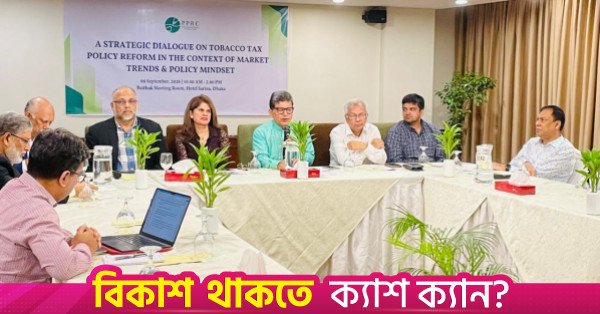
The PPRC strategic dialogue on tobacco tax policy reform held at Hotel Sarina in Dhaka on 9 September 2026. Photo: Courtesy
“>

The PPRC strategic dialogue on tobacco tax policy reform held at Hotel Sarina in Dhaka on 9 September 2026. Photo: Courtesy
Bangladesh needs stronger and more effective tobacco tax reforms that prioritise public health alongside revenue generation, experts said at a strategic dialogue organised by the Power and Participation Research Centre (PPRC).
Titled “Tobacco Tax Policy Reform in the Context of Market Trends and Policy Mindset”, the high-level dialogue was held at Hotel Sarina in Dhaka yesterday (9 September), bringing together public health experts, economists, researchers and policymakers to discuss the country’s tobacco taxation landscape and the reforms needed to improve public health outcomes.
The discussion began with a presentation by Mohammad Ihtesham Hassan, senior research associate at PPRC, who highlighted emerging trends in Bangladesh’s tobacco market, changing consumption patterns and evolving challenges for tobacco tax policy.

Participants said tobacco taxation should be viewed not merely as a revenue-generating mechanism but also as a crucial public health intervention to reduce tobacco consumption and protect vulnerable populations.
Experts stressed that tax policies need to better account for changes in the tobacco market, product affordability, consumer behaviour and purchasing preferences.
They also highlighted the limitations of small, incremental tax increases and called for a simpler, evidence-based tax system aimed at achieving stronger public health outcomes.
The discussion underscored the need to ensure that rising incomes and purchasing power do not make tobacco products increasingly affordable.
Participants said an effective tax system should lead to meaningful and sustained increases in tobacco prices, discourage consumers from switching to cheaper tobacco products and strengthen broader tobacco-control measures.
They also called for greater cooperation among government agencies, health professionals, economists, researchers and civil society organisations to develop a tobacco tax system aligned with Bangladesh’s tobacco-control and disease-prevention goals.
The dialogue also sought to translate market evidence and public health priorities into practical recommendations for effective tobacco tax reform.
The event was chaired by Dr Hossain Zillur Rahman, executive chairman of PPRC. Dr Maheen Malik, regional director, South Asia Programs, Campaign for Tobacco-Free Kids (CTFK), attended as the guest of honour.
The expert panel comprised Dr Syed Mahfuzul Hoque, former national professional officer for non-communicable diseases at the World Health Organization (WHO); Prof Dr Syed Md Akram Hussain, chairman of the Department of Clinical Oncology at Bangladesh Medical University; Prof Dr Shafiun Nahin Shimul, director of the Institute of Health Economics at the University of Dhaka; and Prof A K Enamul Haque, director general of the Bangladesh Institute of Development Studies (BIDS).
About The Author