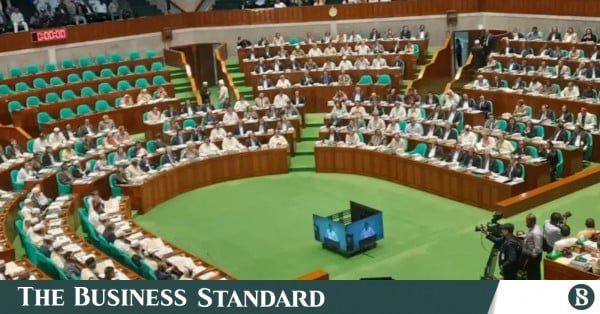
Opposition MPs have raised religious and legal objections to the newly passed bill allowing property donors to retain lifetime enjoyment rights after transferring ownership, arguing that the provision could conflict with Islamic rules on inheritance and Heba.
The ‘Transfer of Property (Amendment) Bill, 2026’ was passed by voice vote in parliament yesterday (6 September) despite objections from Jamaat-e-Islami MPs, who called for the bill to be withheld and reviewed by Sharia experts and the Islamic Foundation.
Opposition leader Shafiqur Rahman said he believed the bill had been brought forward with humanitarian intentions.

“I have no questions regarding the intention of this law. But our point of objection is, how will those who have faith in the eternal provisions given by Allah Almighty view or receive the application of this law?”
Citing verses on inheritance from Surah An-Nisa, he said Sharia contains specific provisions on Heba, Wasiyat (will) and inheritance.
“There is a clear contradiction here. The issue of will or Heba that has come up here conflicts with Sharia,” Shafiqur Rahman said.
“Now my question is, a matter to know, shall we keep the principle of the Quran, or omit it? Do we have any right to omit it?” he said.
He called for the bill to be withheld in the current session and sent to Sharia experts for review.
“If they examine the matter and make any recommendations to us, it will be good for the nation. And in that case, I would say it can also be referred to the Islamic Foundation, there is no problem,” he said.
What the bill says
The Transfer of Property (Amendment) Bill, 2026 brought changes to the Transfer of Property Act, 1882 to introduce legal recognition of lifetime usufruct rights. A new method of property transfer titled ‘Gift reserving life interest’ has been added to the bill.
Under the bill, when parents or grandparents transfer property to their children or grandchildren, or when spouses transfer property to each other, the donor can retain the right to enjoy the property for life.
Ownership passes to the recipient, but the donor retains the right to use and enjoy the property during their lifetime.
If the recipient dies during the donor’s lifetime, the property passes to the recipient’s heirs according to law, while the donor’s lifetime right of enjoyment remains intact.
During the debate, Law Minister Md Asaduzzaman said the new method is not Heba under Muslim law and would not restrict property transfers recognised under Heba or any other law.
He said sub-section 4 of Section 122A of the bill makes clear that the new method would not limit or impair the validity of transfers recognised under Heba or any other law.
Before the bill was passed, opposition proposals to seek public opinion and send it to a scrutiny committee were rejected by voice vote. Proposed amendments to the clauses were also rejected.
The law minister then moved for passage of the bill, which was approved by voice vote. The bill will become law after the President gives his assent.
Opposition MPs briefly walked out of the chamber during the debate but returned shortly afterwards.
Najibur claims BNP breaking promise
Jamaat-e-Islami MP for Pabna-1 Najibur Rahman also opposed the bill, describing it as “anti-Quran and Sunnah”.
He said, “Before the election, the BNP had stated that they would not enact any law contrary to the Quran and Sunnah.”
Najibur also said the Parents’ Maintenance Act, 2013 could be used to protect parents’ rights.
He argued that allowing property to be donated while retaining lifetime enjoyment rights could create scope for bypassing Islamic rules on inheritance and Heba.
Rumeen Farhana backs bill, but calls for additional safeguards
Independent MP Rumeen Farhana of Brahmanbaria-2 supported the bill, thanking the law minister and pointing to cases where children neglect their parents or send them to old age homes after taking possession of their property.
However, she proposed additional safeguards, including a provision allowing donors to unilaterally seek cancellation of a deed through the courts if their children neglect or torture them.
She also proposed that during the donor’s lifetime, the donee should not be allowed to mortgage the property to a bank or transfer it to a third party without the donor’s written consent.
Rumeen further suggested that such disputes be resolved quickly through family courts, with decisions issued within 60 to 90 working days.
Limits on property transfers urged
Jamaat MP for Bagerhat-4 Abdul Alim acknowledged that many parents face harassment after transferring property to their children.
However, he proposed a law limiting donations in line with Islamic provisions instead of introducing the proposed method.
“If parents need to be protected, then in accordance with the provision of the Quran that no one can donate more than one-third, this law should have been introduced by us at the state level,” he said.
‘Is it Heba if donor retains control’
Jamaat MP for Sherpur-1 Rashedul Islam Rashed said they had no objection to the bill’s objective, including protecting elderly parents and reducing family property disputes.
However, he questioned whether a transfer would be considered Heba if ownership passed to another person while the donor retained enjoyment and control of the property for life.
Jamaat MP questions need for the provision
Jamaat MP for Chuadanga-1 Masud Parvez said not all children mistreat their parents.
“As a good citizen or as a person of a faith, we do not expect a law to be passed that conflicts with our basic thoughts, beliefs, and spirit just for a handful of offenders,” he said.
Shafiqul proposes Fatwa Board review
Jamaat MP for Patuakhali-2 Shafiqul Islam said objections to the bill had been raised by Islamic scholars and called for the matter to be sent to the Fatwa Board.
“This will create confusion among the Ulema, and they will fall into doubt. There is a Fatwa Board; it can be sent there,” he said.
Jamaat MP for Pabna-3 Ali Asgar called for the bill to be considered after obtaining opinions from the Islamic Foundation and Islamic law experts.
‘Muslim law tactfully tampered with’
Jamaat MP for Mymensingh-6 Kamrul Hasan said the amendment to the 1882 law had “tactfully” tampered with Muslim personal law.
“By tactfully speaking of human rights, speaking of equal rights, or speaking of parents, an attempt is actually being made to pass this law,” he said.
He also objected to applying the same provision to people of all religions.
‘Bill does not affect Muslim law’
Responding to the opposition’s objections, Law Minister Asaduzzaman said the proposed provision does not affect Muslim law on Heba or Wasiyat.
Reading out sub-section 4 of Section 122A of the bill, he said it clearly states that property transfers under the new method would not affect the validity of transfers recognised under Heba or any other law.
“Very clear, very unambiguously clear that if this transfer occurs, it will by no means affect property transfer through Heba or any other law,” he said.
The minister said the Transfer of Property Act covers various methods of transferring property, including sale, mortgage, lease, exchange and gift, and that the new provision introduces a separate form of general gift.
“This gift is a general gift. This is not Heba. Heba will take place according to Quranic law,” he said.
Under the new provision, if parents transfer property to a child, ownership will pass to the child while the parents retain the right to enjoy the property for life, he said.
Asaduzzaman said ownership and the right to enjoy property are separate matters and cited Muslim law books and court verdicts in support of the provision.
According to him, under Muslim law, a gift does not become void if a donor transfers ownership of the property while reserving the right to its income or enjoyment for life.
He cited DF Mulla’s Principles of Mahomedan Law and AAA Fyzee’s Outlines of Muhammadan Law, as well as court decisions in India and Pakistan, including a 1922 Privy Council verdict.
“Even then, we are saying that we have kept Heba distinct. We have not attempted to touch that part of Muslim law in any way,” he said.
The minister also cited the Muslim Family Laws Ordinance, 1961, as an example of how procedural provisions can be incorporated into state law without altering religious principles.
He referred to provisions on marriage registration, notice to an arbitration council before divorce, and inheritance rights for children whose father dies before their grandfather.
Asaduzzaman said no changes were being made to the provisions on Heba and Wasiyat under the proposed amendment.
“We said at the very beginning that this gift is never Heba. It has no connection with Heba,” he said.
He added that Muslims would remain free to make an unconditional Heba in accordance with prevailing Sharia law.
The Law Minister also cited legal provisions in several countries, including Saudi Arabia’s Civil Transactions Law, Egypt’s Civil Code, the civil codes of the UAE and Jordan, and Malaysia’s system, as examples of transferring property ownership while reserving lifetime enjoyment rights.
Islamic banking example sparks fresh dispute
During his speech, Asaduzzaman also referred to Islamic banking, saying Islamic banks take profit instead of interest.
He said courts in various countries have nevertheless raised questions about the extent to which the principle of sharing losses alongside profits on investments is followed in practice.
Najibur Rahman strongly objected to the remarks during the subsequent discussion on amendments, describing the minister’s statement on Islamic banking as “misleading” and “completely false”.
Opposition amendments rejected
Najibur Rahman proposed an amendment to Clause 3 to explicitly include protection under the Muslim Personal Law (Shariat) Application Act, 1937.
He argued that Sharia provisions apply to gifts made by Muslims and that this should be stated explicitly in the new law.
The Law Minister said the bill already protects property transfers under Heba and the 1937 Act, making a separate amendment unnecessary. Najibur’s amendment was rejected by voice vote.
The Speaker then put the opposition proposals to send the bill for public opinion and to a scrutiny committee to a vote. Both were rejected as the ‘Noes’ prevailed in voice votes.
After the proposed amendments were also rejected, Asaduzzaman moved for passage of the bill.
As the ‘Ayes’ prevailed in the voice vote, the Speaker declared the ‘Transfer of Property (Amendment) Bill, 2026’ passed.
About The Author