CDA estimates 400-500 acres needed for future waste management
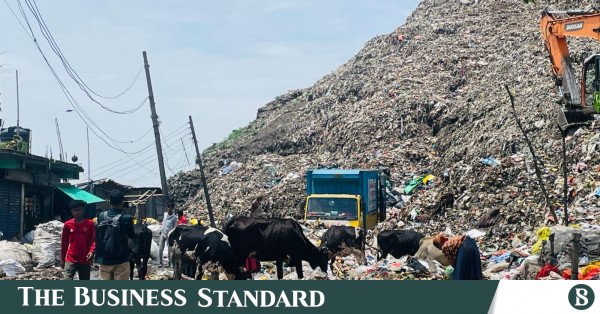
A mountain of mixed waste looms over people and cattle at the Anandabazar dumping site in Chattogram, where years of open dumping have raised concerns over health, soil and water pollution. The photo was taken recently. Photo: Safayet Hosen
“>

A mountain of mixed waste looms over people and cattle at the Anandabazar dumping site in Chattogram, where years of open dumping have raised concerns over health, soil and water pollution. The photo was taken recently. Photo: Safayet Hosen
Nargis Begum’s family lives in TG Colony near the Anandabazar dumping ground in Chattogram, where diarrhoea is a recurring problem in her household.
Her two children also suffer from eye irritation and allergies. With limited access to safe water, the family relies on deep-tube-well water. Buying a 20-litre jar of drinking water costs Tk50, which they cannot afford regularly.
Nargis’s family is not alone in facing these problems. Chattogram generates around 3,200 tonnes of waste a day, while the city corporation collects about 2,200 tonnes, leaving nearly 1,000 tonnes unmanaged, according to CCC officials.

Research around Anandabazar and Arefin Nagar, Chattogram’s two open dumping grounds, has also found environmental and public health concerns. To tackle these hazards, city authorities are looking to waste-to-energy projects.
A 2025 study published in The Dhaka University Journal of Earth and Environmental Sciences surveyed 170 households living within 100 metres of the two dumps and 80 waste collectors. Its health findings were based on self-reported conditions, while information on children came from parents.
Among residents, 38.2% said they very often experienced eye irritation, 27.9% reported hepatitis and 23.5% headaches. Parents reported vomiting among 67.6% of children, diarrhoea among 62.9% and breathing problems among 58.8%.
A separate 2024 study that tested groundwater around Anandabazar and Arefin Nagar also found samples exceeding recommended limits for several water-quality indicators.
Public health specialist Dr Sushanta Barua, member secretary of the Chattogram Public Health Rights Protection Committee, said poorly managed waste can spread pollution through soil, water and air.
He said lead and other harmful substances can move through leachate into soil and water and potentially enter the food chain through crops and fish. Long-term lead exposure can affect children’s nervous systems and brain development, while polluted water can cause skin irritation, he added.
Farmland under pressure
The 2025 study found that 80% of surveyed residents at Arefin Nagar and 63.6% at Anandabazar believed landfill waste was reducing soil fertility.
A separate 2026 study examining soil, irrigation water and drinking water around the two dumps reported higher concentrations of lead, cadmium and chromium closer to the sites.
Farmer Hamid Hasan Alvi manages cultivation on around 11 acres beside Anandabazar. He said he spends Tk30-35 lakh a year but struggles to recover his production costs.
Alvi said leachate entering the fields reduces yields, while monsoon runoff sometimes damages entire crops. He plans to stop cultivating during the monsoon from next year.
He estimated that farmers in the area were each losing around Tk2-2.5 lakh a year.
Farmworker Jamila Begum said she suffers from sores, itching and eye irritation after working in fields where water from the dump enters.
Two open dumps, rising waste
The city depends on two open dumping grounds – around 10 acres at Anandabazar in Halishahar and more than 70 acres at Arefin Nagar in Bayezid.
Neither was built as a sanitary landfill. Both lack proper leachate collection and treatment, gas management and other engineered safeguards.
Urban planner and engineer Delwar Majumder said years of dumping had turned the sites into waste hills, increasing both immediate and long-term pollution risks.
The city’s daily waste generation also broadly matches estimates by Barua and environmentalist Prof Idris Ali, who put the figure at 3,150-3,360 tonnes based on an estimated metropolitan population of around 70 lakh and per-capita generation of 0.45-0.48kg.
Chattogram City Corporation Chief Conservancy Officer Captain Ikhtiar Uddin Ahmed Chowdhury said limited manpower and old equipment remain major constraints. He said the number of secondary transfer stations had increased from nine to 12, but space for sorting waste remains limited.
CDA looks to hybrid system
CDA’s draft Metropolitan Master Plan 2025-2050 estimates that Chattogram could require around 400-500 acres for waste management over the next 20-25 years.
The draft identifies five potential sites covering around 335 acres in total. Rather than relying on one large landfill, CDA proposes a hybrid system combining two controlled landfills of around 80-100 acres each with recycling, composting and refuse-derived fuel production.
Ikhtiar said waste separation must begin at households because transfer stations and dumping grounds lack enough space to sort mixed waste.
The city corporation is also pursuing waste-to-energy projects. A JFE Engineering feasibility study proposes processing around 1,000 tonnes a day to generate roughly 12-15MW of electricity. South Korean and British firms have separately proposed biogas and waste-to-energy projects.
Experts, however, said such projects alone would not solve the problem. They said Chattogram needs segregation at source, separate collection and transport, recycling and safe disposal of residual waste in engineered landfills with leachate treatment and gas management.
About The Author