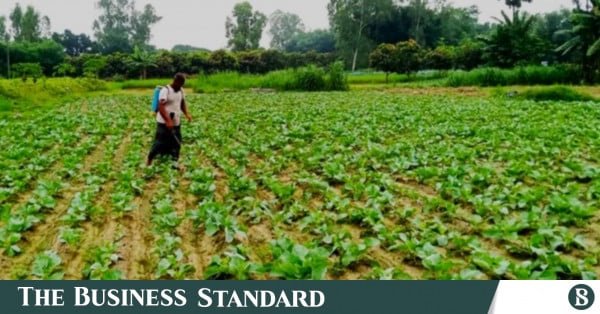
The fields are turning green as farmers work from dawn to dusk to grow early varieties of winter vegetables across the northern districts , hoping to recover from last year’s losses and earn a better return this season.
Although winter is yet to set in, vegetables traditionally associated with the colder months have already begun appearing in markets.
Beans and cabbage are among the early arrivals, while farmers are busy tending fields of cauliflower, radish, cabbage, bottle gourd, tomato, red amaranth, coriander and other winter vegetables.

For many farmers, early cultivation is a race against time—and the weather.
Producing vegetables before the peak winter season allows them to target higher prices, but it also exposes their crops to unpredictable rainfall, pests and diseases.
Despite the risks, the prospect of a good harvest and fair prices is encouraging farmers to expand cultivation across the region.
According to the Department of Agricultural Extension (DAE), farmers in the eight northern districts—Rangpur, Dinajpur, Kurigram, Lalmonirhat, Nilphamari, Gaibandha, Thakurgaon and Panchagarh—have set a target of cultivating early winter vegetables on around 33,900 hectares this season.
The expected production is around 314,000 tonnes.
The region has long been known for its abundant vegetable production, with Rangpur often described as a “vegetable hub”.
Farmers here traditionally start planting early varieties of winter vegetables before winter arrives, allowing them to bring produce to markets ahead of the main season.
This year, large swathes of farmland are already covered in rows of vegetables.
Some farmers are harvesting their first crops, while others are planting seedlings and preparing fields for the next round.
Agricultural officials say improved farming techniques and greater use of modern technologies are also helping farmers increase production.
The DAE has provided training on modern vegetable cultivation, while field-level officials are regularly monitoring crops and advising farmers on irrigation, pest control, disease management and other aspects of production.
For farmers such as Zahidul Islam of Ranipukur in Rangpur’s Mithapukur upazila, the early harvest has already brought some relief.
“I grow early winter vegetables every year. This time, I cultivated leaf cabbage and coriander,” he said.
Zahidul said he has already sold leaf cabbage at Tk 2,000 per maund and coriander worth around Tk 10,000.
“I got a good price compared to the production cost, so I am happy,” he said.
Aynal Mia, another farmer in the area, said unfavourable weather made early vegetable cultivation more difficult this year.
“I managed to grow vegetables within a short period, but the excessive rainfall has created problems,” he said.
He has cultivated cabbage, beans, radish, red amaranth and coriander.
Some farmers have already lost portions of their crops to rain and have had to start cultivation again, he added
The weather remains one of the biggest uncertainties for farmers who venture into early vegetable production. A timely harvest can bring significantly better prices, but excessive rain can damage young plants, waterlog fields and increase the risk of disease.
Mohammad Sirajul Islam, additional director of the DAE in Rangpur division, said the agricultural department is working to increase early winter vegetable cultivation in the region.
“Farmers have been provided training on ways to expand early winter vegetable cultivation. We are also providing them with technical advice and all possible support at the field level,” he said.
About The Author