Highlights:
- Chattogram daily trips could reach 1.56 crore by 2050
- CDA proposes integrated buses, commuter trains and water buses
- Around 700 modern buses could meet future transport demand
- Up to Tk3,400 crore proposed for transport system modernisation
- Metro rail is considered unsuitable due to insufficient passenger demand
- New terminals, commuter rail and water buses aim to reduce congestion
Daily travel in Chattogram could more than double to 1 crore 56 lakh 69 thousand trips by 2050, according to a draft transport plan.
To meet the growing demand, the Chattogram Development Authority (CDA) has proposed an integrated public transport system combining around 700 modern buses, commuter rail and water buses instead of costly metro rail.

The projection was made in the Traffic and Transport Master Plan under the draft Chattogram Metropolitan Area Master Plan (2025–2050).
According to CDA, daily trips in the city and surrounding areas stood at 74.38 lakh in 2022 and are projected to reach 92.88 lakh in 2030, 1.22 crore in 2040 and 1.56 crore in 2050—an increase of about 82 lakh trips over 2022.
Around 1,100 buses currently operate on city routes. However, the plan says future demand could be met with about 700 buses through route rationalisation, company-based operations and a modern fleet.
It proposes Tk2,500-2,900 crore for buses, terminals, depots, bus bays and stops, with another Tk300-500 crore for modern traffic signals and parking management. Overall, investment of up to Tk3,400 crore is proposed to modernise bus, traffic and parking systems.
Public transport accounted for 21% of total trips in 2022. The plan targets increasing this share to 24% by 2030, 26% by 2040 and 28% by 2050.
Tk5,000cr transport infrastructure plan
The plan identifies poor traffic management, not just inadequate road capacity, as a major source of congestion. Illegal parking, indiscriminate bus stops, footpath encroachment, goods vehicles parked on roads and traffic-law violations are also contributing to the problem.
It proposes traffic signals at 68 key intersections and modern parking management systems, requiring an estimated Tk300-500 crore.
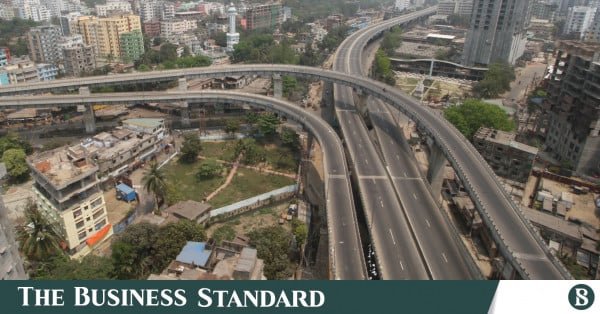
The plan also proposes upgrading 385.57km of roads, including 244.97km of existing roads and 140.6km of new roads. Key roads such as Halishahar Road, Pahartali College Road and Bayezid Bostami Road would be widened, while new links would connect different upazilas.
Modernising buses before metro rail
The draft plan says metro rail would require demand of around 18,000 passengers per hour per direction to operate effectively. Various studies suggest Chattogram may struggle to generate such demand even by 2040-2050, while some scenarios indicate the threshold may not be reached before 2080.
The plan therefore prioritises restructuring and modernising the existing bus system rather than making large immediate investments in metro rail. It proposes consolidating fragmented bus services under one or more companies, reorganising routes, and modern ticketing.
New bus terminals in six upazilas
To reduce the pressure of inter-district and regional buses on the city, new terminals are proposed in Anwara, Patiya, Karnaphuli, Boalkhali, Salimpur in Sitakunda and Raozan.
The plan also proposes expanding the existing Hathazari terminal and upgrading the Chattogram city and inter-district terminals.
Commuter trains, water buses
The plan recommends using existing railway infrastructure to launch direct commuter train services between the city and Sitakunda, Hathazari and Patiya.
It also proposes integrating the Karnaphuli River into the public transport network by assessing the feasibility of water buses connecting different river ghats.
Terminals for 10,000 cargo vehicles
To ease pressure from port-bound cargo vehicles, the plan recommends modern truck terminals with a combined capacity of at least 10,000 trucks.
It proposes terminals for 2,000 trucks in Salimpur and 1,000 each in Bhatiary, Anwara and Karnaphuli. The Chattogram Port Authority is separately constructing a 5,000-truck terminal in the Bay Terminal area.
Mohammad Abu Eisa Ansari, deputy chief city planner of the CDA and project director of the Chattogram Metropolitan Master Plan, told TBS that widening roads alone cannot solve the city’s transport problems.
“With travel demand rising, public transport must be brought under an integrated system,” he said.
The plan calls for reorganising and modernising bus routes, introducing commuter rail on unused or underused railway lines and utilising waterways.
About The Author