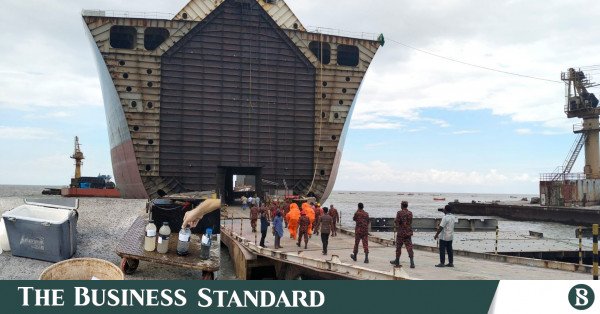
Hydrogen sulphide dissolved in stagnant water and sediment inside the ship’s ballast tank went undetected because ballast tanks were not covered by the existing gas-free safety protocol, contributing to the deaths of 10 workers at Ferdous Steel Ship Recycling Industries in Sitakunda, according to three probe reports.
The toxic gas was released when workers pierced the number 3 ballast tank of the MT RASI to drain water before cutting the vessel, the investigations found.
Workers near the discharge point inhaled contaminated air and were exposed to gas-laden water, resulting in acute toxic exposure and oxygen deficiency.

Nine workers died at the yard on 14 August 2023, while another died later in an ICU. One of the 10 victims was an outsider working as a helper on an oxygen supply vehicle.
The findings came from an 11-member investigation committee formed by the industries ministry, a technical committee and a three-member expert team tasked with identifying the source and nature of the gas and recommending measures to prevent similar accidents.
Ballast tank inspection gaps
The government investigation found that the gas-free certificate issued for the MT RASI did not include tests for hydrogen sulphide or carbon monoxide.
The certificate issued by Intertek Kimsco assessed oxygen and lower explosive limit (LEL) levels as acceptable. It also marked all tanks as acceptable without physically inspecting each tank, which the probe described as a serious flaw.
The Department of Explosives did not conduct gas testing of the ballast tank because the Petroleum Rules 2018 had no specific provision requiring such testing.
The regulatory gap effectively left ballast tanks outside the gas-free safety protocol despite their potential to contain toxic gases.
The probes recommended bringing ballast tanks under mandatory inspection and gas-testing requirements in line with international safety standards.
How hydrogen sulphide accumulated
The expert team found that hydrogen sulphide was likely generated in stagnant water and sediment that had remained at the bottom of the ballast tank for a prolonged period.
The government probe estimated that water mixed with bilge or sewage had remained inside the tank for around 13 to 14 months, leading to certain bacteria possibly converting sulphates naturally present in seawater into sulphides and hydrogen sulphide, the report said.
Workers lacked respiratory protection
The government probe found major failures in safety management at the yard.
Workers involved in piercing the tank were not wearing gas masks or self-contained breathing apparatus, despite the potential risk of toxic gas exposure.
Workers who entered the area to rescue their colleagues also lacked adequate apparatus, potentially increasing the number of casualties.
There was no safety manager, ambulance, doctor or emergency rescue team present during the high-risk operation.
Most victims not on approved list
The investigation found a significant discrepancy between the manpower list submitted to the Bangladesh Ship Recycling Board (BSRB) and the workers actually present at the yard.
Except for one, the names of the five main workers who died were not included in the approved manpower list submitted to the BSRB, the report said.
The yard authority told investigators that “outsiders” had destroyed documents after the accident, but the committee could not verify the actual attendance records.
The discrepancy indicated negligence in worker recruitment and record keeping, according to the probe.
Environmental clearance had expired
The probe also found that the yard continued dismantling the ship after its environmental clearance had expired on 12 August 2023, two days before the accident.
The clearance had not been renewed when the accident occurred.
The yard also failed to notify the Department of Environment within the legally required 48-hour period after the accident.
Its CCTV system was not operational either. Investigators therefore could not obtain CCTV footage of the accident.
Ballast tanks to come under safety protocol
The investigation committee recommended mandatory inspection certificates for ballast tanks of ships imported for recycling, along with testing of ballast water and sediment samples.
It also proposed requiring digital ballast water exchange records so regulators can verify data from a ship’s ballast water treatment system instead of relying solely on declarations by the ship’s master.
Ship owners and cash buyers should provide declarations detailing all tanks and their contents before a vessel enters Bangladesh for recycling.
Yard faces punitive action
The government probe recommended punitive action against Ferdous Steel under the Ship Breaking and Recycling Rules 2011 over the safety lapses.
BSRB Director General Shafiul Alam Talukder told The Business Standard that action against the yard had already begun.
The yard was temporarily suspended following the accident, he said, adding that further action could be taken.
The yard has also paid Tk10 lakh to the family of each deceased worker as compensation.
About The Author