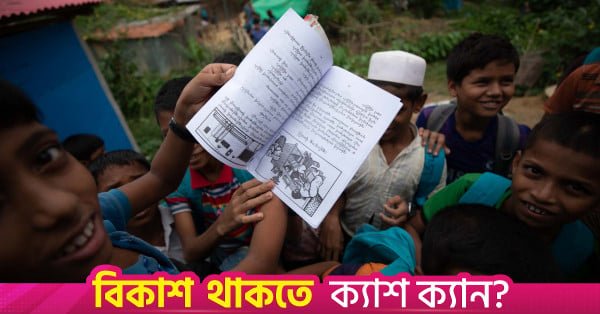
Rohingya language and education, which faced severe restrictions in Myanmar for decades, have expanded in Bangladesh’s refugee camps since nearly 0.8 million Rohingya had fled the country following the 2017 military crackdown.
While living conditions are precarious, efforts to preserve their language and provide quality education have grown across the 33 refugee camps in Cox’s Bazar.
A major development came in 2018 when Unicode incorporated the Hanifi Rohingya script, enabling the community to read and write in their own language on digital platforms.

According to the Rohingya National Education Board (RNEB), over 300,000 Rohingya of different ages have completed language courses since 2017. The expansion has also extended to education based on Myanmar’s national curriculum.
Nearly 1.2 million Rohingya currently live in Cox’s Bazar camps. Repatriation has remained stalled amid Myanmar’s 2021 military coup and the conflict between the junta and the Arakan Army in Rakhine State since 2024.
More than 216,000 children have been born in the camps over the past nine years. Children under 18 account for about 52% of the refugee population, while those under 12 make up around 38%.
According to the Refugee Relief and Repatriation Commissioner (RRRC), the camps currently have 6,137 learning facilities, including 3,723 learning centres and 2,368 community-based learning centres.
A total of 8,017 teachers work at these facilities, serving 302,802 students. Another 150,000 children remain outside the learning facilities.
In 2020, the Bangladesh government approved the introduction of Myanmar’s national curriculum in the camps. The programme was launched in 2022 through a joint initiative of the government and UNICEF after delays caused by the Covid-19 pandemic.
The programme is being implemented through 219 learning centres under the education department of the United Council of Rohingya (UCR), with 54,750 students and 2,190 teachers.
Community leaders say the literacy rate in the camps has risen from 4% to 10% following the expansion of education programmes.
First unified examinations
Students studying the Myanmar curriculum previously had no central examination or standardised assessment system.
That changed in the 2025-26 academic year when the Examination Board of Rohingya Refugees (EBRR) was established by the community to introduce unified examinations.
The board conducted midterm and final examinations for Grades 5, 9 and 12 based on Myanmar’s national curriculum.
The first pilot midterm examination was held in April 2025, with 1,483 Grade 5 students, 750 Grade 9 students and 300 Grade 12 students from 53 schools taking part.
The final examinations were held simultaneously at 14 cyclone centres in March-April this year, with 2,105 students from 75 community-run learning centres participating.
Of 1,228 Grade 5 students, 1,030 passed. Among 609 Grade 9 students, 523 passed, while 145 of 268 Grade 12 students passed.
Abdullah Ahsan Asad, vice-secretary of the EBRR’s School Affairs Committee, told TBS that establishing the examination system was not easy.
“Initially, school principals were not willing to participate. We spoke with community members every Friday and gradually convinced everyone,” he said.
Several committees now oversee the examinations, including a management committee responsible for question papers and teacher assignments for evaluating answer scripts. An observer committee monitors whether the examinations follow Myanmar’s curriculum.
More than 100 books in Hanifi script
The development of Rohingya language education has been closely linked to the Hanifi script.
The Rohingya language did not historically have a widely accepted written form. In the 1980s, linguist and Islamic scholar Mufti Muhammad Hanif Arkani and a group of researchers developed a script specifically for the Rohingya language.
Named after Hanif, the script contains 29 consonants, seven vowels and six tonal marks.
Its use remained limited in Myanmar because of government restrictions. After the Rohingya arrived in Bangladesh, however, language education and preservation activities expanded.
The script’s inclusion in Unicode in June 2018, followed by ISO registration and the development of digital fonts and software support, brought Hanifi Rohingya into the digital ecosystem.
Rohingya people can now communicate in their own language through digital devices and produce e-books, documents and educational materials.
RNEB currently conducts language education alongside Myanmar’s curriculum in 354 learning centres, with around 33,000 students.
It also operates four specialised schools offering Grades 0-5 education to around 1,000 students. The curriculum includes science, history, mathematics and geography in Rohingya, alongside English, Arabic and Burmese.
Muhammad Zubair, a technical officer at RNEB, told TBS that 647 teachers are involved in language education. The organisation is also preparing another Rohingya language textbook for tertiary-level learners.
RNEB President Maulana Mohammad Saleh said language education had been difficult in Myanmar.
“While in Myanmar, we had to conduct language education secretly. Even printing or photocopying materials was difficult,” he said.
Since arriving in Bangladesh, more than 100 books have been translated into Rohingya, he said.
Rohingya communities in 12 countries, including Myanmar, the US, Japan, Indonesia, Malaysia and Saudi Arabia, are connected with RNEB programmes.
“Our goal is to spread the language throughout the entire community before repatriation to Myanmar,” Saleh said.
Higher education remains uncertain
Despite progress at the school level, access to higher education remains a major challenge.
Under Myanmar’s national curriculum, students completing Grade 12 can enter universities, medical colleges and engineering institutions. However, examinations conducted by the EBRR have no formal recognition from Bangladesh or Myanmar.
Khin Maung, a panel member of the United Council of Rohingya, told TBS that the EBRR is not a legally recognised authority, making certification a major challenge.
“Our objective is to ensure access to higher education. We have created a structure to ensure quality education and assessment before students enter higher education,” he said.
The organisation is also communicating with universities that provide scholarships to Rohingya students.
RRRC Commissioner Mohammed Mizanur Rahman told TBS that repatriation remains the government’s main objective.
“Keeping refugees engaged in education helps keep them away from illegal activities. They should have opportunities to study,” he said.
He added that universities could provide online and offline education to Rohingya students, although such initiatives would depend on government policy.
About The Author