Two-day celebration features traditional rituals, folk tales, jhumur dance and music.
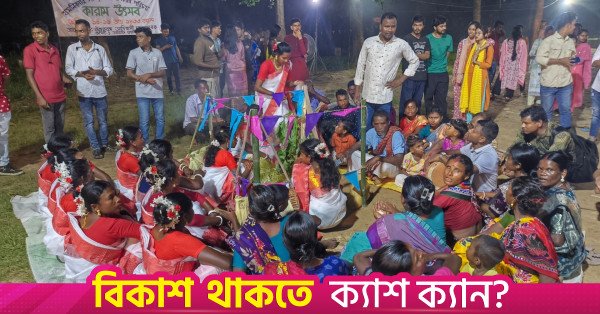
Participants attend the two-day ‘Karam festival’ at Jahangirnagar University last night (27 August), celebrating the traditional culture and heritage of Indigenous communities. Photo: TBS
“>

Participants attend the two-day ‘Karam festival’ at Jahangirnagar University last night (27 August), celebrating the traditional culture and heritage of Indigenous communities. Photo: TBS
The beat of madals, jhumur songs and the chanting of prayers filled the JU campus as Indigenous communities came together for their two-day Karam festival, a tradition rooted in nature and agriculture.
Organised by the Uttarbanga Indigenous Volunteer Committee and Arfi — an Indigenous students’ organisation at the university — the “Uttarbanga Indigenous Karam Festival 2026” brought together representatives of different Indigenous communities from across the country, along with university teachers and students.
Held under the theme “Our culture is our identity,” the festival took place at the university’s Seventh Chhayamancha.

The celebrations began yesterday evening (27 August) with the installation of three branches of a karam tree at the main altar, or akhra. Earlier, young women had prepared “jawa” — germinated seeds of rice, wheat, mung and chickpea — by planting them in clean sand and soil collected from a river.
Following festival traditions, the branches were brought from a forest in a procession accompanied by drums and madal music. At around 7pm, an elder priest, known as a pahan or laya, installed the branches at the altar.
Photo: TBS
“>

Photo: TBS
The rituals included offerings of milk, oil, vermilion and jawa. Later in the evening, participants gathered in a circle to hear the traditional folk tale of Dharma and Karma from the priest.
The story was followed by a ritual in which sisters tied karam leaves and jawa on their brothers’ hands, praying for their long lives and well-being. The night then continued with traditional jhumur dance, songs and madal music.
This morning, the karam branches were removed from the altar and taken to the lake beside the university’s medical centre, where they were immersed following tradition.
Ranjit Khalho, a member of the Uttarbanga Indigenous Volunteer Committee, said the festival was a way of preserving a tradition passed down from their ancestors.
“Karam is a deeply traditional nature-worship festival that has been passed down from our ancestors,” he said, adding, “It is generally observed on Ekadashi, the full moon or other specified lunar dates in the month of Bhadra. This year, we observed it on the full moon.”
He also said participants pray to the Karam deity for social harmony, protection from serious diseases and a healthy and peaceful life.
The festival also aimed to introduce younger generations and the wider public to the history and significance of the tradition, he added.
Photo: TBS
“>

Photo: TBS
Soma Dumri, president of Arfi, said the organisation had been jointly arranging the festival with the Uttarbanga Volunteer Committee since last year.
She said the festival centred on the karam tree and the religious and cultural traditions of Indigenous communities such as the Oraon, Mahle and Santal.
“One of our main goals is to give Indigenous students on campus an opportunity to celebrate this traditional festival in an environment that feels like home,” she added.
She further said that the festival was also a way to showcase their culture, traditions and way of life, as well as their struggle for identity and rights.
Dumri expressed hope that people from all communities would join the festival in the coming years.
About The Author