Highlights:
- Dhaka records highest rate of elevated lead levels
- Strategy targets multiple sources of lead exposure
- Plan strengthens monitoring, regulation and public awareness
The government has approved a 10-year strategy and action plan to control lead pollution and poisoning in Bangladesh, targeting a 50% reduction in children’s blood lead levels by 2030 and a 95% reduction by 2035 from the baseline.
The draft National Strategy and Multi-Year Action Plan for a Lead-Free Bangladesh (2026-2035) was approved at a Cabinet meeting chaired by Prime Minister Tarique Rahman at his office today (17 August), according to a press release from the prime minister’s press wing.

The strategy, proposed by the Ministry of Environment, Forest and Climate Change, outlines responsibilities for government ministries, departments and agencies, as well as the private sector and other stakeholders.
It calls for short-, medium- and long-term measures focusing on institutional capacity building, identification and monitoring of lead exposure, policy and regulatory development, monitoring and enforcement, private-sector engagement, public awareness and behavioural change, research and innovation, and coordination among ministries and agencies.
The government’s initiative comes amid concerns over high levels of lead in the blood of children and pregnant women.
According to the Bangladesh Bureau of Statistics’ (BBS) 2025 Multiple Indicator Cluster Survey (MICS), 38.34% of children aged 12–59 months had elevated blood lead levels.
About 7.54% of pregnant women also had blood lead levels above the prescribed threshold, according to the survey.
The situation varies significantly across regions.
MICS 2025 data showed that 65.2% of children aged 12–59 months in Dhaka Division had elevated blood lead levels. The rate was 42.1% in Chattogram and 46.7% in Sylhet.
The rate in Dhaka is therefore significantly higher than the national average.
Lead is a potent neurotoxin. The World Health Organization says no level of lead exposure has been identified as completely safe for health.
Children are particularly vulnerable because their developing brains are more sensitive to lead exposure. It can reduce intellectual and learning abilities and cause behavioural problems.
In adults, high exposure can increase the risks of high blood pressure and damage to the heart and kidneys. Lead exposure during pregnancy can also adversely affect foetal development.
Lead exposure in Bangladesh comes from a wide range of sources.
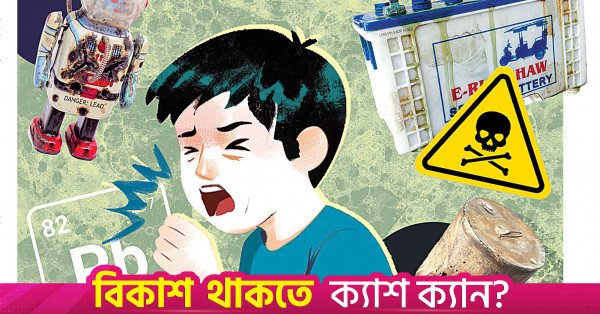
According to a recent UNICEF analysis, people can be exposed to lead through informal lead-acid battery recycling and e-waste processing, lead-based paint, contaminated toys, cookware made from metal scrap, adulterated turmeric and spices, unregulated traditional medicines, cosmetics and jewellery.
The issue is not new in Bangladesh. A 2020 report by UNICEF and Pure Earth estimated that 35.5 million children in Bangladesh were at risk of having elevated blood lead levels.
The report identified informal lead-acid battery recycling and lead contamination in spices as major sources of exposure.
The 2025 MICS, however, provides a stronger national baseline on blood lead levels among children and pregnant women. The survey tested the blood of more than 11,000 children and more than 2,000 pregnant women.
The government has used the findings as a baseline for setting specific targets for the next decade.
The new strategy aims not only to reduce blood lead levels but also to identify and control sources of exposure, protect vulnerable groups and strengthen controls over relevant products and industries.
If implemented, the 2026–2035 action plan will serve as a coordinated government initiative addressing both environmental pollution and the protection of child and public health.
About The Author