The highest level since the Excelerate Energy FSRU incident on 21 July.
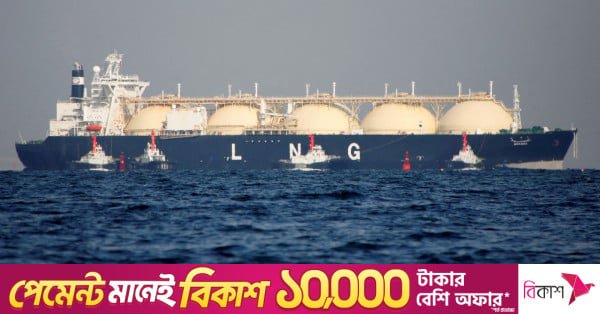
File of an LNG vessel. Photo: Reuters
“>

File of an LNG vessel. Photo: Reuters
Highlights:
- LNG supply rises to 810 mmcfd
- Total gas supply reaches 2,425 mmcfd
- Highest supply since 21 July FSRU incident
- Power sector may get up to 960 mmcfd
- Domestic gas supply stands at 1,615 mmcfd
- Excelerate supplies 300 mmcfd, Summit 510 mmcfd
Bangladesh’s liquefied natural gas (LNG) supply to the national grid rose to 810 million cubic feet per day (mmcfd) today (15 August), taking the country’s total gas supply to 2,425 mmcfd, the highest level since the disruption at Excelerate Energy’s floating storage and regasification unit (FSRU) on 21 July.
According to Public Relations Department of Petrobangla’s 4pm data, Excelerate Energy’s FSRU supplied 300 mmcfd, while Summit’s FSRU supplied 510 mmcfd to the national grid.

At the same time, domestic gas production and supply stood at 1,615 mmcfd.
The latest LNG supply marks a significant improvement in imported gas availability following the disruption at Excelerate Energy’s FSRU off Maheshkhali, which sharply reduced LNG supply to the national grid and contributed to widespread gas shortages and pressure on electricity generation.
According to Petrobangla’s daily gas and condensate production and distribution report, national gas supply stood at just 1,931.2 mmcf on 13-14 August against an official demand of 3,854 mmcf.
Supply stood at 2,039.2 mmcf on 12-13 August, 2,109.6 mmcf on 11-12 August and 2,199.1 mmcf on 10-11 August.
Today’s total supply of 2,425 mmcfd is therefore the highest recorded since the Excelerate FSRU incident on 21 July.
Power sector to get up to 960 mmcfd
Meanwhile, Petrobangla is planning to allocate up to 960 mmcfd of gas to the power sector to help sustain electricity generation amid the ongoing power crisis and load shedding.
Gas allocation to power plants has been fluctuating, remaining around 860 mmcfd at different points, according to Petrobangla. The state-run gas company plans to increase the allocation to as high as 960 mmcfd, depending on overall gas availability and system requirements.
The additional allocation is aimed at supporting power generation as authorities manage limited supplies among power plants, fertiliser factories, industries and other consumers.
According to Petrobangla data, domestic sources accounted for around two-thirds of the country’s total gas supply, while LNG made up the remainder.
Bangladesh’s two operational FSRUs have a combined regasification capacity of around 1,100 mmcfd. Summit’s FSRU has a capacity of up to 500 mmcfd, while Excelerate Energy’s terminal can handle up to around 600 mmcfd.
With Excelerate currently supplying 300 mmcfd, its output remains below full capacity, while Summit is supplying 510 mmcfd, according to Petrobangla.
The recovery in LNG supply is expected to provide some relief to the national gas grid, although Petrobangla continues to face the challenge of meeting demand from multiple sectors amid the ongoing supply constraints.
About The Author