Tk298cr equipment project awaits Ecnec approval amid funding hurdle
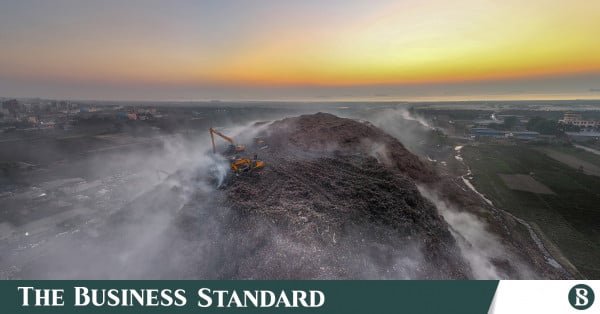
Chattogram generates around 3,200 tonnes of waste daily, but the city corporation collects only about 2,200 tonnes, leaving the rest unmanaged. Ageing equipment, limited manpower and weak collection systems cause waste to spill onto roads, into drains, canals and water bodies, worsening waterlogging, pollution and public health risks. The photo was recently taken at a dumping station in the Anandabazar area of Halishahar, Chattogram. Photo: Mohammad Minhaj Uddin
“>

Chattogram generates around 3,200 tonnes of waste daily, but the city corporation collects only about 2,200 tonnes, leaving the rest unmanaged. Ageing equipment, limited manpower and weak collection systems cause waste to spill onto roads, into drains, canals and water bodies, worsening waterlogging, pollution and public health risks. The photo was recently taken at a dumping station in the Anandabazar area of Halishahar, Chattogram. Photo: Mohammad Minhaj Uddin
Highlights:
- Bangladesh’s fuel import bill hit a record $10.63 billion
- Fuel accounted for over 14% of total merchandise imports
- Fuel imports surged 107%, far exceeding overall import growth
- Higher prices and domestic demand drove the increase
- Refined fuel prices rose faster than crude oil prices
- Experts warn elevated oil prices could further increase import costs
Nearly 1,000 tonnes of the roughly 3,200 tonnes of waste generated in Chattogram every day remain uncollected as ageing equipment, limited manpower and inadequate dumping space strain the city’s waste management system, according to Chattogram City Corporation officials.
Chief Conservancy Officer Captain Ikhtiar Uddin Ahmed Chowdhury told The Business Standard that the city corporation can collect around 2,200 tonnes a day.

“Some of the uncollected waste ends up on roads and in drains, canals and water bodies, increasing the risk of waterlogging, pollution and public health problems,” he said.
Infograph: TBS
“>

Infograph: TBS
Tk298cr project awaits Ecnec approval
To increase collection capacity, the city corporation has a Tk298 crore project to purchase modern waste-management equipment awaiting approval from the Executive Committee of the National Economic Council (Ecnec).
According to Ikhtiar, the project was originally proposed at around Tk3,289 crore but was reduced to Tk298 crore after review during the interim government. Under the revised plan, the city corporation would bear one-third of the cost and the government the rest.
“Most of the corporation’s equipment is around 25 years old. The Tk298 crore project for new equipment would significantly increase our waste collection and transport capacity,” he said.
However, Ikhtiar said the city corporation did not have the financial capacity to bear its share.
“The mayor will raise the issue with the government so that it can bear the full cost,” he said.
He added that the project was prepared based on market prices from two to three years ago, meaning equipment costs would have to be reassessed before implementation.
Urban planner Delwar Majumder said the project should be approved quickly as the capacity of the city corporation’s ageing equipment was declining, but new machinery alone would not solve the problem.
He called for greater public awareness, separation of waste where it is generated, proper treatment and recycling.
Consumers Association of Bangladesh Central Vice-President SM Nazir Hossain said responsibility should not be placed solely on residents.
“The city corporation and its contractors also have to be held accountable for whether they are properly collecting, transporting and disposing of waste,” he said.
Nazir said waste removed from drains can return to waterways if it is not cleared quickly, while transporting waste in open trucks causes odour and air pollution.
3,237 workers, yet collection gap remains
The city corporation currently has 3,237 workers engaged in waste management.
Officials said retirements and dismissals had reduced the workforce, while recruitment was not being expanded due to limited capacity.
However, they said manpower was not the only reason for the collection shortfall. Ageing vehicles and equipment, along with inadequate infrastructure, were also major constraints.
The city corporation had also engaged private vendors to collect household waste in parts of the city. At one stage, door-to-door collection was run privately in 41 wards, with households charged Tk70 a month.
As the system failed to produce the expected results, the city corporation is now moving to introduce free door-to-door waste collection in 25 wards using its own funds.
Mayor Shahadat Hossain announced the pilot programme at a city corporation meeting at Nagar Bhaban on 4 August.
Ikhtiar said the service was initially planned for 10 wards but was later expanded to 25 on the mayor’s instructions.
“Free waste collection could cost Tk15-20 crore a year. But we have taken this initiative to build a cleaner, healthier and more environmentally friendly Chattogram in the long run,” the mayor said.
“New equipment alone will not be enough. People must also dispose of waste at designated places. Many still throw waste on roads and into drains and canals,” Ikhtiar said.
Dumping grounds near capacity
A shortage of disposal space has become another major challenge for the city corporation, with its existing dumping grounds nearing capacity.
Ikhtiar said complaints from residents living near the sites were also increasing.
“Around 70 waste-carrying vehicles enter the dumping grounds every day. Managing waste is becoming increasingly difficult because of the shortage of space,” he said.
The city corporation currently relies mainly on two open dumping grounds — Arefin Nagar in Bayezid and Anandabazar in Halishahar.
During visits to the sites, large piles of waste were seen after years of open dumping. Neither site has a modern waste-processing system or a plant to treat liquid draining from the waste. Foul-smelling liquid was also seen entering nearby drains and canals.
The city corporation is pursuing land acquisition for new landfill sites, including in Fateyabad.
Korean support sought for sanitary landfill
The city corporation has also sought South Korean assistance to develop a modern sanitary landfill.
Consultants appointed by the Korea Environmental Industry and Technology Institute met Mayor Shahadat Hossain at the city corporation office on 6 August to discuss the proposed project and possible cooperation.
“Waste management is one of the major challenges of modern urban management. An international-standard sanitary landfill is now necessary to protect the environment and public health,” the mayor said after the meeting.
According to the city corporation, the initiative is being pursued with support from the Economic Relations Division (ERD) and the Embassy of the Republic of Korea. The ERD sent a formal request for assistance to the Korean embassy in May.
Under the proposal, the two existing open dumping sites would gradually be closed and rehabilitated, while a modern sanitary landfill focusing on waste treatment, recovery and recycling would be developed.
Waste-to-energy plans
The city corporation also plans to use waste as a resource in the longer term.
Mayor Shahadat Hossain said improved waste management could create opportunities to generate electricity and biogas from waste.
“If we can collect an additional 400 to 500 tonnes of waste, it will make future waste-to-electricity and biogas projects easier to implement,” he said.
About The Author