The leaders said the current wages of garment workers were wholly inadequate to meet their basic living costs.
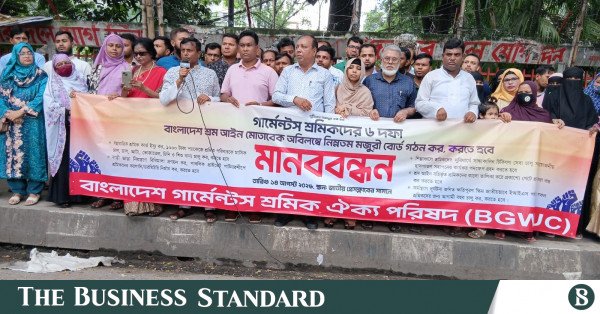
Garment workers stage a human chain in front of the National Press Club today (14 August), demanding the reconstitution of the minimum wage board. Photo: TBS
“>

Garment workers stage a human chain in front of the National Press Club today (14 August), demanding the reconstitution of the minimum wage board. Photo: TBS
Bangladesh Garment Workers Unity Council today (14 August) formed a human chain in front of the National Press Club demanding the reconstitution of the minimum wage board for garment workers in accordance with labour law, along with a six-point set of demands.
Speaking at the event, leaders of the platform said the minimum wage board is supposed to be reconstituted every three years.
Referring to the amended labour law, they said a new wage board should be announced in the second half of 2026 but the board had yet to be reconstituted.

From the human chain, they called for the implementation of their six demands including a monthly food package worth Tk1,000 for workers’ families, containing rice, pulses, flour, edible oil, sugar and baby food; taking measures to introduce evening medical services and establish necessary hospitals in industrial areas for workers.
They also demanded for Introduction of a nationwide scheme for all workers from next year to provide compensation for workplace accidents; constructing workers’ colonies and dormitories through public-private partnerships.
The leaders urged the government to use its public mandate to formulate a roadmap, in consultation with garment factory owners, for the phased implementation of the workers’ six demands.
They said they were putting forward their demands peacefully before the relevant ministers and authorities of the current government.
The leaders said the current wages of garment workers were wholly inadequate to meet their basic living costs.
They also said uncontrolled increases in the prices of essential commodities have made everyday life increasingly difficult and urged the relevant authorities to take into account the circumstances facing nearly four million garment workers across the country.
About The Author