Huawei unveiled the SUN2000-506KTL-H3, which it described as the industry’s first grid-forming smart string inverter, alongside the LUTERRA-6261-25 battery energy storage system.
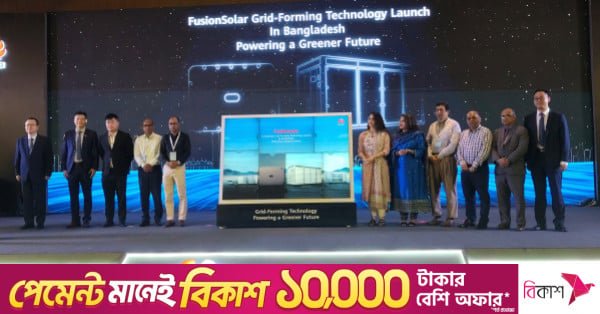
Participants pose for a group photo at an event titled “Grid-Forming Technology Powering a Greener Future” in Dhaka on 12 August 2026, where Huawei unveiled Bangladesh’s first grid-forming smart string inverter and battery energy storage system (BESS) for the utility sector. Photo: TBS
“>

Participants pose for a group photo at an event titled “Grid-Forming Technology Powering a Greener Future” in Dhaka on 12 August 2026, where Huawei unveiled Bangladesh’s first grid-forming smart string inverter and battery energy storage system (BESS) for the utility sector. Photo: TBS
Huawei has launched Bangladesh’s first grid-forming smart string inverter and battery energy storage system (BESS) for the utility sector, aiming to support the country’s renewable energy targets and strengthen grid stability.
The technologies were unveiled at an event titled “Grid-Forming Technology Powering a Greener Future” in Dhaka today (12 August).
The event brought together stakeholders from Bangladesh’s power and renewable energy sectors, including government officials, utility suppliers, independent power producers, global investors, technical advisers, consultants and EPC contractors.

Will Yu, managing director of Huawei South Asia Digital Power Department, said integrating solar power with battery energy storage systems is becoming increasingly important to the global renewable energy transition.
“Intelligent energy storage and grid-forming technologies are needed to ensure reliable clean energy,” he said, adding that Huawei is committed to helping Bangladesh develop a smarter, more resilient and sustainable power system.
Huawei unveiled the SUN2000-506KTL-H3, which it described as the industry’s first grid-forming smart string inverter, alongside the LUTERRA-6261-25 battery energy storage system.
According to Huawei, the inverter offers higher power density, improved system availability, grid-forming capability, intelligent operation and maintenance, and enhanced safety and reliability. These features are expected to help developers reduce balance-of-system costs and lower the levelised cost of energy.
The LUTERRA-6261-25 BESS has a round-trip efficiency of 92.6% and features pack-level optimisation, a cell-to-grid safety architecture, improved state-of-charge accuracy and state-of-health performance, as well as rapid grid-forming response.
Masud Rana, head of technical at Paramount Group, said the company’s 100MW solar plant has benefited from Huawei’s digital power technologies, helping improve efficiency and reliability.
Huawei said its integrated Solar+Storage solution can store excess solar power generated during the day and supply it during evening peak demand.
The system can also provide grid-support functions, including ramp-rate control, frequency regulation, voltage and reactive power support and, where required, grid-forming capability.
Compared with conventional PV-only installations, Huawei said the integrated solution can improve plant dispatchability, grid compatibility and renewable energy integration, contributing to a more stable and resilient power system.
The company said it aims to support Bangladesh’s renewable energy ambitions through more efficient solar generation, greater energy storage, improved grid stability and enhanced integration of renewable power.
About The Author