After years of promising my children and myself the trip, we finally made it to Japan in April. It was 12 days of solo ramen booths, onigiri wrestled out of their wrappers (there’s a knack, I never quite got it), and trains that pulled in to the second and were wiped clean at an alarming frequency.
We spent one of our first mornings in Tokyo, cherry blossoms at their peak, walking around Meiji Jingu, a Shinto temple, the three of us following the crowd in the hopes that it would take us to the right place. I heard a strange song drifting through the trees, tinny and a little mournful, coming from somewhere near the entrance gate.
Upon investigation, it was a smoking, rattling truck, playing its own theme song — in English, for the benefit of tourists like us — as it sold yaki imo, sweet potatoes roasted slowly over charcoal, right in the back of the Nissan van.
I did some digging and learned these trucks route through Japanese neighborhoods, playing the same tune and getting people to run out of their houses to chase a sweet potato. In my childhood and my children’s, the ice cream van had that same effect. (At some point, when things got out of hand, I managed to convince my boys that the van played the music when it ran out of ice cream; not my proudest parenting move.)
I love being handed something that must be eaten immediately. Call it a childlike fascination with mess, or with ingenuity: an oil drum cut in half and propped on two bricks, a bicycle with a griddle welded to the back. Really, though, it’s just how much of the world eats. Follow the sun all the way round, and there are plenty of stalls, carts or renovated Nissan vans, serving one spectacular thing, at any given hour.
In Mexico City, a comal — a flat griddle pan, cast-iron or clay — has been going since 5 this morning. Tortillas turning, one after another, corn masa slapped down and flipped and slapped down again, the line already three deep by the time most of the city’s up.
If it’s 5 in the morning in Mexico City, then it’s already light in Singapore, and the hawker centers never really closed from the night before, soft-boiled eggs and kaya toast going out before most alarms have gone off. Vendors were moved here off the sidewalk in the 1960s, and the recipes have been passed down by hand rather than written down ever since. UNESCO put the whole tradition on its cultural heritage list in 2020.
By midday, the heat’s caught up. In Penang, it turns the Malaysian air faintly hostile and everyone a little less patient, which, if anything, makes the food feel more essential. My favorite stall there cooks char kway teow over a flame too high for comfort, noodles and shrimp and dark soy tossed in short, violent bursts, the wok itself blackened to a color no amount of scrubbing will ever bring back to steel.

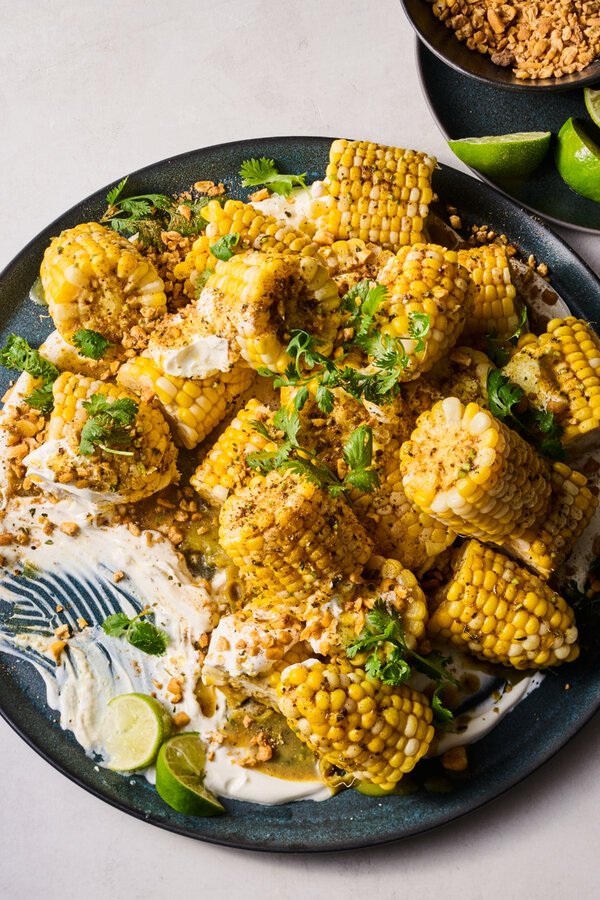
A finish of corn nuts doubles down on the corn flavor here, while adding crunch.Credit…Joe Lingeman for The New York Times. Food Stylist: Barrett Washburne.
On a corner in New York, it’s a hot dog cart: propane tank underneath, a vat of seasoned water doing the real work, an umbrella pulling double duty as shade and signage. In India, lunch is chaat (which means “to lick”), though what that word means in practice seems to change every time you cross a state line. In Delhi, it’s papdi: crisp fried wafers, potato, chickpeas, a tangle of chutneys and yogurt, all eaten in one bite. In Mumbai, it’s more likely bhel puri: puffed rice, sev, raw onion, held together with tamarind and good timing. And over almost all of it, right at the very last second, chaat masala: amchoor and black salt and a little cumin and chile, dry enough to survive a shelf for months, built for one job: to make food taste alive again, right at the point of selling it.
Corn turns up all over the world: balal in Iran; elote, slathered in mayonnaise, Cotija and chile, in Mexico; yaki tomorokoshi, brushed with soy and butter at a festival stall until it’s almost caramelized, in Japan. At an Indian roadside stand, it’s bhutta rubbed with chaat masala, what you eat, apparently, only when it’s raining. There’s an ocean between some of these places, a language, sometimes a few thousand years. And yet they all arrived at more or less the same conclusion: Something sweet and charred needs salt to hold it up, something sour or spiced to cut through it, a little heat or funk to finish the job.
It’s a big delicious world out there, on street corners and inside markets, under a tin roof or no roof at all, in whatever hour of the day the hunger happens to land. Have napkins ready. And if you want to bring a little of that home tonight, no line required, here’s where I’d start.
Follow New York Times Cooking on Instagram, Facebook, YouTube, TikTok and Pinterest. Get regular updates from New York Times Cooking, with recipe suggestions, cooking tips and shopping advice.
About The Author