Investigators suspect the Hemayetpur house was part of a wider network involved in making bombs used in several recent incidents.
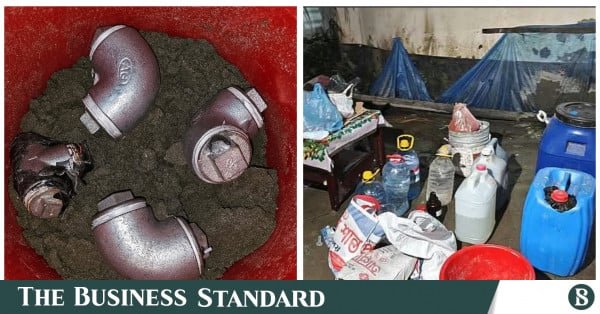
(Left) Crude bombs made using ordinary pipes used in household water lines. (Right) Materials and equipment used to make explosives. Photo: TBS
“>

(Left) Crude bombs made using ordinary pipes used in household water lines. (Right) Materials and equipment used to make explosives. Photo: TBS
From the outside, there was little to distinguish the rented house in Hemayetpur’s Shyampur from any other ordinary home.
But after police surrounded it yesterday evening (11 August), the picture changed dramatically.
Inside, investigators found pipe bombs, hand bombs and a large quantity of materials and equipment used to make explosives.

The operation continued into the early hours of today, with investigators recovering 13 pipe bombs, according to sources involved in the operation.
What has particularly concerned investigators is the construction of the devices. The bombs were made using ordinary pipes used in household water lines.
But the discovery may be more significant than the explosives themselves.
Investigators suspect the house was part of a wider network involved in making bombs used in several recent incidents.
Counter Terrorism and Transnational Crime (CTTC) Chief Mohammad Shamsul Haque said, “The recent bomb attacks and bomb disposal incidents in various places including Dhaka can be traced back to the same source. We have investigated, considering all aspects. The names of some people have also been found. A drive is underway to arrest them.”
From Ashulia to Motijheel
Investigators suspect that the pressure cooker bomb recovered in Ashulia was manufactured at the Hemayetpur house.
They say clues obtained from an arrested man, Mohammad Arif, led them to the suspected bomb-making facility.
Arrested suspect Mohammad Arif. Photo: TBS
“>

Arrested suspect Mohammad Arif. Photo: TBS
Savar Model Police Station Officer-in-Charge Saiful Alam said police initially suspected Arif of having links to the banned Jama’atul Mujahideen Bangladesh (JMB).
Police have also found similarities between the pipe bombs recovered near the Motijheel Metro Rail station in late July and those found in Savar.
According to sources involved in the investigation, an umbrella-shaped bomb recovered from the Motijheel area was also manufactured by the same network.
This has widened the scope of the investigation. Investigators are now looking into whether similar devices recovered from different locations were made by the same group.
The investigation has also uncovered another possible link. CTTC members found TATP, or triacetone triperoxide, at the Savar site.
The same explosive material was reportedly found after a bomb-making explosion at Ummul Qura Madrasa in Keraniganj last December.
A CTTC official said the nature of the incidents and the materials recovered in Keraniganj and Savar suggest there may be a link between the two cases.
The name of Mohammad Arif had surfaced in connection with the Keraniganj incident as well. Police later said they had obtained information about his alleged involvement in several other incidents.
One name, several incidents
An explosion occurred on 26 December while bombs were allegedly being made at Ummul Qura Madrasa in Keraniganj. Madrasa director Al Amin was arrested in connection with the incident.
Police said at the time that Arif’s name emerged as an associate of Al Amin, who had previously been arrested on suspicion of links to the banned JMB.
His name subsequently surfaced in connection with other incidents.
In February, during a police search in Jatrabari, a suspect allegedly stabbed someone, dropped a bag containing bombs and fled.
In March, an explosion occurred at a Shiv temple in Cumilla, while another bomb exploded during a police search in Sayedabad.
Police later said they obtained information about Arif’s alleged involvement in those incidents.
Law enforcement agencies had not previously disclosed details about Arif, saying operations were being conducted while information about his arrest was kept confidential.
Investigators now say information provided by him helped lead them to the suspected bomb-making facility in Savar.
They also say Arif referred to a “guru”, whom investigators have identified as a homeopathic doctor by profession.
The tenant who raised no suspicion
The person who rented the Hemayetpur room had given the landlord little reason to suspect anything unusual.
According to the landlord’s eldest daughter, the man used the identity of Abbas Ali and rented the room on 5 August for Tk4,000 a month.
He introduced himself as a private car driver and said he would enrol his children at the nearby Shyampur Government Primary School.
He paid Tk1,000 in advance, installed a fan and left.
After that, however, he was rarely seen during the day. Various items were brought into the house at night, while the landlord’s daughters occasionally heard the sound of heavy objects being placed on the ground floor.
At the time, there was no reason for the family to imagine that explosives were being manufactured inside the room.
The house’s owner, Abdul Jalil, is paralysed and bedridden, and his daughters look after the property.
Now, investigators are trying to establish how the house fitted into the suspected network, who supplied the materials and who was behind the manufacture of the bombs.
At the centre of their investigation is Najmul Hasan alias “Bomaru Mamun”, whom CTTC sources describe as a senior instructor of the banned Neo-JMB and the suspected mastermind behind the network.
Investigators suspect that the recent discoveries are not isolated incidents, but pieces of a wider bomb-making operation whose links stretch from Savar to several locations in Dhaka and beyond.
About The Author