The home minister says India cannot seek friendly ties with Bangladesh while allowing ousted prime minister Sheikh Hasina to make statements against its democracy and people.
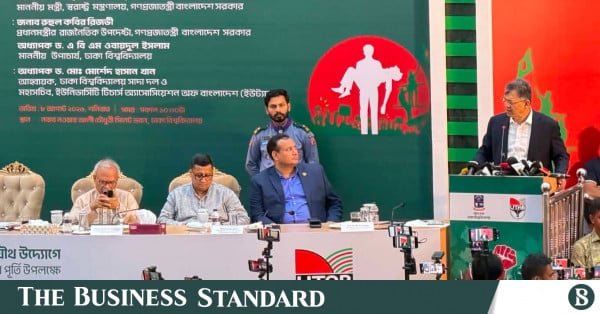
Home Minister Salahuddin Ahmed addresses a discussion at Dhaka University on Saturday, 8 August 2026, to mark the second anniversary of the July Uprising. Photo: TBS
“>

Home Minister Salahuddin Ahmed addresses a discussion at Dhaka University on Saturday, 8 August 2026, to mark the second anniversary of the July Uprising. Photo: TBS
Home Minister Salahuddin Ahmed today (8 August) said Bangladesh would maintain relations with India based on mutual dignity, respect and sovereign equality, while keeping the country’s interests above all else.
“We can never become the Awami League. Keeping Bangladesh’s interests above all, we will maintain relations with you [India] on the basis of mutual dignity and respect and sovereign equality,” he said.
Salahuddin made the remarks at a discussion at Dhaka University’s Nawab Ali Chowdhury Senate Bhaban, organised by the Dhaka University White Panel and the University Teachers’ Association Bangladesh (UTAB) to mark the second anniversary of the July Mass Uprising.

The home minister said India could not avoid responsibility for statements ousted prime minister Sheikh Hasina had been making from Delhi against Bangladesh’s democratic culture, democracy and its people, as well as for creating instability in the country.
“India is allowing these while at the same time seeking a friendly relationship with Bangladesh? The two do not go together,” he said.
He also accused Sheikh Hasina of being responsible for the killings and crimes against humanity during the uprising.
Citing a UN estimate, Salahuddin said more than 1,400 people were killed during the uprising, with women and children accounting for 13-14% of the victims. He also alleged that people were shot from helicopters.
“Even after that, whether India can recognise her as a leader of democratic culture — this question remains ours,” he said.
‘Awami League’s fate to be decided by court’
Salahuddin said the government was seeking to try the Awami League as a political organisation and that its fate would be decided by the court.
“We are talking about trying the Awami League as a political organisation. The fate of that organisation will be decided in court,” he said.
The relevant law had been enacted under Article 47 and was included in the International Crimes Tribunal Act, while the party’s activities had been banned under the Anti-Terrorism Act, he added.
“Whether the Awami League will be banned as a political party, whether there will be any other punishment, whether it will be suspended for a long or short period, or whether all its assets will be confiscated — these provisions are laid out there,” he said.
“The investigation is ongoing. Hopefully, it will be completed very soon,” he added.
‘Politics of selling the July spirit has failed’
The home minister criticised those he said were trying to claim the credit for the 2024 July Mass Uprising and form political parties based on it.
“We have said many times that the politics of selling the spirit has failed in Bangladesh. The politics of selling the spirit of 1971 failed disastrously in Bangladesh. Sheikh Hasina, after selling the spirit of 1971 continuously, is now sitting in Delhi,” he added.
He also criticised those who, he said, believed the July Uprising could be understood solely in terms of the 36-day movement.
“If anyone thinks that the 17 years of continuous movements had nothing to do with those 36 days of protests, that too is political immaturity,” he added.
‘We have only just started’
Responding to criticism that the government had “already failed,” Salahuddin said, “The government is only five and a half to six months in its tenure, and people are already giving speeches on the streets calling it a failed government. It takes time even to fail. We have only just started.”
He also said the government had pledged to carry out democratic reforms and amend the state structure.
“We will carry out democratic reforms and amendments to the state structure. We will bring such amendments to the constitution,” he mentioned.
Salahuddin said the government would seek to amend the constitution to prevent the return of autocratic rule.
“Through constitutional amendments, we want to introduce such a provision so that no autocrat can ever be created in Bangladesh again, even through the parliamentary system,” he said.
He also proposed setting a 10-year limit on how long a prime minister can remain in office, regardless of the number of terms.
“We will not allow any opportunity for more than 10 years in this constitution,” he added.
Salahuddin further said the constitution would also be amended to allow MPs to directly and independently elect the president.
“We will bring a system into the constitution where members of parliament will directly and freely vote to elect the president,” he added.
He also proposed introducing checks and balances between the upper and lower houses of parliament.
About The Author