The decision follows the appointment of the bank’s new chairman and managing director, allowing the merged institution to operate under its regular management structure, central bank officials said.
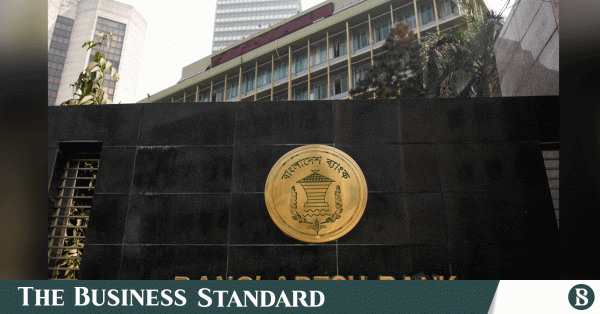
Bangladesh Bank. Photo: Collected
“>

Bangladesh Bank. Photo: Collected
Highlights
- New chairman and managing director assume full operational control.
- Exim Bank administrator removed first; four banks follow phased transition.
- Loan, deposit, and IT integration largely completed across merged banks.
- Technology integration continues before unified Sammilito Islami Bank operations.
- Merger aims to restore stability after banks’ financial crisis.
The Bangladesh Bank plans to withdraw its appointed administrators from the remaining four banks under the merged Sammilito Islami Bank by 15 August, as the central bank moves to hand over full operational control to the new management.
The decision follows the appointment of the bank’s new chairman and managing director, allowing the merged institution to operate under its regular management structure, central bank officials said.

The Bangladesh Bank withdrew the administrator from Exim Bank on 30 July as the first step. Administrators will now be removed in phases from Social Islami Bank, First Security Islami Bank, Global Islami Bank and Union Bank.
“The administrators were appointed temporarily after the formation of Sammilito Islami Bank. Their primary responsibility was to coordinate the integration of the five banks’ loans, deposits and information technology systems,” Bangladesh Bank Executive
Director and spokesperson Arief Hossain Khan told The Business Standard.
“Now that the bank has a chairman and a managing director, who has already assumed regular duties, retaining the administrators would create administrative duplication. That is why we have decided to withdraw them,” he said.
Integration enters final phase
Central bank officials said the administrators were tasked with coordinating the operations of the five merged banks and facilitating the transfer of responsibilities to the new management. As most of that process has now been completed, operational control is being handed over to the management of Sammilito Islami Bank in phases.
However, the technological integration of the merged entities has yet to be completed. The integration of the core banking software, information technology infrastructure and nostro accounts used for international transactions remains underway.
As a result, some banking operations are still being conducted under the banks’ existing names. Officials said the merged institution would begin operating fully under Sammilito Islami Bank identity once the technology integration is completed.
Officials also said there is no administrative justification for retaining both an administrator and a managing director within the same institution after the appointment of the MD.
Under standard governance practices, the two roles cannot operate simultaneously with overlapping authority, prompting the phased withdrawal of the administrators.
According to the officials, Exim Bank was selected for the first handover because the newly appointed managing director will operate from its office as the principal administrative base.
Consequently, Exim Bank’s transition was completed first, while the remaining four banks are expected to come fully under the management of Sammilito Islami Bank by 15 August.
Chairman sees challenging transition
Sammilito Islami Bank Chairman Kazi Shairul Hasan described the integration and administrative transition as a challenging process, saying its success was essential for maintaining financial stability.
He said failure to complete the restructuring successfully could have adverse implications for both the banking sector and the broader economy. Efforts were under way to restore normal operations and place the bank on a stronger financial footing, while seeking cooperation from all stakeholders.
Banks’ previous control
Before the merger, Exim Bank was controlled by former Bangladesh Association of Banks chairman Nazrul Islam Mazumder during the previous Awami League government. The other four banks – Social Islami Bank, First Security Islami Bank, Global Islami Bank and Union Bank – were controlled by the S Alam Group.
After the four banks failed to repay depositors, creating severe financial stress, the interim government merged the five banks to form Sammilito Islami Bank as part of efforts to stabilise the sector.
The merged bank began operations with paid-up capital of Tk35,000 crore. Of the total, the government contributed Tk20,000 crore, while the remaining Tk15,000 crore will be converted into shares against depositors’ funds.
About The Author