9,330 stranded containers block up to 22% of port yard; port users estimate combined economic losses exceed $5b
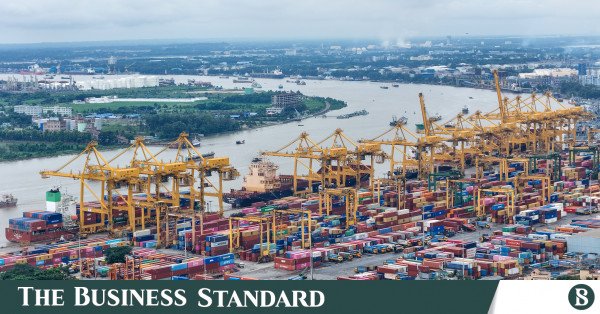
The photo shows a view of the New Mooring Container Terminal of Chattogram Port. A growing logjam of stranded import cargo at the port is eroding nearly two-fifths of the port’s operational capacity, dragging down turnaround times and inflicting severe losses on the country’s trade-driven economy. The photo was taken on Wednesday. Photo: Mohammad Minhaj Uddin
“>

The photo shows a view of the New Mooring Container Terminal of Chattogram Port. A growing logjam of stranded import cargo at the port is eroding nearly two-fifths of the port’s operational capacity, dragging down turnaround times and inflicting severe losses on the country’s trade-driven economy. The photo was taken on Wednesday. Photo: Mohammad Minhaj Uddin
Highlights:
- Stranded cargo occupies 22% of Chattogram Port yard capacity
- Over $2 billion in imports remain trapped at port
- Total economic losses exceed $5 billion, industry estimates show
- Customs delays and legal disputes drive severe port congestion
- Congestion slows trade, increases shipping costs and turnaround times
- Experts urge faster auctions, legal reforms and customs dispute resolution
A growing logjam of stranded import cargo at Chattogram Port, Bangladesh’s main maritime gateway, is eroding nearly two-fifths of the port’s operational capacity, dragging down turnaround times and inflicting severe losses on the country’s trade-driven economy.
As of 30 June 2026, a total of 9,330 twenty-foot equivalent units (TEUs) of containers remained stuck at the port, occupying 22% of the port yard, according to Chittagong Port Authority (CPA) data.

Infograph: TBS
“>

Infograph: TBS
Port officials and trade associations estimate that administrative delays and protracted legal battles have immobilised more than $2 billion worth of commercial goods, with total economic damage, including container penalties and lost port revenue, exceeding $5 billion.
The CPA has now sounded a formal alarm. In a letter dated 2 July 2026, its Chief Personnel Officer and Secretary (in-charge) Md Nasir Uddin urged the National Board of Revenue chairman to take necessary steps to clear or dispose of auctionable cargo and containers that have remained stranded in the port for years because of customs-related delays.
“The outstanding port storage charges for containers and goods lying in the port yard have reached Tk8,000-Tk10,000 crore (nearly $1 billion),” Nasir wrote. “If the occupied space were cleared and returned to operational use, the port could generate more than $1 billion in additional revenue, which would contribute to the country’s economic growth.”
In the letter, the CPA also argued that if auctionable cargo were removed, existing infrastructure could handle about 40% more cargo and containers without any additional government investment. As a result, government revenue would increase and import-export activities would become faster.
Scale of stranded cargo and economic losses
The yards also held 124,799 packages of less-than-container-load cargo, 6,792 packages of bulk goods and 775 packages of hazardous chemicals. Some of the goods have been lying at the port for at least 23 years. Most of these abandoned goods have deteriorated beyond usability.
Port users estimate the combined economic losses as follows: stranded cargo value at no less than $2 billion; container and shipping line losses around $1.5 billion; port storage rent approximately $1 billion; and additional potential customs revenue losses that experts say are substantial but unquantified. The total damage exceeds $5 billion.
The CPA warns that the impact extends far beyond financial losses. With yard space increasingly constrained, vessels are unable to unload imports and load exports efficiently, pushing up average turnaround times. Ships are being forced to remain longer at the outer anchorage before securing berths, disrupting efficiency and damaging Chattogram’s reputation in the international shipping community.
Now the CPA has asked the NBR to immediately complete auctions of cargo and quickly destroy goods that must legally be destroyed and recognise that the CPA has already handed over auctionable goods to customs, so responsibility now lies with customs to complete disposal.
That’s not all. The CPA also wants the NBR to take measures to compensate the CPA for the significant financial losses caused by prolonged storage.
Why cargo remains stuck
Speaking to The Business Standard, businesspeople, freight forwarders and clearing agents point to a cluster of interconnected failures: customs inefficiency, prolonged valuation disputes, demands for unnecessary documents, penalties that accumulate before assessments are even complete, and chronic delays in auctioning abandoned goods.
“Customs assessment takes eight to 10 days, but demurrage begins after four, forcing businesses to pay penalties from the fifth day,” said Amirul Haque, president of the Chittagong Chamber of Commerce and Industry. “Delayed release traps importers’ investments, disrupts supplies of raw materials and essential goods, and leaves paid-for consignments to deteriorate at the port.”
Khairul Alam Suzan, former vice president of the Bangladesh Freight Forwarders Association, said the consequences of delay compound rapidly. “Despite spending our valuable foreign currency to import these goods, they have remained unused. Generally, everything from perishable items to machinery loses its value or functionality after five years, yet many of these goods have been lying here for years.”
Customs officials said more than 600 cases are currently pending with court, effectively preventing the release or disposal of several thousand containers. The CPA has repeatedly requested Customs to remove auctionable cargo, hazardous chemicals and abandoned consignments from the port and, port officials say, many of those requests have remained unresolved for years.
Business reaction
Trade bodies including the Chittagong Chamber of Commerce and Industry, BKMEA, FBCCI and BGMEA have collectively raised the alarm, estimating the value of stranded cargo alone at no less than $2 billion.
Amirul Haque called for immediate structural changes. “The authorities could release the goods against fines, bank guarantees or written undertakings. Timely release would support the market, the economy and port efficiency,” he said.
Business leaders draw a pointed comparison: when cars imported for Awami League MPs needed to be disposed of quickly, customs acted with speed. They argue that the same urgency should apply to long-abandoned commercial cargo that is costing the country billions.
Warda & Jubayer: a $6,440 shipment, a $22,000 bill
The financial impact is illustrated by the case of Warda & Jubayer Industries Limited, a startup registered with the Bangladesh Investment Development Authority (Bida), which imported a container of rock salt on 4 May 2026 for use as raw material in a frozen-food factory.
The shipment was valued at $6,440. After customs failed to release it, the importer wrote to Chattogram Custom House on 23 May seeking an explanation. Customs officials said the company needed a no-objection certificate from the industries ministry. The importer disputed the requirement, arguing that Bida was its relevant regulatory authority, and filed a writ petition.
The High Court ordered customs to release the goods within seven days. The container remained stuck. Contempt-of-court proceedings followed. By the time of reporting, demurrage and other charges had reached approximately $22,000 – more than three times the shipment’s original value – and were still rising. The company alleged that customs officials deliberately delayed the release after it refused to pay bribes. Customs officials, however, ruled out the allegation.
Storage charges for a 20-foot container run at $6.90 a day for the first seven days, $13.80 a day for the next seven, and $110.04 a day thereafter – a cost structure that rapidly renders modest shipments economically unviable.
Plaster of Paris: 1,764 days and counting
A single container tells the wider story with equal force. Container TGHU 2355028, carrying plaster of Paris aboard the vessel San Alfonso, arrived at Chattogram on 28 September 2021. As of 28 July 2026, it had been stranded at the port for 1,764 days – nearly five years. Accumulated port charges alone reached approximately $193,072. The shipping line was unable to redeploy the container anywhere else, turning it into a liability rather than an income-generating asset.
“The fate of this single container is enough to demonstrate the magnitude of the wider crisis,” said Khairul Alam Suzan.
Impact on shipping lines and port
International shipping lines are among the major casualties. As their containers remain stranded for prolonged periods, they cannot be redeployed on global shipping routes. Shipping lines are losing container rental income, while the containers’ usability and financial value decline through extended inactivity. Refrigerated (reefer) containers carry additional electricity costs that accumulate throughout their period of immobilisation.
Suzan estimated that if the price of idle containers alone were counted, the figure would approach half a billion US dollars and the lost circular rental income would amount to several billion more.
The result is a double loss: the port loses revenue on one side, while shipping lines are deprived of income on the other. The congestion slows loading and unloading operations, limits container movement, and reduces overall port productivity. Businesses pass the resulting costs – storage charges, demurrage, administrative expenses – on to consumers through higher prices.
Suzan warned that the continued storage of hazardous chemicals and flammable cargo also significantly increases the risk of fires, explosions and environmental accidents, while creating opportunities for theft and organised smuggling.
Customs response
Chattogram Custom House spokesperson Sharif Al Amin rejected suggestions that all long-staying containers could simply be auctioned or released. He said that as of December 2025, 5,630 containers were legally eligible for auction, while 1,098 containers had been disposed of through auction during 2025 and up to 15 July 2026. Goods from 54 containers were destroyed in accordance with the law during the same period, and 132 containers are currently undergoing the destruction process.
“Not every container lying at the port is legally auctionable,” Al Amin said. “Many consignments remain tied up in court cases, writ petitions, investigations, valuation disputes and other legal processes. We cannot auction those containers until the cases are resolved by the courts.”
He said customs must complete statutory processes – issuing notices, preparing inventories, conducting valuations, obtaining clearances from relevant agencies and completing e-auction procedures – before disposal is possible.
On the bribery allegation in the rock salt case, Al Amin declined to comment, saying the importer should file a formal complaint with the customs commissioner if evidence existed.
Solutions from experts
Khairul Alam Suzan said the quickest and least expensive remedy would be a coordinated, time-bound initiative involving the National Board of Revenue, Chattogram Custom House and the CPA to dispose of all long-staying auctionable cargo.
He also proposed establishing specialised alternative dispute resolution teams to resolve disputes quickly, alongside fast-track court proceedings for customs-related cases.
“Only an efficient, fast-moving port can strengthen Bangladesh’s competitiveness in global trade,” he said.
Former CPA member (administration and planning) Zafar Alam proposed structural reforms. He said Chattogram Custom House, which collects around $7 billion in revenue annually, has the financial capacity to establish its own dedicated container yard for auctionable cargo and goods tied up in legal disputes.
He also proposed mandatory regulations requiring containers uncleared for more than five days to be transferred from the port yard to that dedicated customs facility. “That would free valuable yard space, improve operational efficiency and significantly reduce congestion,” he said.
Legal reform proposals
Lawyers and civil society representatives say customs officers face no accountability if they harass importers or delay releases – there is no mechanism to penalise officials who block goods without cause, and the burden of prolonged court proceedings falls entirely on the business community and the country.
Advocate Akhtar Kabir Chowdhury, president of the Chittagong city unit of the Sachetan Nagorik Committee, proposed that Bangladesh establish an independent review panel to resolve customs disputes quickly.
Under his proposal, any case in which customs refuses clearance should automatically be referred to the panel within one day, with a hearing held within the following two days. The panel should include representatives from civil society, the government, the NBR, the Chittagong Port Authority, and an independent legal expert.
He also proposed a dedicated customs bench – one in Chattogram, one in Dhaka – to hear appeals from parties dissatisfied with the panel’s decision.
“Keeping imported goods stranded at the port serves no one. The country has already spent valuable foreign currency to import these products, so prolonged delays only increase losses,” Kabir said.
He estimated the annual cost of establishing such a system at well under $10 million. “Given the billions of dollars the government earns from customs revenue every year, investing in a fast and transparent dispute resolution mechanism would help clear goods more quickly, improve market supply and protect national economic interests,” he added.
About The Author