They said expanding the domestic fleet could retain around $2 billion annually in the country and warned that relaxing foreign ownership rules would further weaken local participation in the logistics sector and increase foreign exchange outflows.
Infographics: TBS
“>

Infographics: TBS
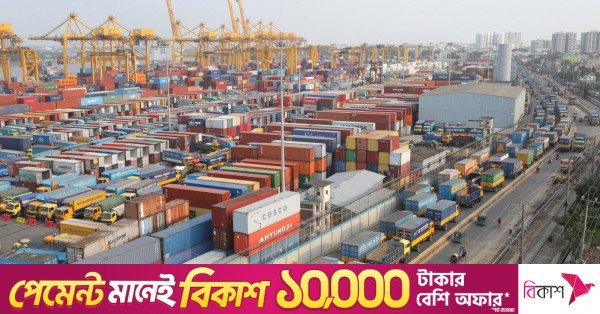
Bangladesh spends at least $9 billion annually on freight, yet domestic vessels carry only 8% to 10% of the business, allowing most of the earnings to flow overseas, speakers at a roundtable in Dhaka said on Wednesday as they opposed a proposal to raise the foreign ownership ceiling in freight forwarding from 40% to 49%.
They said expanding the domestic fleet could retain around $2 billion annually in the country and warned that relaxing foreign ownership rules would further weaken local participation in the logistics sector and increase foreign exchange outflows.
The observations came at a roundtable titled “Protecting Domestic Investment in Logistics & Policy Reform”, organised by the Centre for Strategic Research (CSR) at the BRAC Centre in Mohakhali on Wednesday, according to a press release.
Zonayed Saki, state minister for planning, joined the event virtually as chief guest, while Mahmudur Rahman Manna, president of Nagorik Oikya, attended as special guest.

Presenting the concept paper, Saqeeb Anwer, executive director of CSR, said freight forwarding, shipping agency, customs agency and courier-express services required little fixed capital to operate.
He argued that foreign ownership in these businesses brought neither factories nor equipment nor significant technology. Instead, foreign firms could use their licences to redirect existing cargo flows to their global networks.
“What takes place in the market is substitution rather than competition,” he said.
The concept paper said Bangladesh could retain around $2 billion annually by expanding its domestic fleet. Following the enactment of the Bangladesh Flag Vessels (Protection of Interest) Act 2019, the number of domestic ocean-going vessels increased from 48 to 80.
It also cited Section 9(4) of the Civil Aviation Act 2017, which requires the general sales agent of a foreign airline to be wholly owned by a Bangladeshi citizen, saying the provision had helped develop a fully domestic general sales agent industry.
Saqeeb Anwer said that although several wholly foreign-owned companies operated in Bangladesh, none had invested in domestic vessels or logistics infrastructure.
Speakers expressed concern that the Shipping Agent and C&F Agent Licensing Rules had already replaced the 60:40 ownership structure with a 51:49 ratio.
They said the current budget had also removed the 49% foreign ownership ceiling on inland container depots and off-docks, while courier services were exempt from the limit.
Against this backdrop, they described the 60:40 ratio under the draft Freight Forwarding Rules as the last remaining benchmark for majority domestic ownership in the sector.
Speakers also said the validity of licence renewals for wholly foreign-owned companies remained pending before the High Court Division under Writ Petition No 12489 of 2019. They warned that amending the rules before disposal of the rule nisi could render the proceedings ineffective.
Fazle Huda, MP for Naogaon-3, described logistics as a sensitive sector linked to national security.
He said many foreign companies took significant amounts of foreign currency out of Bangladesh by issuing bills of lading and other documents without investing in visible infrastructure.
“We are not against foreign investment. But that investment must go into infrastructure—railways, cold chains, modern trucks and agriculture-based supply systems,” he said.
Citing restrictions imposed by Sri Lanka and India, Fazle Huda said sectors connected to trade, ports and internal security should be treated as strategic.
He also called for an end to businesses being operated through nominal local partners arranged by lawyers or consultants.
Kabir Ahmed, president of IAEAB and adviser to BAFFA, said foreign companies controlled around 80% of Bangladesh’s freight business but brought little meaningful foreign direct investment.
Md Ariful Ahsan, president of BAFFA, warned that continued overdependence on foreign companies would weaken the domestic logistics industry.
Shafiqul Alam, editor of Daily Waadaa, said global developments and geopolitical considerations should shape Bangladesh’s approach to foreign investment and that foreign investment might not be necessary in every sector.
Mahmudur Rahman Manna said excessive foreign participation was depriving domestic entrepreneurs of opportunities. He also called for greater public discussion of what he described as a lack of transparency in the sector.
ATM Azizul Akil David, former senior vice-president of the Bangladesh China Chamber of Commerce and Industry, said effective interest rates of 23% to 24% were forcing domestic entrepreneurs out of business, while foreign companies enjoyed a comparative advantage.
The roundtable presented six demands:
- A uniform 60:40 ownership structure across all four logistics subsectors, with domestic majority ownership covering shares, dividend rights and board voting;
- Strict enforcement of existing rules during licence renewals;
- Minimum paid-up capital of $5 million to $10 million for companies with foreign participation, with at least 40% invested within 24 months in warehouses, equipment and transport fleets;
- Restrict foreign nationals to senior management positions;
- Assess foreign exchange outflows before licence renewal; and
- Mandatory disclosure of beneficial ownership to prevent nominee shareholding.
Abu Alam Md Shahid Khan, former secretary; Barrister M Saquibuzzaman; Mahmud Hosain FCA, former vice-president of ICAB; Hasan Mamun, consulting editor of Dhaka Stream; and Kamruzzaman, head of finance at Rifline Logistics, also attended the event.
Speakers urged the relevant ministries and policymakers to consider the recommendations before finalising the rules.
About The Author