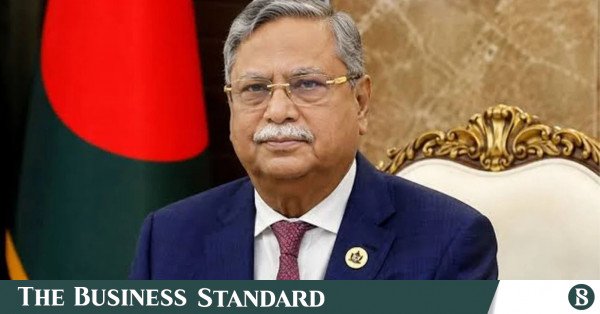
Following the resignation of Mohammed Shahabuddin as president, several political parties and organisations, including the National Citizen Party (NCP), Bangladesh Khelafat Majlis and Inqilab Mancha, have demanded his arrest and prosecution.
Shahabuddin has rejected the possibility of legal action against him, citing Article 51 of the Constitution, which provides protection for presidential actions taken while performing official duties.
“What trial will they hold? For what? Let them read Article 51 of the Constitution,” Shahabuddin said in a media interview after stepping down.

Article 51 provides two forms of protection for the president. Under Article 51(1), the president cannot face legal accountability in any court for any act done or omitted while exercising the duties of the office or considering those duties.
The provision, however, does not prevent legal proceedings against the government in relation to such actions.
Immunity continues for official presidential acts
The constitutional protection under Article 51(1) does not apply only during the president’s tenure. Some legal experts say it continues even after the individual leaves office for actions taken as part of official presidential responsibilities.
Article 51(2) provides a separate protection during the president’s tenure. It prevents criminal proceedings from starting or continuing against the sitting president and bars the issuance of arrest or imprisonment warrants while the person remains in office.
Since Shahabuddin has resigned, this protection no longer applies.
Legal experts say Article 51 does not provide complete immunity for every action taken by a president. The protection does not cover activities unrelated to presidential duties, corruption-related offences, criminal acts or offences committed before becoming president.
A former president can still face legal proceedings for actions outside the scope of official presidential responsibilities.
Shahabuddin rejects allegations
Shahabuddin resigned from office citing health reasons. In an interview with a private television channel, he rejected allegations surrounding a reported London visit, describing them as “baseless” and “imaginary”.
“The world is now so connected that anyone can communicate from anywhere. Can someone from Bangladesh not talk to Delhi? Why would I need to go to London?” he said.
He said the allegations had no connection with his resignation and claimed that he had been considering stepping down for seven to eight days because of health concerns.
“My next plan is medical treatment: getting better treatment at home and abroad,” he said, adding that he may travel overseas within 10 to 12 days if his health improves.
Responding to the NCP’s demand for his prosecution, he said, “Forget it. I do not pay any attention to these things.”
In a separate interview, Shahabuddin said, “I am not a criminal. I worked with my head held high as president. I managed the crisis in 2024 after August 5.”
He also dismissed reports that pressure forced him to resign, calling such claims false and baseless.
Demand for arrest, trial
At a press conference in Dhaka, Rangpur-4 lawmaker and NCP Member Secretary Akhter Hossen demanded Shahabuddin’s immediate arrest and prosecution.
Inqilab Mancha held a procession in Dhaka after Shahabuddin’s resignation, demanding that he be arrested and tried.
The Bangladesh Khelafat Majlis also called for Shahabuddin’s arrest.
Criticism
Md Rashed Khan, political assistant to the prime minister, wrote on Facebook yesterday, “If Nahid Islam [NCP convener and Dhaka-11 MP] and others had formed a revolutionary government instead of abiding by the Constitution and taking the oath at the hands of the outgoing president, the issue of immunity would not have arisen, and there would have been an opportunity to take action against the outgoing president.
“However, by taking the oath at the hands of the outgoing President, the interim government – formed on the advice of Nahid Islam and his allies – effectively pardoned him and gave him renewed legitimacy.
“You cannot pardon someone, grant them a fresh evaluation and then turn around to demand their trial… But why did they not conduct this trial during their interim government’s tenure?”
Speaker declines to comment
Parliament Speaker Hafiz Uddin Ahmad, who assumed the president’s duties under Article 54 after receiving Shahabuddin’s resignation letter, declined to comment when asked whether the former president should be arrested.
“I have no comment on that matter,” he told reporters.
Jamaat welcomes resignation
Opposition Leader and Jamaat-e-Islami chief Shafiqur Rahman welcomed Shahabuddin’s resignation, describing it as the removal of “a dark shadow of authoritarianism”.
Asked about corruption allegations against the former president, he said no one is above the law if credible evidence emerges.
Shafiqur also criticised Shahabuddin’s silence during the 2024 July Uprising, saying he failed to speak out against the killings of protesters.
Shahabuddin became Bangladesh’s 22nd president on 24 April 2023 for a five-year term but resigned yesterday with nearly two years remaining.
In his resignation letter, he cited heart disease, high blood pressure, diabetes, kidney complications and autonomic neuropathy.
About The Author