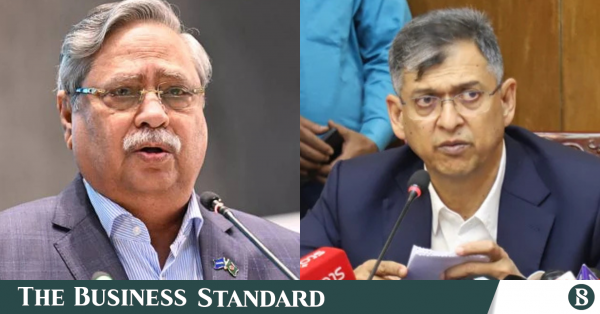
Amid reports and speculation over President Mohammed Shahabuddin’s possible resignation, Home Minister Salahuddin Ahmed today (23 July) said the government was unaware of any such decision, while the president himself neither confirmed nor denied the reports, describing the question as “embarrassing”.
“Rumours are rumours. If it becomes a reality, we will deal with it then,” Salahuddin told reporters when asked about media reports of the president’s possible resignation.
When journalists pointed out that the issue had already been reported in the media, Salahuddin replied, “Then you should ask the president.”

“There has been no initiative from the government on this issue, nor has the government made any statement about it. If the president wants to resign due to health or any other reason, that is a matter for him to explain,” he said.
Asked whether the president had spoken to ousted prime minister Sheikh Hasina while receiving medical treatment abroad, Salahuddin said he had no information.
He said that if the president decided to resign, he would have to submit a resignation letter to the speaker of parliament, after which the constitutional process would take effect.
“If the president resigns, the question of who becomes the next president will be resolved in accordance with the Constitution,” he said.
President says question ’embarrassing’
President Shahabuddin in a WhatsApp interview with an English daily today did not deny or refute reports of his possible resignation.
The president, when asked directly if he planned to step down, said, “You will see. [It’s an] embarrassing question.” He rejected claims that two ministers had recently met him, calling the claims “false” and “lies”.
Asked about reports of a phone conversation with Hasina, Shahabuddin said, “Only when someone has lost their mind will they come up with such concocted stuff. It is baseless, baseless and baseless. Totally baseless.”
He added, “I have acted fairly all my life. I don’t like to manufacture any news.” He claimed that he was undergoing medical treatment in London at that time.
When asked whether he was waiting for the speaker of Jatiya Sangsad to return to the country, Shahabuddin said he was not supposed to be aware of the speaker’s whereabouts.
Meanwhile, BNP’s Media Cell member Sayrul Kabir Khan said today Speaker Hafiz Uddin Ahmad is likely to return home on Friday after cutting short his overseas visit to Thailand, reports UNB.
President’s departure would be natural: Sources
Media reports, citing official sources, suggest President Shahabuddin is likely to resign soon.
A senior government source told a Bangla daily that his departure was “only natural”. “It is only natural that he will not remain, whether today or tomorrow,” the source said.
Asked why the issue had resurfaced, the source said the government had become dissatisfied with reports that the president had attempted to re-establish old contacts and no longer considered it prudent to retain a pre-uprising figure in the country’s highest office.
Meanwhile, NCP Convener and Opposition Chief Whip Md Nahid Islam today called for the arrest of the president, saying resignation alone would not be sufficient, while urging the election of a qualified, neutral and guardian-like successor.
What Constitution says about president’s resignation
The Constitution sets out a clear process if Shahabuddin resigns. Under Article 50(3), the president may step down by submitting a resignation letter to the speaker of parliament.
Article 54 provides that the speaker will serve as acting president if the office falls vacant or the president is unable to perform his duties due to absence, illness or any other reason. The speaker will remain in office until a new president assumes the post.
Under Article 123, a new president must be elected within 90 days of a vacancy caused by resignation, death or removal. The president is elected by MPs, meaning the ruling BNP, which holds a parliamentary majority, is expected to secure the presidency for its nominee.
Can the top bureaucrat in talks be the next president?
A senior bureaucrat currently serving on a contractual appointment has emerged in social and mainstream media speculation as a potential successor if Shahabuddin resigns.
However, even if the ruling BNP nominates him, the Constitution and the Representation of the People Order (RPO) raise a legal hurdle. Article 48(4)(b) of the Constitution states that a person is ineligible for election as president if he is not qualified to be elected as an MP.
As the bureaucrat is still serving on contract, he would not qualify to contest an election. Even if he resigned, Section 12(f) would still require a three-year gap from the date of resignation or retirement before he could become eligible to be elected an MP.
As presidential candidates must also qualify for parliamentary election, the bureaucrat would remain ineligible until three years after the end of his contractual appointment.
Media reports have meanwhile suggested several senior BNP leaders, including Mirza Fakhrul Islam Alamgir, Khandaker Mosharraf Hossain and Abdul Moyeen Khan, as possible contenders for the presidency if Shahabuddin steps down.
About The Author