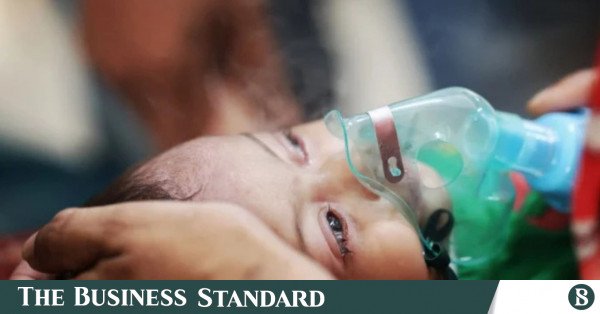
Herd immunity not achieved as more than 40 lakh children remained unvaccinated.
Infographics: TBS
“>

Infographics: TBS
For months, measles has continued to claim children’s lives across Bangladesh without pause despite a nationwide vaccination campaign.
Since the outbreak began in March, more than 800 children have died from confirmed and suspected measles infections, while over 800 more continue to fall ill each day, with an average of four deaths daily.
Public health experts say the outbreak remains uncontrolled due to major gaps in vaccination coverage, failure to achieve herd immunity, and inadequate public health interventions.
Six more children died from measles-like symptoms in the 24 hours until 8am yesterday (22 July), raising the combined death toll from confirmed and suspected cases to 803 since 15 March, according to the Directorate General of Health Services (DGHS).

DGHS data shows that of the 803 deaths reported through 22 July, the highest monthly toll was in May with 309 deaths.
Prof Mahmudur Rahman, former director of the Institute of Epidemiology, Disease Control and Research (IEDCR), told The Business Standard the outbreak persists because two highly vulnerable groups remain largely unprotected.
“Nearly one-quarter of patients are infants under six months, who are too young to be vaccinated. At the same time, many children over five were never vaccinated. These two groups alone are enough to sustain transmission,” he said.
Prof Mahmudur, who also chairs the National Verification Committee for Measles and Rubella Elimination, said the government’s vaccination target underestimated the actual number of eligible children. More than 40 lakh children remained unvaccinated, preventing herd immunity.
Following the outbreak, the government launched a phased measles vaccination campaign on 5 April, targeting over 1.80 crore children aged six months to under five years.
Official data showed the campaign achieved 103% of its target. However, the nationwide Vitamin A campaign in June reached 2.26 crore children in the same age group, suggesting about 46 lakh eligible children had been missed by the measles campaign.
Public health specialist Dr Tajul Islam A Bari said at least 95% of children must develop immunity to achieve herd immunity.
“Increasing vaccine coverage alone is not enough. We also need to assess vaccine effectiveness by testing whether vaccinated children have developed adequate protective antibodies,” he said.
He added that children older than five are also being infected, despite no vaccination programme covering that age group. Previous Measles-Rubella (MR) campaigns included children up to 10-15 years, and he recommended extending the current programme to at least 10-year-olds.
Experts for new response strategy
Prof Mahmudur urged the government to convene an emergency meeting with experts to develop a revised strategy.
Because infants under six months cannot be vaccinated, he said stronger public health measures – including isolation, hand hygiene, mask use and infection prevention in hospitals and households – are essential to protect them.
He also called for identifying low-coverage areas and conducting Supplementary Immunisation Activities.
Prof Mahmudur further recommended reintroducing hospital triage systems.
“During the Covid-19 pandemic, patients with infectious diseases were treated separately. That is no longer being practised, and children visiting hospitals for other illnesses are also becoming infected with measles,” he said.
Govt admits vaccination target error
Health Minister Sardar Md Sakhawat Husain told TBS the government realised it had underestimated its vaccination target after the Vitamin A campaign.
“After the Vitamin A campaign, we realised there had been an error in setting our vaccination target. Although the nationwide campaign ended on 20 May, our health workers have been going door to door since 21 May to identify and vaccinate children who were missed,” he said.
The minister said about 90% of children hospitalised with measles at the hospitals he visited had not been vaccinated. He also identified malnutrition as a key factor behind measles deaths.
“Malnourished children who contract measles develop pneumonia very quickly. Many mothers are also malnourished, and exclusive breastfeeding is not being practised properly. As a result, children become critically ill very rapidly,” he said.
He added that many families wait four to five days after symptoms appear before seeking treatment, by which time children often require critical care, significantly increasing the risk of death.
The minister said the government has expanded intensive care capacity, including bubble CPAP and ventilator support, strengthened treatment protocols, and stepped up awareness campaigns urging parents to seek immediate medical care if children develop a fever.
Since 15 March, 1,03,078 suspected measles patients have been hospitalised nationwide, with 99,294 recovering, according to the DGHS.
About The Author