At present, both the Islamic Foundation and BSTI separately issue halal certificates in Bangladesh.
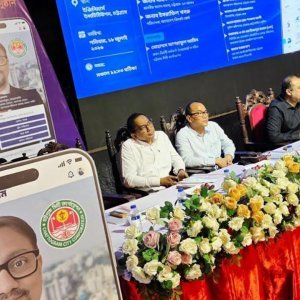
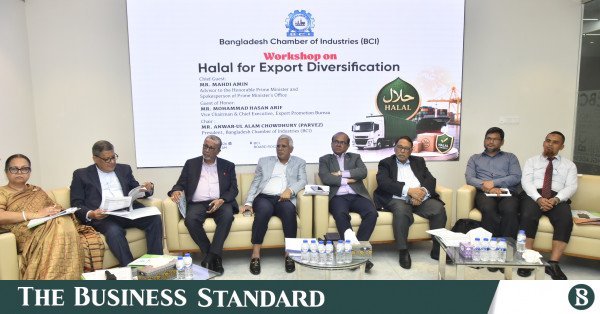
Bangladesh Chamber of Industries (BCI) organises a workshop titled Halal for Export Diversification in Dhaka today (18 July). Photo: Collected
“>

Bangladesh Chamber of Industries (BCI) organises a workshop titled Halal for Export Diversification in Dhaka today (18 July). Photo: Collected
Highlights
- Businesses allege bribery in halal certification process
- High costs discourage firms from seeking official certificates
- Exporters seek single internationally recognised halal authority
- Lack of Saudi recognition hampers Bangladesh’s halal exports
- EPB urges unified certification to unlock global halal market
Businesses have alleged that they are forced to pay bribes and incur excessive costs to obtain halal certificates from the Bangladesh Standards and Testing Institution (BSTI) and the Islamic Foundation, calling for the certification to be provided free of charge.
They said the current certification process discourages many companies from obtaining official halal certificates and weakens Bangladesh’s prospects in the rapidly growing global halal market. As a result, many exporters are compelled to secure halal certification from organisations in countries such as India and Singapore.

The allegations were raised at a workshop titled Halal for Export Diversification, organised by the Bangladesh Chamber of Industries (BCI) in Dhaka today (18 July).
The event was chaired by BCI President Anwar-ul Alam Chowdhury Parvez, while Export Promotion Bureau (EPB) Vice Chairman and Chief Executive Officer Mohammad Hasan Arif attended as the chief guest.
Speaking at the workshop, Khurshid Ahmed Farhad, general manager of Bombay Sweets and Company Ltd, said obtaining halal certification involves high fees, repeated factory inspections and submission of numerous laboratory test reports.
He said his company initially paid Tk16–18 lakh in certification fees for several products. Although the fees were later reduced by half, the company has still not received the certificates despite paying around Tk14.5 lakh.
Farhad also claimed that the authorities require test reports for heavy metals and pesticide residues, although such testing facilities are not available in Bangladesh.
He further alleged that businesses are expected to make unofficial payments during the certification process.
“There is a non-halal activity involved in obtaining halal certificates – bribes have to be paid,” he said.
Farhad also alleged that neither BSTI nor the Islamic Foundation holds accreditation from Saudi Arabia’s recognised halal accreditation authority, forcing Bangladeshi exporters to obtain certification from accredited organisations in India, Singapore or Thailand to export to Saudi Arabia.
As a result, his company had to remove halal logos from around 50 of its more than 200 products, spending about Tk62 lakh solely on changing packaging.
During an open discussion, BCI Director and Easy Process Food Chairman Zia Haider Mithu alleged that officials from BSTI and the Islamic Foundation demand additional facilities during factory inspections.
“They ask us to provide a vehicle because a large team will visit the factory. We also have to arrange meals for them. After that, they charge Tk200,000 annually for exporting 200 tonnes. If I have to spend this much money to obtain certificates for thousands of products, then I do not need those certificates,” he said.
He added that many overseas buyers, after learning about the costs involved, simply ask exporters to print the word “halal” on product packaging instead of obtaining formal certification.
Representatives from leading halal exporters, including PRAN, Paragon, Akij, Meghna and Bengal Meat, attended the workshop and expressed support for the concerns raised by the business community.
EPB Vice Chairman Mohammad Hasan Arif said the global halal economy is now valued at $5.2 trillion, but Bangladesh remains largely confined to exporting halal food and agricultural products.
He said the country has significant untapped potential in cosmetics, pharmaceuticals, fashion, tourism, manufacturing supply chains, fintech, education and research.
Arif identified the absence of a unified and internationally recognised halal certification authority as one of the sector’s biggest challenges.
He recommended establishing a single national authority similar to those in Malaysia or Turkey.
Presenting the keynote paper, Md Mominul Islam, assistant professor at the International University of Business Agriculture and Technology (IUBAT), said separate certification by BSTI and the Islamic Foundation weakens Bangladesh’s country branding in the halal market.
He recommended establishing a single halal authority or halal board to strengthen Bangladesh’s international branding.
In his closing remarks, BCI President Anwar-ul Alam Chowdhury Parvez said Bangladesh currently exports only $850 million worth of halal products despite the enormous size of the global halal market.
“Halal is not limited to food. It also covers pharmaceuticals, textiles, cosmetics and industrial products. With a unified certification system, stronger international branding and improved laboratory capacity, Bangladesh can significantly increase exports, employment and foreign exchange earnings within a short period,” he said.
About The Author