Manufacturers want adequate pressure rather than subsidies
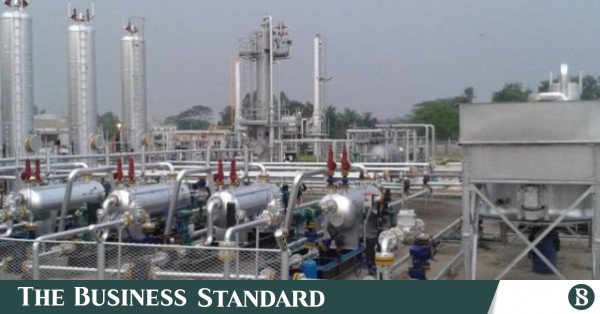
Titas Gas fields. Photo: Collected
“>

Titas Gas fields. Photo: Collected
Highlights:
- Textile mills crippled by years of critically low gas pressure
- Factory owner reports Tk450 crore production losses from gas shortages
- 234 textile mills closed since 2014 amid mounting industry pressures
- Energy shortages force factories to use costly CNG, LPG, solar
- Ceramics, tyres, footwear industries also suffer unreliable energy supplies
- Declining gas production and LNG shortages worsen industrial fuel availability
Khorshed Alam, a spinning mill owner, has a sanctioned gas pressure of 10 PSI – generally the minimum required for industrial gas engines and boilers to operate reliably.
However, for the past four and a half years, his factory has been receiving an average of just 1.5 PSI, causing an estimated production loss of Tk450 crore.

In a desperate bid to resolve the problem, Khorshed has sent 44 letters to Titas Gas Transmission and Distribution Company, copying the Energy Ministry and Petrobangla.
Infograph: TBS
“>

Infograph: TBS
Yet, the situation has remained unchanged. With no viable alternative, he invested Tk8 crore in a solar power system with battery storage recently. While it has provided some relief, it is far from enough to keep the factory running at full capacity.
The prolonged energy crisis has pushed many entrepreneurs to the brink. For instance, AKM Shaheed Reza, chairman of Reza Group, is now exploring options to sell his textile factory.
Alam and Reza are far from isolated cases.
According to the Bangladesh Textile Mills Association, 234 textile mills have shut down since 2014. These include 114 spinning mills, with the remainder comprising weaving, dyeing, and other textile factories.
Of the closed mills, around 120 have expressed interest in reopening under a recent Bangladesh Bank initiative aimed at reviving sick and closed industries. That still leaves 114 factories with little or no prospect of resuming operations.
Textile entrepreneurs attribute the crisis to three key factors: a persistent energy shortage despite gas price hikes of up to 179% in January 2023; the nearly 40% depreciation of the taka against the US dollar following the Russia-Ukraine war in 2022; and easier imports of yarn and fabrics under the duty-free bonded warehouse facility, which they say has intensified competition for local producers.
“Currently, we are getting just 1 PSI of gas, which is not enough to run our machines. We have no choice but to use costly CNG to operate our generators,” said Hossain Mehmood, vice chairman of Anwar Group of Industries, which has operations spanning yarn and fabric manufacturing to dyeing and printing.
According to Mehmood, generating one kilowatt-hour (kWh) of electricity using natural gas costs Tk7.5-8, compared with Tk14-15 when using CNG. Even then, CNG supplies are erratic, while LPG is not a commercially viable alternative.
“Many dyeing and processing factories are shutting down because of the gas shortage,” Mehmood told The Business Standard.
Entrepreneurs say the textile industry’s heavy reliance on natural gas stems from the unreliability of the national power grid. Frequent outages and voltage fluctuations force factories to generate their own electricity to avoid costly production disruptions.
“In China and India, factories don’t have to worry about where their energy comes from. The government ensures a reliable supply,” Mehmood said. “Governments in India and Pakistan are extending policy support to keep their textile industries competitive. Our government should identify where we are falling behind. Otherwise, how can we survive?”
Other industries too reel from low pressure
The energy crisis extends well beyond the textile sector. Industries ranging from ceramics and tyres to footwear are grappling with acute shortages of gas and electricity, disrupting production and driving up operating costs.
Irfan Uddin, managing director of export-oriented FARR Ceramics, said gas pressure at his factory often falls below 1 PSI during the day, although it improves to around 10 PSI at night.
“We cannot simply shut down production,” he told TBS. “Instead, we have to use expensive LPG or CNG to keep our machines running. We are losing money every day.”
Luthful Bari, chief executive officer of the Tyre Division at Meghna Group, said his company applied more than a decade ago for an increase in the sanctioned gas load for its factory in Sreepur. Although the Bangladesh Investment Development Authority recommended that Titas approve the request, it has yet to be implemented.
Meghna’s other tyre plant in the Sylhet region receives gas for only about 16 hours a day and 24 days a month, making uninterrupted production impossible.
“Tyre manufacturing is a continuous process that requires a reliable, round-the-clock energy supply,” Bari said. “Interruptions are hurting our productivity and increasing losses.”
Nasir Khan, chairman and managing director of export-oriented Jennys Shoes, does not rely on gas, unlike many manufacturers struggling with severe supply shortages. But his factory faces a different challenge: an unreliable electricity supply.
“Power comes and goes without warning. These frequent fluctuations are severely damaging our machines,” Nasir told The Business Standard.
He said the Rural Electrification Board should provide factories with a schedule of planned power supply so they can arrange backup sources accordingly.
“If we know how many hours of electricity we will receive, we can prepare ourselves with alternative power sources,” he said.
Falling supply
Titas Gas acknowledges on its website that customers in parts of its franchise area have been facing low gas pressure due to supply shortages. The state-owned distributor attributes the problem to declining domestic gas production and a shortage of imported LNG, worsened by disruptions in the global energy market following recent conflicts.
As of 30 June 2025, Titas had 2.78 million customers, including 5,673 industrial users.
Company data show that gas supply to industrial consumers fell from 4,330mmc per month in FY21 to 3,737mmc in FY25. Supply to captive power plants also declined, from 4,672mmc a month to 3,989mmc over the same period.
A Titas official, speaking on condition of anonymity, said gas supply to industries and captive power plants has since fallen by another 300mmc per month, worsening the shortage.
The Business Standard contacted Titas Managing Director Shahnewaz Parvez by phone and text message for comment, but he did not respond.
Why pressure matters
Gas engines and boilers generally require 8-10 PSI of gas pressure to operate reliably, while 12-15 PSI enables them to run at full efficiency and maintain continuous production.
Once gas pressure falls below 7-8 PSI, engines begin to lose power or trip, boilers struggle to generate adequate steam, and production becomes increasingly disrupted.
At 2-5 PSI, the situation becomes critical for most large mills. Captive power plants can no longer generate sufficient electricity, boilers fail to produce enough steam for dyeing and other processes, and many factories are forced to cut production or suspend operations.
Manufacturers say the problem is compounded by severe pressure fluctuations throughout the day. During peak hours, many mills receive only 2-3 PSI, well below the pressure their equipment is designed to handle. As a result, captive power generation declines or shuts down, steam supply becomes inadequate for humidification and processing, spindle speeds fall, production efficiency drops, and operating costs soar as factories switch to expensive diesel or CNG-fired generators.
Spinner Khorshed Alam said he doesn’t need subsidised gas. “We only need enough pressure to use the gas we’re already paying for.”
About The Author