Industry leaders warn introduction of 15% capital gains tax on apartment registrations may worsen crisis
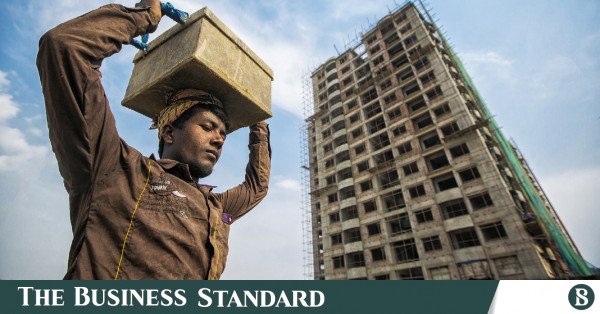
Representational image: Photo: Noor-A-Alam
“>

Representational image: Photo: Noor-A-Alam
Highlights:
- Apartment sales continue steep decline across Bangladesh
- Rising construction costs stall projects and reduce new developments
- New budget taxes further weaken housing market confidence
- Hundreds of developer-landowner agreements cancelled amid financial strain
- Buyers face lengthy delays despite substantial upfront payments
- Large developers remain resilient, but market pressures are growing
The country’s housing market is sinking deeper into a prolonged slump as soaring construction costs, political uncertainty, the Middle East conflict and stubbornly high inflation continue to erode both buyer confidence and developer activity.
Industry insiders speaking to The Business Standard warned that the newly introduced 15% capital gains tax on the government-assessed value of apartments – enacted in the FY2026-27 budget – is set to slow the sector down even further.

This downward trajectory is now starkly visible in official registration data.
Infograph: TBS
“>

Infograph: TBS
The slump in numbers
According to the Directorate of Registration, only 41,804 apartment transfer deeds, with a declared value of around Tk18,000 crore, were registered nationwide during the first half of this year (January-June). Nearly three-quarters of these transactions – 29,913 – took place in Dhaka.
This first-half performance points to another bleak year for a sector already in retreat.
Compared with the semi-annual average of 2025, apartment registrations in the first six months of this year declined by 19.61%. The contraction is even sharper against earlier years: sales dropped 25.35% from the same period of 2024 and plunged 42.73% compared with January-June 2023, reflecting the depth and speed of the housing market’s deterioration.
Nationwide apartment registrations had already fallen to 1,04,000, worth Tk61,000 crore, in 2025 from 1,12,000 (Tk79,000 crore) in 2024 and 1,46,000 (Tk1 lakh crore) in 2023.
The collapse in transactions has also taken a toll on state coffers.
Nipendra Nath Sikder, assistant inspector general of registration, confirmed that the sharp fall in apartment registrations has significantly reduced revenue collection from property registration, though he did not specifically disclose specific figures.
Choked pipelines and fractured agreements
The systemic slowdown is also choking the industry’s future project pipeline.
Kamal Mahmud, former senior vice-president of the Real Estate and Housing Association of Bangladesh (REHAB), said developers are signing far fewer joint-venture agreements with landowners, while many existing deals are being called off as projects become financially unviable.
According to a Rehab official, around 450 landowner-developer agreements were cancelled in Dhaka alone during the first half of this year, following nearly 1,000 cancellations in 2025. Compounding the industry’s headache, Rehab is currently mediating around 1,600 unresolved complaints from apartment buyers who have yet to receive possession of their flats.
Spiralling costs and stalled sites
Developers report that the price of key construction materials has surged by 50% to 60% – and in some cases by over 100% – since the 2020 Covid-19 pandemic and the subsequent Russia-Ukraine war. Cement currently retails between Tk540 and Tk580 per bag, while mild-steel rod prices have climbed to between Tk85,000 and Tk1 lakh per tonne.
“The price of steel rods is rising almost daily due to raw material supply disruptions,” said Md Jasim Uddin, Director (Sales and Marketing) of steel manufacturer KSRM Group. “The conflict in the Middle East has driven up freight and import costs, inflating production expenses. To top it off, the 10% regulatory duty imposed in the new budget has pushed market prices even higher.”
While major steelmakers like BSRM report that overall industrial demand for rods remains stable, their field data confirms that real estate companies have dramatically scaled back procurement.
The crisis has left mid-and-small-scale developers unable to complete projects. At South Baridhara in the capital, Ruposi Builders signed sales contracts for 22 out of 48 planned apartments across two projects starting in early 2024. However, after completing only the third floor, construction ground to a halt because the remaining 26 units could not be sold.
“We invested the agreement money received from customers to push the project as far as possible,” said Jahurul Ahsan Rose, managing director of Ruposi Builders. He added that the company has now mortgaged its own share of the properties to secure bank loans just to keep the site active.
Buyers are facing agonising delays despite making major financial commitments. Debashish Ranjan Pal, a private bank official, signed a contract in March 2024 to buy a Ruposi Builders apartment for Tk1.20 crore, paying an upfront deposit of Tk50 lakh.
“The apartment was promised within two years. It has been over two years now, and not even half the project is complete,” Pal said.
Fellow buyer Dr Shahzada Imran Hossain, who has also cleared Tk70 lakh, shared a similar ordeal.
Budget measures worsen outlook
Industry leaders warn that fiscal tightening in the FY2026-27 budget – specifically the new 15% capital gains tax on apartment registrations, a 10% duty on steel rods and cement, and stricter limitations on whitening untaxed money – has compounded the crisis.
“The new taxes will create further complications for both buyers and sellers,” Ali Afzal, president of Rehab, warned.
The crisis is visible across leading developers. Sheltech reported that approximately 25% of its bookings have been cancelled since August 2024, alongside a 15% to 18% drop in new sales.
“Global volatility has driven up steel and cement prices, and local manufacturers have lowered production,” said Tanvir Ahmed, managing director of Sheltech. “Consequently, developers are forced to buy from the spot market at higher rates.”
Similarly, Naimul Hasan, managing director of Hasan & Associates Limited, stated that while his company used to deliver seven to eight projects annually before 2020, it could only finish three each in 2021 and 2022.
Four projects initiated in 2023 remain incomplete despite 70% of the units being sold. “We haven’t been able to take on any new projects since 2023. Most housing companies are in the same crisis,” Hasan said.
Large conglomerates resilient but not immune
While small and medium developers struggle for survival, larger market players are leaning on their financial cushioning to stay afloat.
Tariqul Alam, Brand Manager of the Real Estate Division at Concord Group, noted that while large-scale firms have bypassed severe disruptions so far – partly because commercial real estate projects are outperforming residential units – the prolonged slump will eventually drag down larger portfolios as well. Representatives from Anwar Landmark and South Breeze Housing echoed this sentiment, stating that robust balance sheets are currently absorbing the market shocks.
However, the chill is spreading. A branch manager of a prominent private bank in Dhaka’s Moghbazar pointed out that even major industry names are beginning to falter. He cited a leading developer that easily sold out a residential project in Moghbazar a few years ago. Encouraged by the success, the company launched a second project nearby – only to find themselves struggling to attract buyers.
About The Author