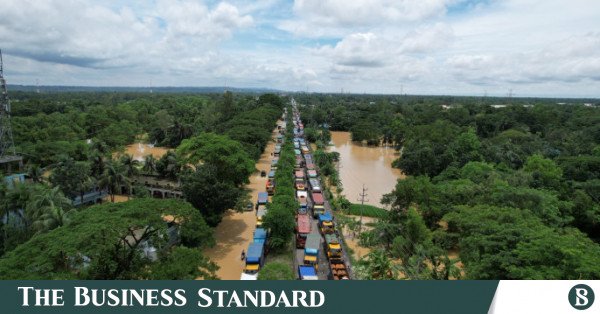
A long tailback on a highway in Chattogram. Photo: Mohammad Minhaj Uddin/TBS
“>

A long tailback on a highway in Chattogram. Photo: Mohammad Minhaj Uddin/TBS
Experts have said Chattogram’s recurring waterlogging and landslides stem not only from climate change but also from decades of unplanned urbanisation, canal encroachment, destruction of wetlands, illegal hill cutting and poor maintenance of drainage infrastructure.
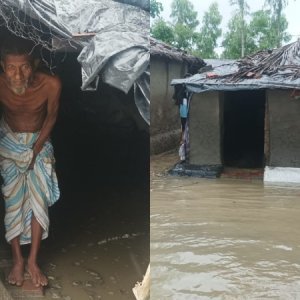
The issue resurfaced after five consecutive days of heavy rainfall left vast areas of the city and surrounding districts inundated. In Kulgaon, where three large ponds and low-lying water bodies were filled in 2023 to build a city bus terminal, around 300,000 residents of Kulgaon, Baluchara and Jalalabad remained marooned. Roads and homes went underwater, highlighting the role of natural retention areas in managing stormwater.
According to experts, thousands of ponds and wetlands have disappeared across Chattogram over the past two decades due to housing, commercial and infrastructure projects.

They also point to the 101-kilometre Chattogram-Cox’s Bazar railway, constructed after hill cutting at 91 locations covering nearly 13 kilometres, as an example of development that altered natural drainage. During the recent floods, about 70% of Satkania and Banshkhali went underwater, affecting around 750,000 people.
Climate change is not the only factor
Md Shamsuddoha, chief executive of the Centre for Participatory Research and Development (CPRD), said waterlogging is primarily a human-made problem caused by the encroachment of canals and water bodies. While climate change has intensified rainfall and altered monsoon patterns, he said urbanisation practices have significantly worsened the situation.
Environmentalist Idris Ali said waterlogging has become disastrous because natural drainage routes have been occupied and wetlands filled. He added that illegal hill cutting contributes to flooding and landslides by washing soil into canals, reducing their carrying capacity.
He also said Chattogram’s tidal geography complicates drainage, as water cannot flow into the Karnaphuli River during high tide and often becomes trapped inside the city.
Development ignored natural drainage
According to the Chattogram city authorities, the city now has 57 canals stretching about 163.5km, down from more than 118 in the past. Of the existing canals, 31 connect to the Karnaphuli River, 16 to the Bay of Bengal and 10 to the Halda River.
Under ongoing CDA and Chattogram Wasa projects, 36 canals have been renovated and 176 kilometres of retaining walls and canal-side roads are being built.
However, Engineer Subash Barua, vice-president of the Forum for Planned Chattogram, said repeated violations of approved master plans have turned waterlogging into a man-made disaster. He said land designated as retention zones has been filled for development, while hill cutting and inadequate culverts and bridges in some infrastructure projects have disrupted natural water flow.
Master plans overlooked
Muhammad Rashidul Hasan, assistant professor of Urban and Regional Planning at Cuet, said successive planning documents, including the 1995 CDA-UNDP Drainage Master Plan, the 2008 Detailed Area Plan and the 2016 Jica Strategic Master Plan, recommended protecting wetlands and retention ponds.
He said the 1995 master plan proposed an integrated drainage network and four new canals, but only one canal project began in 2014 and remains unfinished. Mega drainage projects launched in 2018 largely focused on widening major canals, while neighbourhood drains remained narrow, damaged and poorly maintained.
He also identified the absence of silt traps and continued hill cutting as major causes of canal siltation.
Govt reform is critical
M Zakir Hossain Khan, co-founder and managing director of Change Initiative, said waterlogging now affects about 58 locations, covering roughly 8.42% of Chattogram city. Besides heavy rainfall, tidal backwater, low elevation and sea-level rise, he cited canal encroachment, hill cutting, clogged drains and inadequate drainage capacity as key drivers.
He recommended emergency canal desilting, waste removal, sluice gate repairs, drainage monitoring and pumping during heavy rainfall. Long-term measures include restoring natural drainage routes, protecting canals and wetlands, enforcing zoning regulations, upgrading stormwater systems and curbing illegal hill cutting.
About The Author