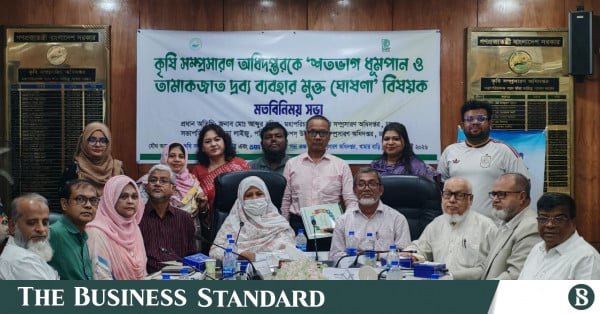
The Department of Agricultural Extension (DAE) has officially declared all of its premises 100% smoke and tobacco-free, banning the use, sale and promotion of all tobacco products to protect public health and shield non-smokers from the harmful effects of second-hand smoke.
The declaration was made yesterday during a discussion titled “Declaration of the Department of Agricultural Extension as a 100% Smoke and Tobacco-Free Institution” held at the department’s conference room.
The announcement was made by Md Hazrat Ali, director (Horticulture Wing) of the DAE.

Speaking as the chief guest, Hazrat Ali said the harmful effects of tobacco extend beyond smokers, exposing non-smokers to second-hand smoke and increasing the risk of serious diseases. He also warned that smokeless tobacco products contribute to oral cancer and other health complications.
He said the use, sale and promotion of all tobacco products—including cigarettes, bidis, zarda, gul and sada pata – would be completely prohibited on all DAE premises from now on to ensure a healthier workplace for officials, employees and service recipients.
AHM Noman, founder and chief executive officer of DORP, said Bangladesh has the highest tobacco use prevalence in South Asia at 35.3%, compared with 28.6% in India and 19.1% in Pakistan, stressing the need for stronger tobacco control measures.
Presenting the keynote paper, Zeba Afroza, coordinator of the Tobacco Control Project, said nearly 38.4 million adults in Bangladesh are exposed to second-hand smoke every day in workplaces, public places and public transport, according to the Global Adult Tobacco Survey (GATS) 2017. She added that more than 61,000 children under the age of 15 suffer from diseases linked to second-hand smoke.
She also cited a Johns Hopkins University study showing that while the government collected around Tk41,000 crore in tobacco tax revenue during the 2024–25 fiscal year, the economic cost of tobacco-related deaths, illnesses and environmental damage reached nearly Tk87,000 crore.
Afroza said tobacco cultivation also reduces the availability of arable land for food and high-value crops while degrading soil quality through excessive use of chemical fertilisers and pesticides.
Chairing the event, Dr Salma Laiju, Director (Crops Wing) of the DAE, said the initiative would help protect nearly 86,000 officers and staff working in around 600 DAE offices nationwide, as well as thousands of farmers and visitors who receive services from the department every day.
Following the meeting, the department installed smoke-free and tobacco-free signboards, notices and stickers at key locations across its premises.
About The Author