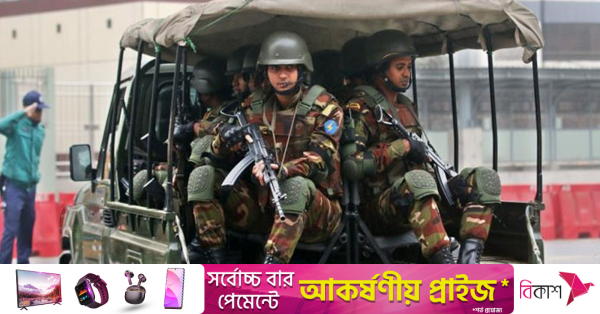
The government plans major upgrades to the navy and air force with advanced warships, fighter jets and missile defence systems.
Representational image. Photo: Collected
“>

Representational image. Photo: Collected
The government has unveiled plans to spend nearly Tk86,000 crore over the next decade to modernise the Bangladesh Army as part of a broader initiative to strengthen the country’s national security.
It has also outlined plans to significantly enhance the capabilities of the navy and air force by acquiring modern frigates, corvettes, offshore patrol vessels and submarines for the navy, as well as fourth-generation multirole combat aircraft (MRCA), attack helicopters, medium-range missile defence systems, anti-drone technology and electronic warfare systems for the air force.
The government also plans to develop a ‘Made in Bangladesh’ defence industry through a national defence industrial policy, the establishment of Defence Industrial Zones, and technology transfer initiatives to boost domestic military production capacity.

The information was provided by Prime Minister Tarique Rahman in written replies to two separate questions in parliament today (8 July).
Responding to a question from MP Masum Mostafa, the prime minister said, “Strengthening and modernising the Bangladesh Army had been given priority to safeguard the country’s sovereignty, territorial integrity and national security. To this end, the government has adopted a three-year plan followed by a seven-year programme.”
He said the implementation of these plans would significantly enhance the army’s overall combat capability. The programme includes acquiring new tanks and armoured fighting vehicles to improve ground warfare capability, alongside modern artillery rocket systems, anti-tank weapons, and short- and medium-range air defence systems to strengthen precision strike and air defence capabilities.
The written reply also stated that the army would enhance its intelligence, surveillance and situational awareness capabilities through the induction of unmanned aerial vehicles (UAVs), counter-UAV systems and advanced surveillance technologies. Strategic and operational mobility will also be improved by expanding the army’s air assault capability, air transport capacity for troops and equipment, and riverine transport operations.
The prime minister said the government also plans to build strategic stockpiles of artillery ammunition, MLRS rockets, tank ammunition, anti-tank guided missiles and other weapons to ensure the army can sustain long-term combat operations.
He added that domestic production facilities and technological capabilities would be developed to manufacture military equipment such as fuses and primers, modern assault rifles, anti-tank guided missiles, bulletproof vests and helmets. This would reduce reliance on foreign suppliers while supporting the growth of the domestic defence industry.
According to the prime minister, around Tk86,000 crore will be required over the next decade to implement the programme.
Navy to acquire frigates, submarines
In his written reply regarding the Bangladesh Navy, the prime minister said the navy’s modernisation plan includes the acquisition of modern frigates, corvettes, offshore patrol vessels and submarines.
The government also plans to induct various unmanned platforms, establish new naval bases, upgrade existing facilities, expand domestic shipbuilding capacity, enhance personnel training, and strengthen international cooperation and joint exercises.
Air force to add fourth-generation fighter jets
Regarding the Bangladesh Air Force, the prime minister said that under the ‘Forces Goal 2030’ programme, the government plans to induct fourth-generation multirole combat aircraft, fighter aircraft, attack helicopters, VIP helicopters, anti-drone systems, UAV systems, electronic warfare systems, passive detection systems, medium-range surface-to-air missile systems, long-range radar and air traffic surveillance radar.
He added that work has already begun on establishing a UAV manufacturing plant in Bogura through technology transfer. The government is also moving ahead with plans to rapidly deploy advanced air defence systems and cutting-edge surveillance technologies.
‘Made in Bangladesh’ defence industry
In response to another question from MP Akhtar Hossain, the prime minister said the government has taken a range of initiatives to develop a domestic defence industry aimed at strengthening national defence capabilities, reducing dependence on foreign suppliers and achieving long-term self-reliance.
He said work is underway to formulate a national defence industrial policy to support a ‘Made in Bangladesh’ defence sector. The government is also considering establishing dedicated Defence Industrial Zones to foster local defence manufacturing.
The prime minister further said the government is promoting collaboration among universities, research institutions, industry and the armed forces to strengthen defence technology research and innovation. Plans are also in place to expand training and higher education programmes to develop skilled engineers, scientists and technologists
About The Author