The first time Subodh appeared, he did not arrive with speeches or slogans.
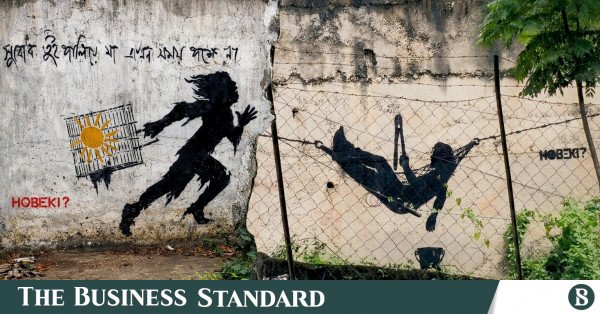
He arrived quietly, almost apologetically, on a weathered concrete wall in Dhaka’s Agargaon.
He looked like someone who had been walking for a very long time.

His beard was unkempt. His clothes hung loosely from a frail body. His feet were bare. In one hand, he carried a small birdcage.
Inside it, impossibly, burned a sun.
Beside him was a warning:
“Subodh, run away. The times are not in your favour.”
No one claimed the work.
There was no exhibition. No gallery opening. No artist standing nearby to explain what any of it meant.
Yet something extraordinary happened.
People stopped.
Office workers on their morning commute slowed their pace. University students photographed the mural and argued over its meaning. Rickshaw pullers looked twice before disappearing into Dhaka’s relentless traffic. Within days, the anonymous figure carrying a captive sun had escaped the wall that gave him life. He entered newspaper columns, Facebook timelines, tea-stall conversations and university classrooms.
Nobody knew who Subodh was.
Yet everyone seemed to recognise him.
Nearly ten years have passed since that mural first appeared in 2017. The original wall has changed. Other murals have faded beneath fresh coats of paint or the slow erosion of monsoon rains.
But Subodh never really disappeared.
He simply kept moving.
Today, the mysterious traveller who first wandered through the streets of Dhaka has journeyed beyond Bangladesh. In June 2026, a new Subodh mural appeared on the wing wall of Majitar Nala Bridge in Rangpo, the gateway to India’s Himalayan state of Sikkim.
According to media reports, it is regarded as the first confirmed appearance of HOBEKI?’s iconic character outside Bangladesh.
For a work rooted so deeply in Bengali language and experience, the crossing feels significant.
It suggests that Subodh was never just Bangladesh’s story.
Perhaps he belonged to anyone who has ever looked towards tomorrow with equal measures of hope and uncertainty.
Subodh is unusual because almost everything about him remains unknown.
The anonymous creator, known only by the signature HOBEKI? (“Will it happen?”) – has never revealed their identity. No interviews have explained the murals. No manifesto has defined their politics. Even the recurring figure himself remains deliberately elusive.
That silence has become part of the artwork.
Where many artists tell audiences what to think, HOBEKI? refuses to say anything at all.
Instead, beneath many of the murals appears the same quiet question:
“Will it happen?”
The phrase works like an unfinished sentence.
Will justice arrive?
Will dreams survive?
Will tomorrow be kinder than today?
The artist never says.
And perhaps that is why the question continues to echo years after the paint has faded.
The comparison with Banksy is almost unavoidable. Both artists conceal their identities, allowing mystery to become part of the work itself. But the resemblance goes only so far.
Banksy’s art often delivers sharp political punchlines.
Subodh rarely offers answers.
Instead, he offers uncertainty.
That uncertainty has allowed different generations to discover different meanings in the same image.
To some, the barefoot traveller represents young people searching for opportunities elsewhere. Others see a refugee carrying hope through hostile landscapes. Some recognise an ordinary citizen trying simply to survive another difficult day. Art critics have interpreted the caged sun as a symbol of hope, truth or freedom held captive, though HOBEKI? has never publicly confirmed any of those readings.
That refusal to explain is not a weakness.
It is the reason the murals continue to live long after the walls themselves have changed.
For every viewer who stops before Subodh, the story begins again.
About The Author