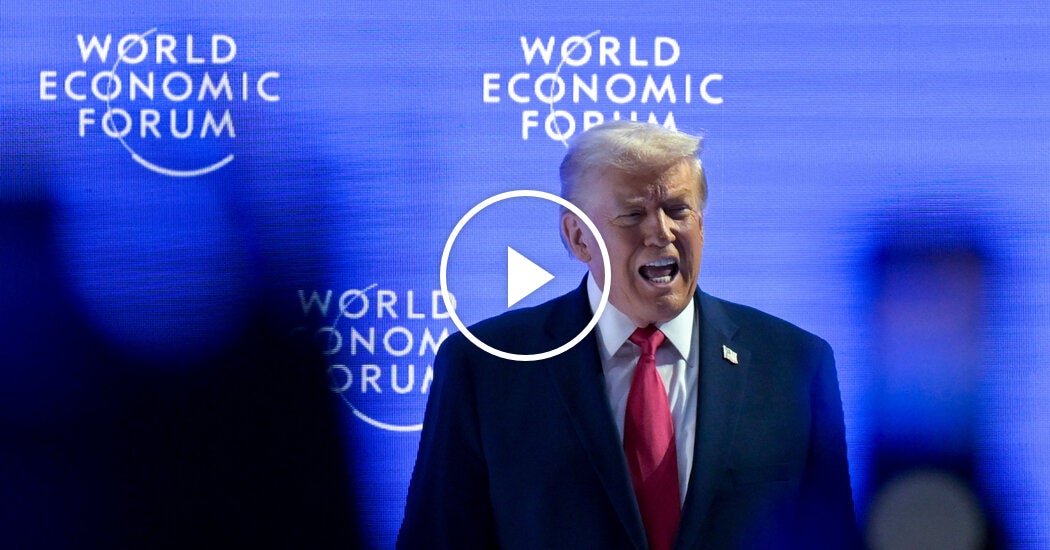
At Davos last week, Mark Carney, the prime minister of Canada, gave a speech that sent shockwaves through the International community. Let me be direct. We are in the midst of a rupture, not a transition. It was a remarkable speech by Canadian Prime Minister. It was a moment of clarity. It received a very rare standing ovation, with praise not only in Davos but around the world. To understand why this speech has been such an international relations earthquake, you need to understand something about him. Carney is as establishment as you get. He is a technocrat’s technocrat, former governor of the Bank of Canada, former governor of the Bank of England. For Carney, this figure to come out at Davos in front of all those assembled government elites and business elites at this moment when Trump is threatening tariffs on Europe in order to take over Greenland, for him to come out and say that we are living in a rupture, that the old order, in which you could have values based relationships with the United States of America is over. For Carney, the leader of Canada America’s both geographically and in many ways spiritually closest ally to say this, that is a break point. I think that’s a moment a week that’s going to be remembered for a long time. Beneath Carney’s analysis of what is happening here is an idea I’ve been following for some time called weaponized interdependence. And this idea comes from the International relations theorists and professors Henry Farrell and Abraham Neuman. It’s in their book, underground empire how America weaponized the world economy. And the basic concept is that over time, in this globalized, woven together world, there are a lot of ways in which being on American technologies and in American financial markets gave us leverage. And that was fine for our allies for the world, so long as we didn’t use that leverage too much. But now we’ve begun to make that a way we can harm them, a way we can extort them, a way we can control them. And that has really changed the nature of the market. Henri Fayol is an international relations professor at Johns Hopkins University. He is author, as I mentioned, of underground empire and of the excellent Substack programmable matter. Want to have him on to talk me through Carney’s speech, these ideas and if the old order is ending. What that might mean for the one to come. As always, my email at nytimes.com. Henry Farrell, welcome to the show. I’m delighted to be here. So I want to begin with this clip of Mark Carney, the prime minister of Canada, speaking at Davos. Let me be direct. We are in the midst of a rupture, not a transition. Over the past two decades, a series of crises in finance, health, energy and geopolitics have laid bare the risks of extreme global integration. But more recently, great powers have begun using economic integration as weapons, tariffs as leverage, financial infrastructure as coercion, supply chains as vulnerabilities to be exploited. You cannot live within the lie of mutual benefit through integration. When integration becomes the source of your subordination, when integration becomes the source of your subordination, what is he saying there. So in a weird way, it feels to me like he is channeling things that Abe Newman and my co-author on this book, underground empire, started saying six or seven years ago. And here I’m not claiming that we are the people who discovered it, but this was not the consensus when we were writing. And it has become a New kind of consensus now, which is if we think about globalization, globalization back in the 90s and the 2000, it seemed like it was an incredible opportunity to build a New kind of economic world in which markets dominated rather than geopolitics. So you have all of these ideas floating around about where paths the world of the Cold War, where path, the world of the Berlin Wall. And we’re now in a New world where it is going to be possible to rebuild politics around market competition. You don’t have to worry about your neighbors invading you. You don’t have to worry about all of these political risks. Instead, you just focus on being the most competitive market that you absolutely can be. And this leads to enormous amounts of integration of the sorts that Carney is talking about. So we see supply chains becoming global. We see these financial systems which are focused on the United States becoming a means through which people can send money back and forth without really worrying or thinking about the politics behind it. And we see this entire plumbing for this New global economy becoming established. And all of this seems great and awesome and functional. But we’re in a world now where as Carney says, the plumbing has become political. All of these means that we use to integrate the world. All of these financial systems, all of these trade and production systems are suddenly being turned against countries and the United States, which actually has been doing this in a much quieter and perhaps less threatening way to many countries, at least for decades is, in fact, the country that is pushing this the hardest. Give me some examples of this. Give me an example. Prior to Trump of the United States doing this in a quieter way. And then give me an example of what Carney is talking about now when he says that great powers are using economic integration as weapons, and he clearly means us. So this really began post September 11, 2001, when the United States, it looks at this attack that has happened and it tries to figure out what are the ways in which terrorists have been able to take advantage of this porous international system of economics, which allows them to send money back and forth. And they begin to start thinking about what kinds of tools can they use to stop it. So this really begins, I think it really begins to get going with a measure against a bank, which is very closely associated with North Korea. The United States begins to target that bank. And so you see, suddenly when that happens, a massive flight of money away from the bank. The bank nearly goes under when you say they target that bank. Slow down a little bit Yeah what do they do. So here. So there’s this whole complicated system. And let me just explain. Maybe the best place to start is with the US dollar. So if you are an international bank, you need to have access to the US dollar, because the US dollar is the lingua Franca of the global economy. This is the currency that everybody exchanges in and out of. That means in practice, that you have to have correspondent relations with a bank in the United States, you are effectively you become subject indirectly or directly to US regulation. Because if you don’t have these banks which allow you to these banking relations which allow you to clear transactions through US dollars, you effectively stop becoming an international bank. And so this then means that you are in a world as the United States discovers, where it is possible for the United States to effectively declare that a bank or another institution is a pariah, that nobody should have anything to do with it, and any bank which wants to maintain access to the US dollar, which means most banks in the world is going to respect that demand from the United States. So suddenly, the United States is able to turn the entire global banking system into a means of power projection. And it uses this first against terrorists, obviously, then against rogue states such as North Korea. But we begin to see over the intervening years that we get more and more ambitious. And I think that the most important example of this came with respect to Iran. And so the Obama administration, very carefully, very, very slowly ratchets up pressure, withdrawing the ability of Iranian banks to use the International system and also ratcheting up pressure against any other bank in any other country which wants to touch the Iranian system in any way. And Iran suddenly discovers that it cannot get paid for its oil anymore. It is having to barter. It has to barter for, say, we will send you X amount of oil, and in return we will get 500 tons of grain, or we will get a crate load of zippers. All of these crazy things that Iran has to do in order to try and get paid. And Iran wants to get out from under that. So this, I think, is a good example of how it is in the United States, is effectively able to use this power to cut an entire country out of the global financial system. Iran does figure out ways around this over time. It does, especially under the Trump administration, begin to figure out alternative shadowy payment systems. So there are real limits to this. But these techniques are perfected from administration to administration. And they’re handed on a little bit like a baton in a relay race. This is not to say that this is the product of grand planning at every moment. I think these are officials who are desperately improvising to try to do whatever the policy need of the moment demands. But over time, they create this entire ramshackle system for coercion, which turns out to be pretty extraordinary and to have pretty extraordinary powers. One example of this that was striking to me was the Trump administration sanctioned some top judges and prosecutors of the International Criminal Court because of bringing suit against Benjamin Netanyahu. Tell me a bit about that moment and what happened. So really, what’s happening here is, of course, the Trump administration sees the International Criminal Court and all of these other international organizations as being in a sense, illegitimate. And this is not just about Trumpism itself. This has always been a tension between the United States and this global system. On the one hand, the United States does want to take advantage of it. There are many people in the United States who see global human rights as being a very, very important thing that we need to protect. But the United States every other country, does not want itself to be constrained by the system when the system acts against it. And so the United States has never actually signed on to the International Criminal Court, and both Democrats and Republicans have been somewhat resistant to it. So then when the Trump administration sees what is happening with Netanyahu, it begins to go after these International Criminal Court officials. And what happens then is that these officials, they suddenly find they can’t use credit cards because their credit cards all rely upon these payment systems. They can’t use Google. And so you discover that there’s this entire incredibly boring seeming infrastructure of institutions of communication systems of money that is really what underpins our ordinary life. It’s possible to live without access to these systems, as these judges and other officials who have been targeted have discovered. But it is a real pain. What Carney is describing here, what he describes as a rupture, not a transition. It’s not just the use of these tools, but the use of these tools for something. What to you is the rupture he’s describing. So here, I think it is worth going back to this whole idea of the liberal international order and the way in which this term comes into being. It’s really two to academics. It’s a deudney and Ikenberry who come up with this idea. And their argument is pretty straightforward, that the United States is incredibly powerful and that power is actually a problem for other countries. If you are a country who wants to deal with the United States, you worry that it is too powerful for you, that it might in fact, you might make some concession. And then the United States decides it wants a little bit more and wants a little bit more. And you find yourself in a situation of complete vassalage, of complete dependence. And so their argument is that the way that the US has worked over the decades after World War II is to create something which amounts to a kind of international quasi Constitution, that is, a set of relationships through which it binds itself, through which it effectively makes it more difficult for itself to abuse at least its allies at other countries which are dependent upon it. And so from this perspective, the more that the Trump administration takes that role, the more that the Trump administration decides to use that leverage, the less other countries want to trust it. And this is why I think many people like deudney and Ikenberry, people who felt that the liberal international order was a wonderful thing, why they are extremely despondent about the world because they see from their perspective, the United States has effectively having thrown away this massive advantage. Because if you are a self-restrained in this way, you actually are able to encourage much richer, much deeper integration with other countries and everybody ends up better off as a result. You’ve called what we’re doing the acidification of American power. Tell me about that idea. O.K, so this is a term which we are taking very directly from Cory Doctorow, who is a science fiction writer and general thinker who is also, I guess, a shit stirrer since we have used the S word already. And so he uses this to talk about the way in which the platform economy works. And so, more or less, his argument is that the platform economy typically platforms start out as being absolutely awesome. You have these wonderful uses which you can make of Google search and whatever. It is beautiful. You have incredible access to information. But over time, the platform has these incentives to get shittier and shittier and shittier for the user. It basically it begins to see the ways in which the users are not the customers. The customers are, of course, the advertisers. And so you find, for example, if you’re using Google these days, you look up a restaurant. Google does not want you to go to that restaurant’s homepage. It wants you to click on some affiliate link to DoorDash or somebody else. So you order via Google rather than via the restaurant. So our argument is that if you look at the ways in which United States power and United States hegemony works, it’s kind of like a similar system, that we are seeing the increased in certification of all of these platforms that the United States provides that the world relies on. So the dollar clearing system, we’ve already talked about the way in which the US is able to use the dollar in order to leverage its advantage against other countries. We can also think about weapon systems as being very similar. Once you buy, for example, a fifth generation fighter aircraft, you are not just buying the aircraft, you’re buying into this extensive platform, which you need to support the aircraft to provide the information that allows you to figure out where to target things, all of these other bits and pieces, and the United States can possibly shut that off. So this is one of the big dilemmas that Canada faces, I think, is that Canada is very, very deeply bought into these platforms. Canada is more deeply integrated into the United States military structure, I think, than any other ally. And suddenly it’s in a world where it has to make some extremely difficult choices. Does it try to withdraw from these military platforms. What kinds of consequences does that have. Once a platform becomes intuitive, you’re kind of like somebody trying to figure out, do you leave Google or do you stick with Google. Do you leave Facebook. Do you stick with Facebook. None of the choices that you have are great. I want to hold for a minute on the motivation of acidification, which is as I understand Corey’s argument, the very simple way to put it is that when these tech platforms want to attract people to the platform, they add a lot of value to the user. You are using early Google search, early Facebook, and it really does what you want it to do. You almost cannot believe how good it is for no cost to you at doing what you want it to do. And over the time when you’re locked in and it’s very, very hard to get out, they then move from adding value to your life to extracting value from you. Cover you in ads and they manipulate you and they draw your attention in and do all these things that change the bargain and that Trump and the people around him seem to have seen the liberal world order under American leadership is something similar, that now it is so hard for other countries to extricate themselves from it from us, that you can begin to squeeze them and to not squeeze them is to leave money, tribute, power on the table. You could maybe make Canada the 51st state. You could maybe have Greenland. You can certainly get all of these countries to give you better trade deals to put money in your pocket. But that’s all built on this theory that they can’t leave. So how good is that theory. It’s somewhat good and it’s somewhat not good. So I think that the United States did not set this up as a deliberate kind of honey trap. This is not a world in which the United States decided we are going to pull everybody in, and then once we pull everybody in, we going to figure out ways to screw the maximum amount of money and tribute out of them that we possibly can. So I think but I do think that this very much is the way in which Trump and the people around him view the world. They do see this as a World in which the United States bluntly ought to be getting tribute. So I had this. I remember 15 years ago I had this big fight with the late David Graeber, which was about whether or not the world economy was a tribute system. And he was saying, absolutely it is. And I was saying, nope, it was not. And I kind of feel the last year or so, Donald Trump has been doing everything he can to possibly to prove that it is a tribute system and to try and figure that out. Now, there are limits, because the more that you do this, the more that other countries begin to try and figure out ways to use what the late political scientist James Scott calls the weapons of the weak. So they begin to resist in different ways. I do think we’re beginning to see some of that happening. The more that you use it as well, the less other countries are going to be willing to buy into the stuff that you offer. And I think one of the really interesting test cases that is coming up is because we see if you look at the political economy of the Trump administration’s approach to AI seems to be to offer it as freely and widely as possible in the expectation that everybody is going to be so impressed with the ways in which US AI companies have powered ahead, that they will have no choice but to become dependent upon it. And then presumably after that, at some point, the US is able to use this as a New means of power. It is effectively in control of another of the great infrastructures of the world. And I’m going to be really interested to see whether countries. Actually shrug the shoulders and go for it, or whether or not they decide that actually it makes better sense for them to build their own platforms, even if these platforms are worse, because at least these platforms are theirs and cannot be used against them. I want to pick up on the debate you had with Graber for a minute, because the idea that this liberal, rules based world order was something of a sham has been around for a long time, and it’s something Carney talks about in his speech. I want to play this clip for you. We knew that story of the international rules based order was partially false, that the strongest would exempt themselves when convenient. That trade rules were enforced asymmetrically. And we knew that international law applied with varying rigor, depending on the identity of the accused or the victim. This fiction was useful, and American hegemony in particular helped provide public goods. Open sea lanes. A stable financial system. Collective security and support for frameworks for resolving disputes. Tell me what you make of that story he’s telling there. So I think that story is exactly right. And in a certain sense, this is the story that people, I think have known, that they have known that this is, in fact, the true story. The United States has always had a opt out option to all of the arrangements it’s made. It has always been willing to either implicitly or sometimes explicitly, pull out when it feels that its national interests are being significantly hampered by some collective deal or arrangement. Equally, at the same time, as Carney says, the services that the United States has provided are useful. So this is the ways in which you might think about a rational hegemon actually working, which is on the one hand, you provide collective goods. Some of these collective goods, some cost you significantly probably pay for more of them than the other countries that you’re protecting, but at the same time, you get more out of the system as well because you are able to shape the system according to your particular needs, desires, and wants. So I think that the interesting thing about what Carney says is not that this is something which is profoundly New. And other academics, my colleague Martha Finnemore, have talked about the incredibly important role of US hypocrisy in securing the order for long. While this is not New, but the fact that Carney is prepared to say this bluntly, plainly and openly, this is New. And this suggests that whatever order Carney wants to build, and I think that there are still some question marks open about how to build it. It is going to be different than the order that was before, which is not to say that it would not have its own hypocrisies, its own areas of self-interest because that is a fact of international politics, but that it is a recognition that the United States has gone beyond the realm of hypocrisy into the realm of pretty naked. We want you to do what we want you to do. And if you don’t do this, we are going to punish you. But I guess if you’re somebody in Trump’s orbit and when I listen to Trump at Davos in a very strange speech and I listened to him more broadly, what he always says is, look how much we’ve done for you. Look at how much of the burden of collective security we’ve borne. And these things that Carney mentions open sea lanes, a stable financial system, collective security. But the American political system is still guaranteeing those. And that leaked signal chat where you saw JD Vance and Hegseth and everybody debating whether or not to bomb, to open sea channels again. One thing Vance says in thinking about this, fight against what would be the Houthis is that he can’t stand that America is, again, doing something on behalf of Europe, and they’re not paying any of the cost. So from the MAGA perspective, American hegemony is still providing these public goods. We just want a fairer deal for it. So I think that the way that you would respond to that is that the United States does pay a disproportionate amount of the cost. And this has always been a problem with the US and NATO in particular. I think that there was bipartisan agreement around this, but also the United States has gotten a disproportionate amount of many of the benefits from it. And also, when it comes to things like NATO, it has been the actor which has been able to set the agenda. There’s a saying in Ireland, a he who pays the Piper calls the tune. And the United States has been capable of calling the tune. The Trump calculation seems to be that we can stop paying, and we can use our awesome terror and wrath in order to provide a kind of substitute, in order to keep on being able to be a substantial power internationally. And I don’t think that actually works because its resources are limited. If it is fighting a war in this place, it is deploying the resources that cannot be used in other places instead of that. And we also have seen this with Venezuela, it’s very clear that they had to pull in a lot of resources from other places. That meant that there were other things that they weren’t able to do in the world at the time. And there’s also this weird kind of disconnect that I see, for example, the National security strategy, which on the one hand does seem to suggest that the United States wants to withdraw from some of its role as global hegemon. It wants to focus on really controlling the Western hemisphere and the notorious so-called Monroe Doctrine. But at the same time, I think the United States still wants to be recognized as the 800 pounds gorilla in the jungle. It wants all of the awesomeness and wonderful things which come with that. And you can’t do both at once. You can’t both withdraw from the world and expect the world to continue to treat you as a hegemon that one and the same time. And this is the fundamental dilemma that I think a lot of the Trump administration are thinking about these things tries to skirt around and doesn’t do successfully. Something I noticed in Carney’s speech is he uses the word American only once, and the word hegemon, or hegemony four times. And the only time he uses American is to specify American hegemony. Is that who we are to Canada now to the world. The hegemon. I think so and so. And also it should be. I should say Canada has always had a slightly weird relationship with the United States. I spent two years at the University of Toronto and it is a wonderful I had a wonderful experience there, but it also felt to me a little bit like my native country of Ireland back in the 1970s and 1980s, which was effectively joined into the economy of a much bigger neighbor, the United Kingdom. And this feeling of on the one hand, of recognition that this was the way that things were, but also a significant amount of resentment at this fact of basic dependency. So I think that has always been there. What I think is different is the sense that the dependency is not on a uncaring giant to the South, who is going to do things that are not in your interest because it simply doesn’t know or care or recognize. I think that there is a worry and a fear that the United States genuinely has malign ambitions towards Canada, even if those malign ambitions are not directly to be acted on in the near future. The United States is now actually a risk and a threat to Canada in a way that it wasn’t. One of the first things Donald Trump did when coming into office was slap huge tariffs on Canada and on Mexico. And in doing so, he elected Mark Carney. Carney and the party. He’s part of Trudeau’s party. We’re going to lose the next election. They were running far behind, a more Trumpist, right wing populist. And then Trump slapped these tariffs on Canada, created a nationalistic backlash in Canada. And I think very clearly threw the election to Carney. Now creating this figure who is beginning to be one of the leaders who opposes him on the world stage, which is to say that it’s not just that we are economically integrated, but highly politically integrated, and that the way Trump is acting is causing backlashes and political turbulence in other places, often in ways that help Trump’s opponents by uniting the country against us. I’m curious how you think about that dynamic of all this. So it’s a very clear dynamic. And it also is something that you saw over the last few days in Europe. So when we began to see the Trump Greenland crisis really come to a head, that’s something we actually haven’t talked about yet, which is oh, we’re getting there. Don’t you worry, Henry Yeah, but you saw a lot of very clear nervousness coming from people like Nigel Farage, who clearly do not want to be in a world where Trump is making these moves. Because if you think about this from a nationalist perspective and all of these parties, which are to some extent, to some extent I’m sympathetic to Trump, they are all nationalists in one way, shape, or form. All of them are clearly because they’re nationalists. They are strongly attached to things like territorial sovereignty. Don’t touch me and whatever. And the Trump administration’s perspective seems to be not necessarily to want to grow these parties in a clear way. I think JD Vance absolutely would love to do that. But I think Trump’s perspective very often is a much more short term. Are these people is doing a deal with them in my interests or is it not my interest. And you saw this, I think most prominently, of course, was Venezuela, where the Venezuelan right clearly sees Trump as a Savior who’s going to come in and provide them with the backing that they need. And the Trump administration’s attitude seems to be, these people aren’t powerful enough. Let’s make a deal with some element of the existing regime and see where we go with that. I want to play you a bit of Trump’s address at Davos, which was, I thought, a very unusual rambling, unfocused piece of rhetoric. But I want to play you the part where he focused on Europe, both America’s relationship to it and his. The United States cares greatly about the people of Europe. We really do. I mean, look, I am derived from Europe, Scotland, and Germany, hundreds percent Scotland. My mother, hundreds percent German, my father. And we believe deeply in the bonds we share with Europe as a civilization. I want to see it do great. That’s why issues like energy, trade, immigration, and economic growth must be central concerns to anyone who wants to see a strong and United West, because Europe and those countries have to do their thing. They have to get out of the culture that they’ve created over the last 10 years. It’s horrible what they’re doing to themselves. They’re destroying themselves. Is beautiful Beautiful places. We want strong allies, not seriously weakened ones. We want Europe to be strong. How do you describe Trump’s view of Europe. So Trump’s view of Europe is and it’s sometimes hard to tell. What is Trump’s view, what are the views of other people in his administration. Because I think that there is a very, very complicated relationship. But I think that here we see the JD Vance version of the argument really coming to the fore. So the idea is here that we are together in some kind of a civilization, implicitly or semi explicitly. This is a civilization of white Christian people, and we need to make sure that the civilization is strong and this civilization is being weakened because Europe is weak, because Europe is allowing all of these hordes of people who have different skin colors, who are very often Muslim. It is allowing them to come in. And so we are going to see the Europe that we know is going to be a fun. It’s going to fundamentally disappear over the next generation to two. Civilizational erasure. Yes the Trump administration uses in its national security strategy document is that Europe faces, I think quote, civilizational erasure. What do they mean by that. What they mean is that Europe is going to move from being a white Christian or maybe post-christian, because of course, not very many Europeans go to church anymore, but a place which is recognizably similar, at least if you look at a photograph to the ideal of what the Trump administration would like the United States to look like. It’s going to move away from that to being a system in which there is a majority non-white, European, non-white, non-european, non-european, back to 10 generations population, and that this is going to be fundamentally something which is going to destroy their notion of what European civilization is. So the idea here is that the important alliance, the affinity, is not between two landmasses, but between two civilizations. And the Trump administration doesn’t recognize their view of what civilization should be, of what America should be, of what Europe should be in what they think Europe is becoming. So that’s right. And I think that this is fundamentally it is a pushback against liberalism. It is a pushback, at least against a certain version of liberalism, which is about allowing systems where you have a lot of people with plural identities that this is messy, this is difficult. This is but this is also an incredibly important source of growth and of life and of energy. And that is something that has to some lesser or greater extent, United the United States and Europe over the last few generations. The United States has been a country which has had wave after wave of immigration. Many of these waves have been seen as problematic. So if I was my equivalent, some three or four generations ago or five or six generations ago inspired the Know Nothings Irish people coming in and were seen as being a fundamental civilizational threat. Jewish people were seen as being problematic in a variety of ways. And we still see still are by many members of the Trump coalition Yeah and we see this happening, of course, in Minneapolis at the moment where people Somali people are being identified and by the Trump administration as being evil. Low IQ, a pirate culture, a pirate. They keep calling. Exactly so, so this so this has never been easy, but there has been at least some reasonable degree of consensus and a stronger consensus over the last couple of generations that this is a good thing. That is what I think the Trump administration is pushing back against and it also is going hand in hand with work by people like Orban in Hungary, who not only share a similar perspective, but also, I think have been extremely influential on people such as for example, Michael Anton, who was one of the major ideologues of this way of thinking about the world. You Hungary has been pushing something like this version of how we need to have a Europe which is illiberal but Democratic. As long as you describe, as long as you have the right description of who the majority, who the people are, who the system is actually supposed to respond to. And these are the White native people. These are not the people who are coming in. So there’s this dimension of the Trump administration’s contempt for European government and leadership as it exists. And then there’s this side but increasingly central fixation on Greenland. Why does Trump or his administration. But it seems at least partly him, want Greenland so much. So there are a lot of different theories about that, and I think it’s really hard to know what goes into his head. I mean, this could be a specific fixation. And some people have argued, based on the fact that Greenland looks really big in the standard map projection of the world. This could also be other people have speculated that this is something that various Silicon Valley type people have been arguing for a while. People, I think. But I think that this is them trying to in a certain sense, retrofit a story, have said that there is a ton of critical minerals of one or another on Greenland that is going to become more accessible as global warming continues. I don’t have a very strong sense of what is actually driving this real obsession that Trump seems to have had. It is also, I think, interesting, however, that he actually seems to have backed off on this obsession rather quickly once he got real opposition. One argument I’ve been hearing from more Trump aligned figures is it. What we just saw play out was classic art of the deal. Trump went in with an aggressive negotiating position on Greenland. Maybe he would use force. He would certainly consider using tariffs. He scared the hell out of the Europeans. And he came out with this framework of a deal that gave under America, under the New telling of the Trump administration, everything we wanted, at a cost of nothing. How do you think about that justification of Trumpism, that this is all just negotiating. It’s just allowing him to get better deals than a more polite president would. So this is just I think, a complete delusional, delusional argument. I don’t think that there is any reasonable way in which you can actually say that Trump got substantial advantages from whatever is going to come out of this, that he would not have gotten otherwise. So as best as we can tell, this is a deal, which is being negotiated via NATO. And this is going to probably involve some kind of a deeper basing agreement which allows the administration more control over bases in the Arctic area. It also provides perhaps some protection of mineral rights against being bought by China or Russia or others. These are not things that would have been difficult to negotiate for. These are things that I think the Danish government and the Greenland and autonomous government would have been willing to give probably no matter what, right at the beginning of the situation. So we have here Trump prides himself on the art of the deal. One important part of the art of the deal is being willing to stick to deals so that people are willing to make them with you. And this is, I think, another example of in a sense, some how it is that Trump, by keeping on pushing, pushing, pushing, he creates a world in which nobody is willing to trust that he is going to stick by a deal that he actually makes. And so, if you’re a strength then becomes whatever temporary concessions you can win. And that. And over the longer term, people are less and less willing to actually do deals with you. I want to play you something again from Carney, which felt in a way like his version of a Warning to America. And there’s another truth. If great powers abandon even the pretense of rules and values for the unhindered pursuit of their power and interests, the gains from transactionalism will become harder to replicate. Hegemons cannot continually monetize their relationships. Shifts allies will diversify to hedge against uncertainty. They’ll buy insurance, increase options in order to rebuild sovereignty. Sovereignty that was once grounded in rules but will increasingly be anchored in the ability to withstand pressure. This seems to me to connect to what just happened with Greenland, which is I think the Europeans began to realize that if they keep giving Trump what he wants, he’s never going to stop taking. So they began to raise the price. It became clear he would face real opposition. What Carney, I think is arguing here is it the more America acts like this, the higher the cost of acting like this will become. Is he right. I think he is. I think he is. So I think we are going to see a world in which there are going to be a lot of people who want to hedge their bets, who are going to be much more skeptical about deep integration with the United States in ways that could allow the United States to take advantage of them. So this is something that Carney pretty clearly and explicitly acknowledges. This is going to be not just expensive for the United States. It’s going to be expensive for the countries that are doing it as well. Canada, if it wants to do this, is going to be poorer. It’s going to have to build its own platforms. It’s going to have to try and figure out ways that it can insulate itself. And insulating itself is going to mean forgoing a lot of the advantages of a globally integrated economic system in favor of going it alone. And so here this is, I think, quite Carney talks about middle powers working together. His ambition is to create a world in which we have Europe, Canada, perhaps Japan and South Korea, although they are more dependent on the US in some ways for security, working together and trying to figure out some way to build a minimal system in which they can all have each other’s backs. The question is, of course, is that going to be adequate to the challenges that they face. And I don’t think it is. Is it going it alone or is it balancing hegemons against each other. Quite publicly, right before Davos Carney made a deal with China lowering the tariff on Chinese electric vehicles. He made a deal with Qatar that in a very public way. I think what he is saying and threatening and even advising other countries like Canada to do, is to make clear to America that if they’re an unreliable partner, well, over there is China. Well, it’s very, very clear that this does go together with making deals with China, for example, on things electric cars, where the United States has seen these connected electric vehicles as being both a security and an economic threat. And Carney is saying we are going to have more imports whether the United States likes it or not. But I think that’s one possible way in which other countries can respond, which is hedging between the fact that there is a rising power, which is China and the United States. A second is going it alone to a greater degree, that is building your own independent resources. And the third is building up the capacity for deterrence. So in a certain sense, thinking about this as if we were back in the Cold War when the United States deterred attacks against it by having the nuclear button. The USSR similarly deterred attacks against itself by having its own nuclear and other forces. And we may be moving back into a world in which whatever kinds of commercial peace we may depend upon the capacity of other countries than the United States to begin to leverage these counter threats so that people like Trump back off when they are pushing too far. One of the I don’t know if it’s an irony or a failure of the Trump administration’s foreign policy is that to the extent Trump had, in my view, a distinctive foreign policy when he came into power in 2016, it was that he so broke with the Washington Consensus on China. He was so much more anti-china than either the Republican or the Democratic Party was at that time. And he began to move in the second term, the trade war with the world into a trade war with China. He then backed down from that. But he also seems to be driving other countries into China’s arms, that China becomes the only way to in a sense, both punish the US, but also balance against it. Now that’s dangerous because then you’re dependent on China. But Trump seems to be ushering in a much more multipolar world by making it much more dangerous for our traditional allies to be dependent on us, on our technology companies. I think the experience of the European Union with Starlink and Elon Musk has become very sobering. Do you really want to be dependent on an internet platform run by such a Mercurial and highly politicized American billionaire. I sometimes joke that it’s hard to know what a Chinese secret agent who rose to high levels of American power would be doing aside from this. But it really does seem to me that he has strengthened China’s geopolitical position almost immeasurably. I think so. So the Carney bat, I think, seems to be that it is much better to have some reliance upon a predictable authoritarian who is several thousand miles away than an unpredictable person with authoritarian tendencies, who is right across the border from you. And that is not an entirely stupid calculation by any means. Equally, as you say, it does involve its own risks. And the other interesting thing, which I still don’t have a good sense of what is driving it, is the extent to which within the administration, the China Hawks have a pretty comprehensively lost. So you have seen various people being kicked out of the National Security Council. There was news suggesting that people in the Bureau of Industry and Security, which is a part of the Department of Commerce that deals with export controls, they had a special unit, which was devoted to looking at the development of Chinese technology, and that the people from that unit have effectively been pushed out. And so I think we are seeing on the one hand the counterproductive policies that the United States has, which makes it very, very easy for Xi, who is not under any anybody’s understandings, a particularly nice or benevolent individual. It is a much easier for him to seem like the predictable, somewhat safe alternative. And on the other hand, there does seem to be this pursuit of the deal or pursuit of something which is really reshaping the internal organization of the Trump administration and pushing people who are skeptical about China, the people who might perhaps have been linked to Matt Pottinger in the Trump administration, those people are losing. And I really don’t have a good understanding of what exactly is happening inside the administration to make that happen. One of the framing devices in Carney’s speech comes from Václav Havel, the famed Czech dissident who later became president. And let me play this part for you. In 1978, the Czech dissident Václav Havel, later president, wrote an essay called The power of the powerless, and in it he asked a simple question, how did the Communist system sustain itself. And his answer began with a greengrocer. Every morning the shopkeeper places a sign in his window. Workers of the world unite. He doesn’t believe it. No one does. But he places a sign anyway to avoid trouble. To signal compliance. To get along. And because every shopkeeper on every street does the same. The system persists not through violence alone, but through the participation of ordinary people in rituals they privately know to be false. Tell me about what he meant by that story and what Carney is saying or suggesting and invoking it. O.K, so the way in which I think about Havel’s story is to introduce another academic. I’m a professor, so professors, I guess, have professional Guild responsibilities. So it’s a book by a guy called Timur Kuran, who’s a somewhat conservative libertarian professor in Duke. I called a private truths, public lies. And so the argument more or less, is that this is you can think about political society and authoritarian regimes as being like a collective action problem, where if everybody knew how much the regime was hated, everybody could rise up against it. And so the regime has a lot of incentive to disrupt that kind of shared collective knowledge of how much the regime is loathed. And one way in which it does it is by introducing uncertainty. If you have everybody having those pictures of the dear beloved leader in the shop window, then everybody is unsure about whether everybody else is actually as willing to act against the beloved leader as in fact, they might be. So you’re in a certain sense, you’re creating this corroded public understanding, and by doing that, you’re preventing collective action from happening. So I think what Carney here is suggesting is that we have something similar with respect to the way the people talk about US hegemony right now. On the one hand, we have, people who really hark back to the good old days and who still are a little bit paralyzed. They don’t know what to say. On the other hand, we have, people who are frankly calculating that their best approach is to be Craven, to put the sign out in the shop window. So we have here the head of NATO calling Trump daddy and saying that more or less daddy has to come back in and to fix things. And it’s very clear, I don’t think that anybody thinks that the head of NATO actually believes this, but he has some putting out his picture, and he is demonstrating his devotion by so doing so. And this means, I think there’s something interesting and weird that happened at Davos. So my sense of this and I wasn’t there are a couple of things which have happened. One is that I think that a lot of Europeans in particular, they have not been directly exposed to the way in which Trump talks and thinks about the world. So I think people here in the United States are pretty used to it. But from talking to Europeans a lot over the last year, I think they just don’t have any understanding of how incoherent, how disconnected. His way of thinking and talking about the world is. I think that speech actually was kind of shocking to a lot of people who simply hadn’t realized how bad it had gotten. Also, we saw the backing down on Greenland, and I think this is creating a greater degree of public consensus to some extent among these people who are in some ways Trump’s natural allies, that there is something deeply wrong, that we do actually need to start moving against this. And one should remember that when Havel was thinking about these things, it took a couple of decades from Havel being a grumpy Velvet Underground underground fan who was trying to work with other dissidents to actually getting to be the president of the Czech Republic. That was a long and extremely painful period. And it was also a period where there was obviously a lot of pushback against Havel and other dissidents who were targeted, who were punished, who were humiliated. So, the way that I think about this is that the international I think that the willingness to completely capitulate is probably not as strong as it was, but we are perhaps moving into the one battle after another realization that if you actually want to do stuff about this, you ought to do it, but it is going to be difficult, it is going to be hard and it is going to be uncertain. My sense of Davos and why it felt unusually important this year, given that it’s usually treated correctly with contempt attempt and why Carney’s speech was so significant and Trump’s speech was so significant. Trump coming in with the threat of at that point, by the way, also force US to take Greenland. I mean, he then disavowed that in his speech. But initially, that was something they were keeping on the table, threatening the tariffs. And then you had so much of the world’s power elite, the European leaders, business elite all gathered together. The people creating the people in charge of great industries to try to work out in this moment of as Carney keeps calling it, rupture, what was really what is really going on. And then Carney comes in and says publicly, in the voice of a very sober world leader and a very card carrying member of that global elite, right, a former central banker. Carney is not some wild eyed radical. He is as Davos is. Davos can possibly get. Again, it created a moment of collective admitting, collectively admitting what was already in some ways known but inconvenient to see right when a marriage or something goes bad. Often what has happened has already happened. But then there’s a moment where the participants see it, and Davos seems to have been a moment both because of what Trump was doing. And then in some ways, Carney creating a point of coordination in which people who saw it but weren’t admitting it, admitted it. People who maybe weren’t seeing it, saw it. And it feels like we’ve moved through a portal of understanding what that means in terms of action after. It is not obvious to me at all, but I think it’s hard to imagine going back to the pretenses that we’re operating before. And by the way, the Trump has been trying so hard to destroy himself Yeah, right. This is not like something Carney did to Trump. In some ways, Carney and Trump are, I think, quite agreeing on the nature of what America now is and forcing everyone else to agree with it, too. Yeah and I think that the way that I would maybe reframe what you’re saying very slightly and a little bit more abstractly, as I say, I am a professor. Is that what we are seeing here is there is an agreement about what America is, but where there is disagreement is whether or not America can continue to be that and can continue to play the oversized role that it has played in the World. And here. So I think and I should also say, because I don’t think I’ve said it, it was a fantastic speech. As speeches go, Carney speech, Carney speech, as speeches go, this was not simply a Emperor’s New clothes moment. It was an extremely well crafted rhetorical way of both, on the one hand pointing to the pointing to what was happening now, but on the other hand, explicitly admitting, and I don’t think that it would have had nearly as much force if it hadn’t admitted this explicitly admitting that a lot of what had preceded this during the so-called good old days had perhaps not been as good as they looked. So I do think that you’re right. If there is, in a certain sense, Carney’s speech, it’s about a rupture, but it’s also clearly a very visible effort to try to create public recognition around that rupture from which other stuff can perhaps begin to happen. But whether or not that stuff is going to happen, it really you recognize that there is a fundamental difference in the world, and you also create collective knowledge that everybody knows that everybody knows that there is something different in the world, and that provides something to build from, but it is an extremely uncertain foundation. The other thing that I think is really interesting here is the so-called board of peace that Trump is building up, which does seem to me to be doomed to failure. And you can think about this very cynically. You could think about this as being. And I do think that this explains maybe 80 percent of it. It’s a little bit like a Truth Social, which is his pet social media service in the United States, which is a platform wrapped up in a special purpose vehicle, which is intended to profit him and the people around him. But it also is, I think, a kind of a bid for a different kind of legitimacy. So my co-author, Abe Newman, who I’ve mentioned together with Stacy Goedert, has this piece which they wrote recently on what they call neorealism, which is effectively arguing that what Trump and people around him are trying to do is to create a different kind of international system which is based around clan loyalties and based around people recognizing that legitimacy does not come from the fact that they are states, but comes from their relationship to Donald Trump. So I think in a certain sense, if you could see the Carney speeches pointing towards an uncertain future, and you could see that Trump approach of the board of peace as pointing towards a project which I think is going to be extremely difficult for them to actually pull off, in which the power of the world shifts to shifts to people like Trump, shifts to other authoritarian regimes, and shifts, in a sense, to recognition of who are the big, powerful individuals and those connected to them, and in a certain sense, to the creation of a dark Davos. In other words, you take the idea is you take this consensus, which is this consensus, which is really an elite consensus, and you try to push it towards a very different form of power, which is much more based around the recognition of personal relationships, creations of family dynasties, all of these things that we haven’t seen since the 15th or 16th century. The Havel story reminds me of something that you’ve written about, building on the late political scientist Russell Hardin. And you wrote there that power in modern societies depends on social coordination. That is just as true of aspiring authoritarians like Trump as of the people who want to mobilize against him. Tell me a bit about this idea of power as a coordination problem, both for the authoritarian or the hegemon, and for those trying to create some kind of alternative. So here the idea and I should say this is building upon other people’s arguments is pretty straightforward. So if you think about a transition in political order and you can think about this in the US context, you can think about this in the global context. It is really an effort to try and recreate collective knowledge, collective wisdom, collective consensus, everybody’s understanding of the way things work around a different pattern, a different approach of one or another. And so this creates advantages and disadvantages for people like Trump, who in a certain sense, they want to recreate the system around themselves and around their own desires. Their advantage is if they are in charge, as the United States is in a certain sense, it does have power in the global system. If you’re in charge, as Trump is domestically, if you’re capable of getting goons to do your stuff for you, you are able to frighten and to terrorize people, and you’re also able to offer people incentives to get on board. So what you want to do is to create a world in which everybody knows that the sensible, strategic thing is to join the Trump coalition. You want to create a world in which this becomes just the general consensus. Everybody knows that this is what you want to do, what they ought to do. If they actually want to prosper and succeed and have any chance. And so you try to organize the world around this. Equally the problem that you face is that the more that you’re capable of using this violence, the more that you’re capable of using these tools, the more that people will be nervous that if they sign onto your side of the bargain, they are going to perhaps delay their punishment, but they’re going to end up being a comprehensively screwed over at some later stage in the process. So that is the strategic dilemma that you’re trying to solve. You’re trying to on the one hand, bring people in. On the other hand, you’re trying to reassure them that if they are brought in, that they are not themselves going to become victims some way down the line, the other side of the thing that both the world and that the opposition in the United States have going for them, is that a Trump is not particularly good at this game of at this game of persuading people on board and then persuading them that they will get what they want out of him. He is, in a certain sense, his short term transactionalism, I think, works very heavily against him. And I think you see this, for example, in the best example I think I see of this is the law firm. So you see this one firm, Paul Weiss, which signs on very early, it crumbles and gives in a way that encourages other law firms to give in as well. But once it gives in, it discovers that the deal that it thought it was signing up to is not the deal that Trump thinks that he wants to have, and it’s very clear that it then it finds itself in a situation where it is going to get squeezed and squeezed and squeezed and squeezed and reputationally destroyed and reputationally destroyed. So very young associates presumably do not want to go with the firm who capitulated, and you find yourself in an extremely difficult position, and there’s some wins, short term benefits for the Trump administration, but it wins those benefits at the cost of undermining its long term ability again, to commit, in a certain sense, to restrain itself. And that is the one thing that is Trump’s fundamental weakness he is incapable of committing to restrain himself in the future. And I think that this is perhaps the single greatest flaw and weakness that other people can push back against. There’s another weakness here, too, or I think it’s a weakness. You go back to the piece in which Havel offers up this story, and he describes the importance of the sign, saying something that is principled. The sign in his story is workers of the world unite. And that sign is, on the one hand, an expression of obedience to the regime. But it is also a inspiring or at least unobjectionable slogan, and Havel writes it. The sign helps a greengrocer to conceal from himself the low foundations of his obedience. At the same time concealing the low foundations of power, it hides them behind the facade of something high. What always strikes me about Trumpism is the absence of the facade of something high, including in this Greenland idiocy, where he starts this particular round by sending a letter to the leader of Norway saying that because you didn’t give me the Nobel Peace Prize, which, by the way, is not given out by the government of Norway, I don’t have to worry so much about peace anymore. I’m just going to do what America needs and I want Greenland. The pure, brutish, narcissistic gangsterish. It made him look terrible. And much of Trump’s transactionalism has that quality where it is claiming this honesty and its corruption and its venality. Everybody is like this. I’m just the one who’s willing to admit it. But it also creates this vulnerability because actually people aren’t all like that. And people do cooperate and they do restrain themselves, and they do try to exist in relationships with others, and they are committed to ideals and values. And the fact that it’s pay me tribute, not workers of the world unite. I mean, that’s some of where Carney is getting his power here too, right. He is doing something that is somewhat dangerous for him to do. He’s clearly taking a risk by doing it. He’s clearly committing to certain ideals by doing it. And I do think a weakness of Trumpism is that I don’t think people want to live in that world. And he doesn’t pretend it’s a different world than it is. He just like the mafia boss tells you to pay your tribute and bend the knee or something bad’s going to happen. I think that’s right. And I think that also and this is something, again, getting back into domestic rather than international politics. So one of the key moments in the fall of the Berlin Wall are these protests that happen in Leipzig in an East German city. And so these protests get bigger and bigger, and they begin to create a collective understanding that in fact, the regime is wildly unpopular. And so, Suzanne Lohmann, who’s a political scientist who wrote this classical article on this, she argues that what happens, one of the key things here is that the Leipzig protesters, they seem like normal people. They seem like good, decent people, people you would like to have as neighbors. So they don’t seem the East German propaganda is that these are evil, weird freaks that these are dissidents they’re scruffy. They’re whatever. It’s the fact that these look like normal, ordinary people that actually make this powerful. So I think what we’re seeing in Minnesota is we’re seeing ordinary people. So it’s very, very clear that the people who are organizing, the people who are pushing back, they are neighbors. They are people who seem very straightforward, very ordinary Midwestern people, people who are part of the community. And I think that the killing of good, I think also, she does not seem like somebody who is strange, who is unusual domestic terrorist in their language Yeah, exactly. She is not a domestic terrorist under any reasonable definition of this. So I think so. I do think that this becomes more and more of a weakness the more that you have people who are out in the streets and dragging people off in cars, people are getting beaten up, cracked ribs or this poor guy who was dragged out in his underwear. I think that this does create a child used as bait to trap a family. This child uses bait in detention Yeah. And So on the one hand, we do live in a fractured media landscape where people are imbibing all sorts of content which supports and reinforces their priors. So there are a lot of people who this does not get through to. But there also does seem to be evidence from the polling that, in fact, some of these stories are actually connecting with people in a different way. So I do think that a lot of the power of the powerless, in a sense, comes from the creation of a consensus and bluntly speaking, a moral consensus, a moral consensus that what is happening is Wicked,’ what is happening is wrong. What is happening is in some fundamental sense, evil. And I think that to the extent what the Trump administration is doing gets on the wrong side of that, either internationally or domestically. It does create a way for people to start pushing back. There’s another framing device Carney uses in his speech that I thought was interesting, where he references a famous quote of Thucydides, I want to play it for you. It seems that every day we’re reminded that we live in an era of great power rivalry, that the rules based order is fading, that the strong can do what they can, and the weak must suffer what they must. And this aphorism of Thucydides is presented as inevitable as the natural logic of international relations reasserting itself. Tell me about that line from Thucydides. What he was describing and what the lesson of it was. Maybe then and now. So the lesson is very straightforward, and it is a very different lesson than many people take from it. People take this dialogue, this famous dialogue in Thucydides as being evidence of a dog-eat-dog world. A world in which the Melians, who are desperately pleading that the Athenians not massacre them, they make this plea, and the Athenians tell them, you’re tough luck. We’re going to observe, massacre your menfolk, and we’re going to take your women and children away and turn them into slaves. So this is seen as being a kind of a expression of realpolitik. This is not how Thucydides himself talks about it. It’s very, very clear that the dramatic tension that he is describing here is effectively a description of Athenian hubris. It is a description of Athens willingness to more or less do whatever the hell it thinks it wants to do, whatever is in its temporary interest, in the assumption that it is going to be able to keep on getting away with it. And Thucydides also, he has these passages where he describes how this hubris really infects the entire Athenian population. This is, in fact, a symptom of all that is rotten in Athens, all that is rotten in this purportedly Democratic power. How it is that they elect demagogues like Klion, who guides this notoriously unsuccessful expedition in which many Athenian citizens. And so they end up themselves being enslaved. And the result is the gradual collapse of Athenian hegemony over the entire miniature empire that it has created. Athens finds itself being occupied by Sparta as it finds its own citizens and being enslaved, as I say, and also as it becomes a broken down and becomes effectively a. So this happens after his lifetime. It becomes a secondary power at best, even in the Greek city-state system, let alone in the Mediterranean world as a whole. I think that’s a good place to end. Always our final question what are three books you would recommend to the audience. O.K, so I’ve got three books, one of which is directly connected to these questions. It’s by a woman, a historian called Mary bridges called dollars and Dominion. And so it is. On the one hand, it is not about what is happening right now. It is about what is happening, what was happening in the beginning of the 1900s, when the United States was trying to build up the kind of hegemony that we’ve talked about during the course of this show. And it is really about how the people who are trying to build it up look some of the people who are acting now, in the twilight of this period. They are a very self-interested. They’re kind of venal. They’re building on their political connections, and they also don’t have much of a clue of what they are doing. So I think that what I take from this is, on the one hand that people we are in a chaotic world that are very often we tend to overestimate the Machiavellian cunning of the people who we are up against. On the other hand, even people who are trying to Bumble through they can sometimes actually win. They can sometimes actually achieve what they want to achieve. Second book is a book that’s not available yet, but will be out in the United States, I think in maybe two months. It’s by Francis spufford. It’s called nonesuch. So spufford wrote this incredible book called read plenty, which really I and Abe took as one of our models for how to write a complicated a book about complicated structures using individuals in order to tell the stories of how those structures work. This is a very different book. In some ways. It’s a fantasy set during the World War two blitz of London, but it’s also a book about what is happening right now, and it’s a book that has some really interesting ways, economic systems and how economic systems work woven through the narrative in ways that you don’t particularly notice, but you actually end up learning quite a lot. And the final book is a book by tin WAN which has just come out called the score. And it’s just I don’t even know how to begin to describe this book. It is about making pizza, it is about games. It is about the big structures that shape our lives and how they don’t recognize the knowledge and the wonder and the intimacy that we have together. And it pulls together these disparate and many other disparate things into this incredibly compelling narrative. It is just it is just a ridiculously beautiful book. We live in times when it’s very easy to just feel unhappy and despairing, and I think that this is a book that brings back joy. Henry Farrell, thank you very much. Thank you.
About The Author