9 a.m. Taste Philly’s Italian heritage
Thanks to an influx of Italian immigrants at the turn of the 20th century, Philadelphia is home to some of the oldest Italian bakeries in the country. Two of them — Isgro Pastries, which opened in 1904, and Termini Brothers, in 1921 — are still cranking out flaky, shell-shaped sfogliatelle and filled-to-order cannoli in South Philly. For a more contemporary take on classic sweets, take a 15-minute cab ride north to East Kensington. Fiore, which opened in 2023, has chocolate-filled bomboloni ($5) and maritozzi ($6), a split brioche bun overflowing with whipped cream, plus sandwiches with soft scrambled eggs and whipped ricotta on housemade focaccia ($13). The formerly industrial neighborhood and neighboring Fishtown are the heart of Philly’s buzziest dining corridor — try to return for dinner at the southern Thai spot Kalaya, which recently nabbed a James Beard Award for Outstanding Restaurant.
10 a.m. Explore the country’s birthplace
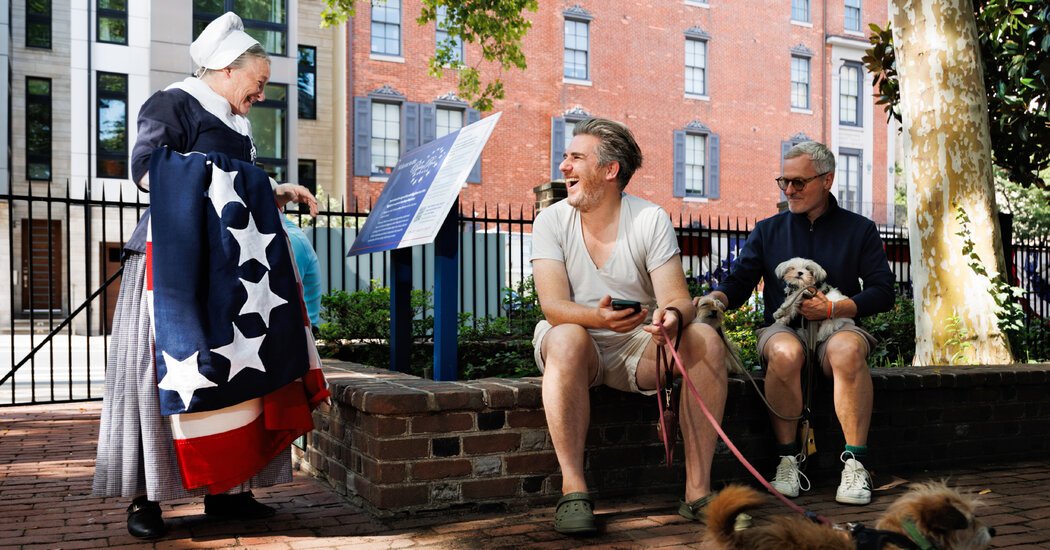
Between Independence Mall and the Delaware River Waterfront, Old City packs the nation’s origin story into a few walkable blocks — from the Liberty Bell and Independence Hall, where both the Declaration of Independence and Constitution were debated and adopted, to the Betsy Ross House, home of the flag’s reputed creator, though historians insist the maker of the flag remains unknown. And after 50 years, a landmark has returned to the circuit. The First Bank of the United States reopened July 1, bringing visitors back inside the financial institution first championed by Alexander Hamilton. Nearby, the Museum of the American Revolution ($25) houses Washington’s war tent and “The Declaration’s Journey,” a current exhibition tracing the document’s influence through artifacts including Martin Luther King Jr.’s Birmingham Jail bench and the suffragist Elizabeth Cady Stanton’s desk.
12 p.m. Crawl the market for roast pork and soft pretzels
Come lunchtime, the place to be is the 133-year-old Reading Terminal Market, just west of Old City. Snake through bustling aisles lined with more than 80 merchants selling everything from Pennsylvania Dutch doughnuts to Peking duck and Georgian khachapuri. Queue at DiNic’s crowded counter for Philly’s other essential sandwich: roast pork piled high with sharp provolone and garlicky broccoli rabe ($18). Add a hand-rolled soft pretzel from Miller’s Twist ($3.75) and scoops of butterscotch swirl or matcha from Bassetts Ice Cream ($7.25), an original market vendor since 1893. If only a cheesesteak will do, head to Uncle Gus’ Steaks for frizzled ribeye and melted Cooper Sharp tucked into a seeded roll ($17).
2 p.m. See the city from Billy Penn’s perch
For most of the 20th century, a gentleman’s agreement held that no building in Philadelphia rose higher than the brim of William Penn’s hat — the 37-foot bronze likeness of the city’s founder that stands atop City Hall. Opened in 1901, the ornate behemoth in Center City, built in the style of the Second Empire, remains a showstopper today. The tower tour ($16) sends you up in the original elevator to an observation deck with 360-degree views of the city. Cast your eye over the 2,000-acre Fairmount Park stretching northwest and, due east, to the Benjamin Franklin Bridge, which this year celebrates its own centennial. Then tilt your head back for a close-up of Penn himself.
4 p.m. See what’s new in an old neighborhood
From City Hall, it’s about a 10-minute drive down to Queen Village, one of Philadelphia’s oldest residential neighborhoods — and now an eclectic showcase for independent shops, pocket parks and public art from Mural Arts Philadelphia. Fabric Row, a stretch of Fourth Street, is home to two standout vintage stops: Ace Outpost, where worn-in denim and concert tees share space with a cafe counter, and Moore Vintage Archive, featuring a collection of rare designer finds. On the same blocks, pick up glossy bonbons at Good Good Chocolates ($4) or a scoop of brown butter pecan at Cuzzy’s Ice Cream ($6), then take your treats to Mario Lanza Park, where Kien Nguyen’s mural “Prism” brightens the community green space.
6 p.m. Feast in South Philly
Once synonymous with red-gravy joints, the culinary landscape of South Philly now tells a broader story, with chapters written by more recent immigrants from Latin America and Southeast Asia. Start on East Passyunk Avenue at Sao, a raw bar from the team behind the beloved Cambodian noodle house Mawn, for aged hamachi crudo dressed in coconut cream, torn lime leaves and crushed peanuts ($27). A mile north, in the Italian Market, the homey Mexican restaurant Blue Corn uses corn grown in Puebla for its housemade tortillas. And the area’s Italian-American legacy endures at spots like Bomb Bomb Bar, a recently revived 90-year-old corner haunt, which in 1936 was in fact bombed twice by a neighborhood rival. Order abundantly from the seafood-focused menu, which includes dishes like clams casino and “mom’s stuffed calamari,” laden with breadcrumbs and Pecorino Romano (prix fixe, $62).
9 p.m. Drink in the city’s wine boom
Pennsylvania’s tightly controlled liquor system has long capped restaurant liquor licenses, making them scarce and expensive and helping to turn Philly into a B.Y.O.B. town. But thanks to recent incremental licensing changes — and the determination of a few entrepreneurs — the city’s wine scene has slowly matured. In Fishtown, fermentation tanks line the back room of Mural City Cellars, a bar and bottle shop in a former auto body garage, turning regionally sourced grapes into low-intervention wines (glasses from $11; bottles from $20). Nearby, Pray Tell Wines brings the Oregon-born cult label to Philadelphia. Closer to dinner, sink into one of the sunny yellow banquettes at Supérette, a French-inspired épicerie and bar from the owner of fellow wine bars Le Caveau and Superfolie — the house rosé ($10) and grower Champagne ($18) are easy, tasty choices.
About The Author