How can people possibly afford to live in one of the most expensive cities on the planet? It’s a question New Yorkers hear a lot, often delivered with a mix of awe, pity and confusion.
We surveyed hundreds of New Yorkers about how they spend, splurge and save. We found that many people — rich, poor or somewhere in between — live life as a series of small calculations that add up to one big question: What makes living in New York worth it?
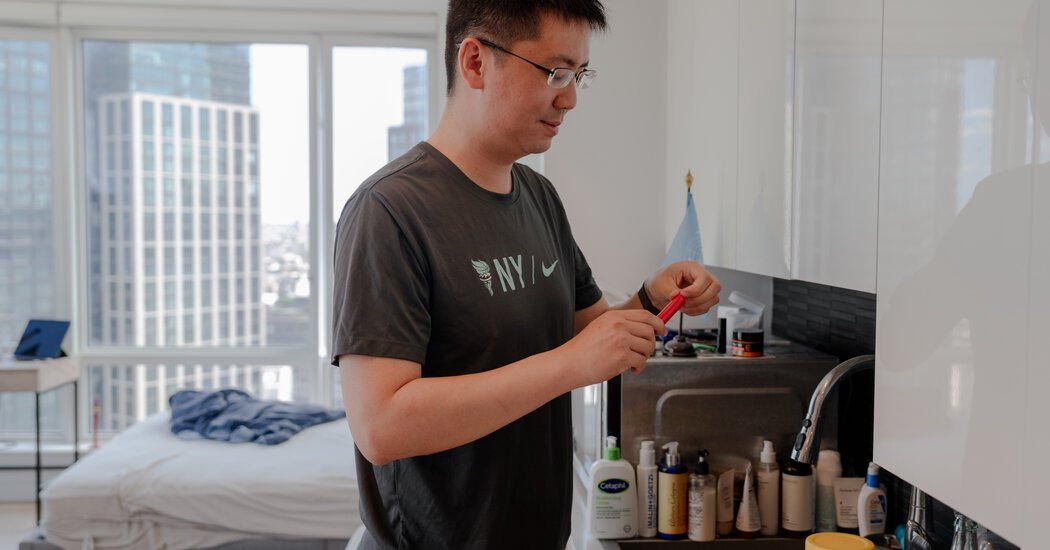
Weixun Hu enjoys what might sound like the ultimate professional perk. New Yorkers pay some of the country’s highest taxes on their income, more than $12,000 on average per person between state and local governments. But Mr. Hu’s income tax this year? $0.
That’s because Mr. Hu, 32, who was born in Guangzhou, China, conducts social development research at an international organization, where most employees are exempt from national income taxes or reimbursed for the cost. His gross and net income are one in the same; he earns roughly $110,000 after his insurance and pension contributions.
Mr. Hu became one of New York City’s 3.1 million foreign-born residents nearly three years ago, after reassignment from a post in Bangkok in the summer of 2023. But he quickly ran into a hurdle: finding an apartment with no credit history, no tax returns and no one to co-sign a lease.
“It sounds very cool that you don’t pay taxes,” Mr. Hu said. “It also creates a lot of problems.”
He discovered that many of his co-workers landed in a handful of pricey residential developments including Stuyvesant Town. Yet renting there felt worlds apart from Thailand’s capital city, where a luxury studio in a high-rise condo with a rooftop infinity pool and premium gym might run $600 per month.
So he found a studio in Long Island City, Queens, where he has in-unit laundry and falls asleep to the sound of waves hitting the shore near Hunters Point South. His employer subsidizes $700 of his $3,900 rent, and utilities and internet cost about $150 monthly.
“It’s much better value compared to renting in Manhattan,” he said.
Saving for Tomorrow
A good deal of young adults in New York City don’t know how to drive, and expect to remain renters for most of their lives. Not Mr. Hu.
He puts away $2,000 or so a month into a high-yield savings account, aspiring to buy a car. His sights are set on a Mazda CX-5. But he expects he’ll need to pay upfront in cash, another consequence of lacking a credit or tax history — and it’ll take about three more years to build up enough.
Eventually, he wants to own a home. “I know most people in New York City don’t care,” he said. “But for me, it’s very important.”
Mr. Hu also supports his parents in their retirement, sending about $3,000 every three months. As their only child, he feels both a sense of guilt for living about 8,000 miles from home — and an obligation to pay them back for their sacrifices.
“People will say, ‘Oh, you’re single. You don’t have a wife. You don’t have kids,’” he said. “‘So all your money is yours.’”
“And I’m like, ‘Excuse me, my parents are still alive.’”
In other ways, though, Mr. Hu fits the profile of an everyday bachelor: He rarely cooks meals at home. “My oven is basically storage space.”
Rather, he searches for affordable deals on Too Good To Go, a popular app where restaurants sell excess food at a discounted price. His No. 1 spot is Chinese Musician in Greenpoint, which offers a three-course meal for $9.
Sometimes, Mr. Hu does the $16 tonkotsu ramen at Nishida Sho-ten on 49th Street for lunch, an $8 lamb over rice meal for dinner from the halal truck in front of Bellevue Hospital or a hot dog for $3.25 from Gray’s Papaya. He’ll swing by the Dollar General in Astoria to stock up on his favorite drink, Coca-Cola Orange Cream.
And he saves up for an upscale dining experience every couple of months. He recently feasted at the Michelin-starred chef Daniel Boulud’s steakhouse, La Tête d’Or, where he spent roughly $300 and ordered what he called the standout filet mignon.
The Lions Over the Knicks
For any sports buff, it’s an incredible time to live in New York City.
But for Mr. Hu, ticket prices to see the Knicks play at Madison Square Garden felt “a little bit off-putting” — and that was even before their championship run. So he started religiously following basketball at Columbia, going to games that often run $10 to $12 on the Morningside Heights campus.
Yankees games, where a 400-level seat might run $45, are a no; he opts to watch the Columbia Lions up close at Robertson Field in Inwood without charge.
He is willing to spend up to about $300 on some singular sports showdowns. He can still recall how Kylian Mbappé flew down the field at MetLife Stadium during a Real Madrid match against Borussia Dortmund last summer.
Typically, though, he elects for low- or no-cost events like this spring’s edition of the Madison Avenue Gallery Walk.
And he regularly joins free lectures at the Asia Society, where he has a complimentary membership through his employer, and at local universities like N.Y.U., where he’s met the minds behind two of his favorite video games, The Elder Scrolls and Monument Valley.
A Sense of Wanderlust
Ever since Mr. Hu can recall, he’s felt a magnetic pull to experience the world. And few things embody such a yearning as aviation.
He sometimes goes to Canarsie to watch planes land at Kennedy International Airport, studying the way pilots pull up the nose of their aircrafts and slow the descent before touching down. He’s even found others who share his passion on walks in the neighborhood.
And traveling draws him even closer to his hobby.
He spent $4,400 on a trip to Guangzhou last June to fly for the first time in an Airbus A380, the only full-length double-deck aircraft in the world. Qatar Airways is one of the few airlines that still has an active fleet — so Mr. Hu arranged his trip by way of Doha.
“Some people treat it as bragging,” he said. “But no, it’s just to admire such an incredible machine that’s very rare to be seen these days.”
“It’s a weird, niche hobby, but I’m happy spending my money on it.”
As a young man living in his seventh country — after Belgium, China, Italy, Poland, Thailand and the United Kingdom — he appreciates that as “a foreigner in this city, you don’t have to worry about whether you stand out.”
He’s relished exploring from Crown Heights to Jackson Heights, taking the train to a random stop and popping into bodegas to chat up the owners. He considers Staten Island — and its Chinese Scholar’s Garden in Snug Harbor where adult admission costs $5 — to be a hidden gem.
And when he boarded the U.S.S. Bataan during a past Fleet Week, he felt obliged to tell a Marine that he was Chinese. “He said: ‘Oh, no worries at all. Everybody can be an American’.”
“To be honest, I still don’t think it’s a value option for the money,” Mr. Hu said of New York City. “But there’s something so unique, and I think it’s that inclusiveness.”
“You don’t need to go to the world,” he said. “The world comes to you.”
We are talking to New Yorkers about how they spend, splurge and save.
About The Author