The minister also alleged that politically motivated bank takeovers, large-scale loan scams, inflated costs of mega infrastructure projects, and legal protection for controversial measures such as quick rental power plants and capacity payments had contributed to widespread financial irregularities.
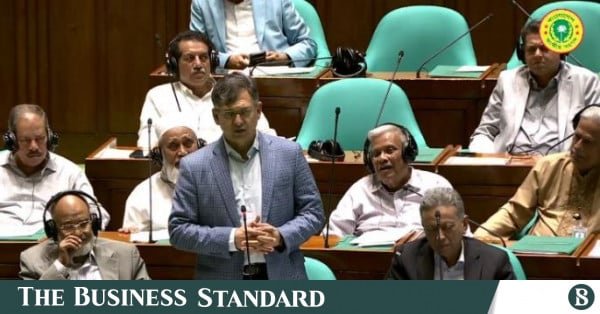
Home Minister Salahuddin Ahmed speaks at the parliament on 15 June 2026: Photo: BSS
“>

Home Minister Salahuddin Ahmed speaks at the parliament on 15 June 2026: Photo: BSS
Home Minister Salahuddin Ahmed yesterday (28 June) called on the prime minister to direct the Anti-Corruption Commission (ACC) to investigate all activities carried out during the interim government’s 18-month tenure, alongside alleged institutional corruption and money laundering under the previous administration.
Speaking during the general discussion on the proposed national budget for FY2026-27 in parliament, Salahuddin said an impartial investigation was needed to verify allegations of corruption raised in a recent report by Transparency International Bangladesh (TIB).
He said the TIB report alleged that high-level corruption had also taken place during the interim government’s tenure.

“The ACC should independently investigate where corruption occurred during those 18 months, how it happened, and who was involved,” he said, adding that the current government’s foundation rests on transparency.
Referring to the country’s economic situation under the previous government, Salahuddin cited the white paper prepared under the leadership of economist Debapriya Bhattacharya.
According to the report, Bangladesh witnessed the rise of a “loot-based economy” and crony capitalism between 2009 and 2024 due to the absence of democratic accountability.
He said the report estimated that an average of $16 billion was illicitly transferred abroad each year during that period, amounting to nearly Tk29-30 lakh crore in total.
The minister also alleged that politically motivated bank takeovers, large-scale loan scams, inflated costs of mega infrastructure projects, and legal protection for controversial measures such as quick rental power plants and capacity payments had contributed to widespread financial irregularities.
He further accused the previous administration of allowing large-scale money laundering through overseas recruitment businesses and distributing a significant share of social safety net benefits on political considerations rather than need.
Salahuddin said the government had formulated the proposed Tk9.37 lakh crore budget after overcoming the challenges of a fragile economy and 18 months of instability.
Despite global economic uncertainty and geopolitical tensions, he said the budget had been prepared on the basis of a “new economic order” with public welfare at its core.
He noted that the first cabinet meeting of the new government approved the waiver of outstanding agricultural loans of up to Tk10,000 for farmers.
Describing the proposed budget as one focused on boosting productivity, developing human resources and accelerating the country’s smart transformation, he said it prioritises state reform, equitable socio-economic development and economic recovery.
He also said Tk17,000 crore has been allocated for social safety net programmes, including Family Cards, Agriculture Cards, and support for imams and muezzins.
About The Author