He questioned how economic democratisation could be achieved without political democratisation, saying reforms in governance and state institutions were prerequisites for sustainable economic transformation.
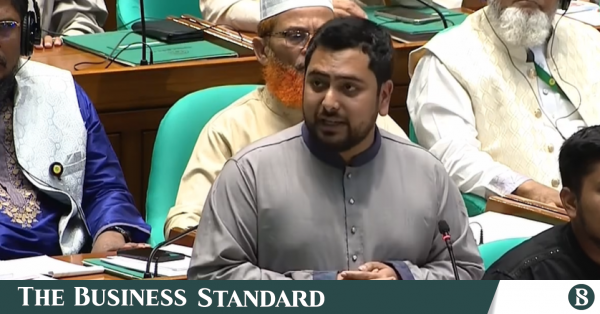
Nahid Islam speaks in parliament on 30 April 2026/ Screengrab
“>

Nahid Islam speaks in parliament on 30 April 2026/ Screengrab
National Citizen Party (NCP) lawmaker and Opposition Chief Whip Nahid Islam today (28 June) launched a scathing attack on the proposed national budget for FY2026-27, questioning the government’s commitment to reform and asking whether it would be wrong to describe the budget as “a document of deception”.
Participating in the general discussion on the proposed budget in the 13th Jatiya Sangsad, Nahid said the finance minister had spoken of economic democratisation, deregulation, economic recovery and reconstruction, but argued that such rhetoric had long featured in political discourse without being translated into meaningful action.
He questioned how economic democratisation could be achieved without political democratisation, saying reforms in governance and state institutions were prerequisites for sustainable economic transformation.

“How can you democratise the economy without democratising politics?” Nahid asked, adding that reforms to institutions such as the Anti-Corruption Commission, the judiciary and the constitutional framework, alongside implementation of the July Charter, were essential.
Referring to previous political commitments, he said the BNP had earlier presented its 31-point reform agenda and later signed the July Charter, while the home minister had admitted in parliament that the charter had been signed as part of an electoral compromise.
“In that context, how can we trust the government’s repeated promises?” he said.
Turning to financial governance, Nahid criticised the proposed amendments to the Bank Resolution Act, alleging that they would allow loan defaulters and individuals accused of siphoning money abroad to re-enter the financial system.
He said he saw little distinction between major loan defaulters, those involved in capital flight and those accused of committing mass killings during the July uprising, arguing that all should be held equally accountable.
The NCP leader proposed nationalising assets acquired through fraudulent loans and converting them into bonds to help stabilise the banking sector, saying recovered funds could be reinvested to restore financial stability.
Describing the budget as lacking a coherent development strategy, he said it failed to present a balanced framework for production, distribution, consumption and investment, and did not offer a credible roadmap for employment generation.
He also criticised alleged irregularities in the power sector under the previous administration, questioning agreements with foreign companies, including Adani and Summit, and calling for international investigations into major energy contracts to establish accountability for alleged corruption.
Referring to remarks by a government lawmaker that many people who once travelled by rickshaw now travelled by car, Nahid said he himself had been using a rented vehicle for security reasons but had been unable to pay the rental bill by the end of the month.
He further alleged that many BNP leaders had seen their wealth increase substantially even while imprisoned under the previous government, and questioned whether similar trends would continue under the current administration.
Nahid also claimed that many BNP leaders and activists, who had once been forced into hiding in rice and jute fields, had experienced significant changes in their lives after 5 August.
Calling for greater support for the July Foundation, established after the mass uprising, he said the organisation was struggling due to a lack of funding.
He also referred to reports alleging that some within the government were obstructing the establishment of the July Mass Uprising Museum, adding that he hoped those reports were untrue.
On governance, Nahid argued that mega projects and large-scale development programmes had historically created opportunities for corruption involving bureaucrats, politicians and business interests.
He said only the implementation of the July Charter and a referendum on reforms could ensure accountability.
He also raised concerns over recent border killings and alleged push-in incidents involving Indian border forces, claiming that around 10 Bangladeshis had recently been killed and saying the matter deserved parliamentary discussion.
Nahid urged stronger cooperation from the BNP on border security issues and called on the government to take a firmer stance.
Referring to recent political developments in India, he criticised remarks by West Bengal politician Suvendu Adhikari and called for a strong diplomatic response from Bangladesh.
He also urged the government to pursue a principled foreign policy based on equality and mutual respect in its relations with neighbouring countries, including India.
Nahid further said the new Indian High Commissioner to Bangladesh, Dinesh Trivedi, should have apologised upon his arrival for what he described as India’s support for the previous Awami League government and its alleged political interference over the past 16 years.
About The Author