Energy Division forms committee to assess fallout of shortfall and is aggressively exploring alternative LNG sources.
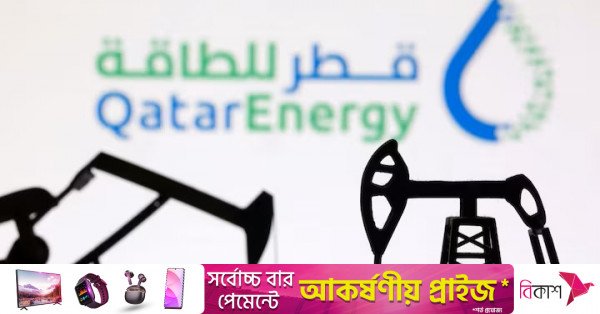
3D-printed oil pump jacks and the QatarEnergy logo appear in this illustration taken March 2, 2026. Photo: Reuters
“>

3D-printed oil pump jacks and the QatarEnergy logo appear in this illustration taken March 2, 2026. Photo: Reuters
Infograph: TBS
“>

Infograph: TBS
Bangladesh’s largest liquefied natural gas (LNG) supplier, QatarEnergy, has warned that it may deliver only half of its contracted LNG cargoes in 2026, putting future long-term energy supply at fresh risk even if the Strait of Hormuz remains open.
The state-owned Qatari giant indicated that the supply crunch is subject to production resuming after recent Middle East conflict disruptions, and cautioned that the lower delivery levels could persist for the next three to five years.
The disclosure was made via an email sent earlier this month to the Rupantarita Prakritik Gas Company Limited (RPGCL), a subsidiary of Petrobangla. The notification did not specify a timeline for when full, long-term supplies would resume.
The supply cut is poised to slash Bangladesh’s scheduled 2026 deliveries from QatarEnergy from 40 cargoes down to 20. This deficit severely impacts the country’s energy outlook, as the missing shipments were originally expected to account for 34.8% of Bangladesh’s total planned LNG imports of 115 cargoes for the year.

The disruption follows missile attacks on QatarEnergy’s production facilities during the recent US-Iran conflict. The attacks prompted the energy giant to invoke force majeure—a contractual clause that frees parties from liability when extraordinary, uncontrollable events such as war render fulfillment impossible. Following the outbreak of the US-Iran war on 28 February and the subsequent closure of the Strait of Hormuz, QatarEnergy became the first long-term supplier to declare force majeure on 2 March.
Speaking to The Business Standard on Wednesday, Energy Secretary Mohammad Saiful Islam confirmed the development:
“We have received an email about the reduced supply of LNG cargoes from QatarEnergy for 2026. QatarEnergy informed us that it will be able to deliver at best 50% of the earlier scheduled cargoes in 2026.”
He added that Dhaka is actively negotiating with Doha, noting, “We are in contact with QatarEnergy to discuss the issue. Apart from this, QatarEnergy also indicated that the reduced supply might continue till 2027 and beyond.”
To mitigate the impending energy crisis, the Energy Division has formed a committee to assess the fallout of the shortfall and is aggressively exploring alternative LNG sources outside the Middle East.
Oman-based OQT followed on 5 March, while US-based Excelerate Energy declared force majeure on 6 March.
According to Petrobangla, the force majeure declared by QatarEnergy has been extended until 16 July, forcing Bangladesh to rely heavily on the spot LNG market.
A Petrobangla official, requesting anonymity, said QatarEnergy had also informed RPGCL that even after production resumes, future deliveries would remain subject to periodic assessment and negotiation.
The Energy Division said it will try to ensure at least 80% of the earlier planned cargo from QatarEnergy.
“Although QatarEnergy has said it may supply at best 50% of its committed LNG volumes in 2026, we will negotiate to secure the full committed quantity. If that is not possible, we will push for at least 80% of the committed volume,” an RPGCL official said, requesting anonymity.
LNG subsidy nearly triples
The fallout from the Iran war has pushed Bangladesh’s LNG subsidy burden to Tk16,600 crore, nearly three times the original allocation of Tk6,000 crore for fiscal 2025-26, as the government was forced to rely heavily on costly spot market purchases.
“The Iran war cost us an additional Tk10,600 crore as most long-term suppliers have maintained force majeure since March, forcing us to rely on expensive spot purchases,” AKM Mizanur Rahman, director (finance) of Petrobangla, told this newspaper recently.
The disruptions also affected some short-term contracts because their loading ports and shipping routes were linked to Qatar and the Strait of Hormuz.
Supply uncertainty deepens
According to the Annual Delivery Plan 2026, Bangladesh was to import 115 LNG cargoes in 2026.
Of those, QatarEnergy was scheduled to supply 40 cargoes, OQT 16 cargoes, QatarEnergy Trading 12 cargoes, OQ Trading LLC four cargoes and Excelerate Gas Marketing 14 cargoes. Another 12 cargoes were expected under short-term contracts and 17 cargoes from the spot market.
Petrobangla data show that QatarEnergy delivered only eight cargoes between January and the first week of March this year before supply disruptions began following the Iran war.
Following the conflict, nine cargoes scheduled between April and June were placed under force majeure by QatarEnergy.
Even if long-term supplies resume from August, Bangladesh may receive at best 12 cargoes out of the 18 cargoes originally scheduled for the August-December period, officials said, if QatarEnergy goes with the latest plan of reduced supply.
Even after a ceasefire agreement between the US and Iran on 17 June, an explosion occurred at QatarEnergy’s Ras Laffan LNG complex on 22 June, killing 13 people and injuring dozens. Officials said the incident may further delay the resumption of its LNG production.
Apart from the possible reduction in QatarEnergy’s deliveries, continued force majeure declarations by LNG traders OQ Trading Ltd and Excelerate Gas Marketing have raised fresh concerns among policymakers.
Energy Secretary Saiful questioned the justification for the traders’ continued suspension of supplies.
“These companies are essentially resellers. They buy LNG from producers and sell it to Bangladesh. Enforcing force majeure during the closure of Hormuz was understandable, but maintaining it after the waterway has reopened is difficult to justify as no production facilities of their own were attacked,” he added.
Committee formed
To address the dual challenge of reduced supplies from long-term contracts and continued enforcement of force majeure by traders, Petrobangla has formed a five-member committee headed by Energy Division Joint Secretary (Development Wing) Hayat Md Feroze last week.
The committee has been tasked with reviewing force majeure provisions under both long-term and short-term LNG contracts and submitting its findings within seven days. The committee held its first meeting on Wednesday.
Officials said the committee will examine whether contracts with suppliers currently invoking force majeure can be amended or terminated and whether alternative procurement mechanisms can be used to reduce reliance on the volatile spot market.
Traders continue force majeure
Bangladesh’s LNG supply concerns do not end with QatarEnergy.
The continued force majeure declarations by LNG traders like OQ Trading Ltd and Excelerate Gas Marketing Limited have further complicated efforts to secure adequate gas supplies.
Energy Division officials said force majeure was understandable during the closure of the Strait of Hormuz because the traders were dependent on LNG loaded from Qatar’s Ras Laffan Port.
However, officials argued that the contracts also allow deliveries from alternative loading ports outside the Gulf region.
In its latest communication with RPGCL, Excelerate said it would not be able to supply LNG until deliveries from Ras Laffan resume.
OQ Trading has also remained reluctant to provide a firm answer on when supplies under its contract will resume.
According to Energy Division sources, both Excelerate and OQ Trading identified Ras Laffan as the designated loading port in their delivery plans.
The suppliers now argue that because Ras Laffan was specified as the loading point, they are entitled to suspend deliveries until Ras Laffan resumes delivery to them.
However, another official noted that the agreements also contain provisions allowing LNG deliveries from other locations out of Ras Laffan, raising questions about the legality of the continued force majeure claims.
Bangladesh explores short-term LNG deals
To offset the looming supply shortfall, Bangladesh is exploring short-term LNG procurement agreements with suppliers from non-traditional markets across South-Eastern Asia, Central Asia and Africa and the Oceania region.
Countries under consideration include Australia, Brunei, Indonesia, Malaysia, Azerbaijan, Kazakhstan, Angola, Nigeria and Algeria.
“As part of our source diversification strategy and efforts to reduce dependence on Middle Eastern suppliers, we are looking at countries in Central Asia and Africa and the Southeast Asian region,” Saiful said.
He added, “We are considering short-term supply agreements instead of relying solely on the spot market to fill the void created by supply constraints by term suppliers. Compared to spot purchases, short-term contracts expose us to less price volatility.”
Bangladesh already has an energy cooperation memorandum of understanding with Malaysia, which officials believe could facilitate LNG imports from the Southeast Asian nation too.
About The Author