The state minister urged city dwellers to regularly remove stagnant water from their homes, rooftops, yards and flower pots, saying public awareness remains the most effective way to prevent dengue.
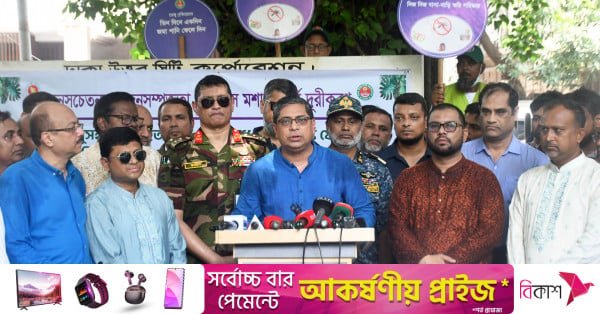
State Minister for Local Government, Rural Development and Cooperatives Mir Shahe Alam today (26 June) spoke at the capital’s Banani. Photo: BSS
“>

State Minister for Local Government, Rural Development and Cooperatives Mir Shahe Alam today (26 June) spoke at the capital’s Banani. Photo: BSS
State Minister for Local Government, Rural Development and Cooperatives Mir Shahe Alam today (26 June) said the government’s objective is not to punish people through fines or imprisonment, but to protect lives by building dengue-free cities through greater public awareness and participation.
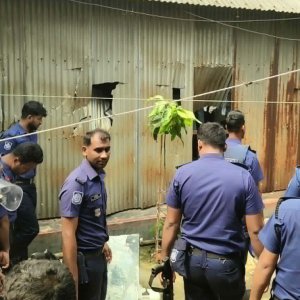
He made the remarks while inspecting an Aedes mosquito larva detection and elimination drive conducted on Roads 18, 21 and 24 in the capital’s Banani area under the initiative of the nationwide mosquito-borne disease prevention task force.
The state minister urged city dwellers to regularly remove stagnant water from their homes, rooftops, yards and flower pots, saying public awareness remains the most effective way to prevent dengue.

“If citizens remain vigilant and regularly clean places where water accumulates, dengue can largely be prevented,” he said, calling on people to ensure that flower pots, coconut shells, paint cans and other containers do not retain water.
Mir Shahe Alam said the government is working with the support of residents to make Dhaka dengue-free. He also informed that mosquito larva-killing tablets are available free of cost at regional and ward offices of the Dhaka North City Corporation (DNCC), urging citizens to collect and use them to destroy mosquito breeding sites.
He called on journalists to intensify awareness campaigns through electronic, print, online and social media to help prevent the spread of dengue and other mosquito-borne diseases.
The state minister also requested the Real Estate and Housing Association of Bangladesh (REHAB) to instruct its members to maintain cleanliness at under-construction and residential buildings.
Replying to a question from reporters, he said the ministry would take necessary measures to ensure similar preventive actions at government residential quarters.
Speaking after the inspection, DNCC Chief Health Officer Brigadier General Imrul Kayes said it would not be possible for the city corporation alone to eliminate dengue unless residents actively cooperate.
He said the city corporation is carrying out regular mosquito control operations, including insecticide spraying, cleanliness drives and Aedes larva destruction at houses, commercial establishments and estaurants.
A three-month special monsoon campaign is also underway to promote household cleanliness and raise awareness among residents, he added.
Imrul Kayes said Aedes mosquito larvae were found in nearly 50 percent of the government quarters and surrounding houses inspected during a three-day drive in Banani, indicating the need for stronger public awareness.
During today’s operation, DNCC Executive Magistrate Marufa Akter Neli fined the authorities of an under-construction residential building on Road 24 in Banani Tk 50,000 after Aedes larvae were found on the premises. In default of payment, a three-month jail sentence was ordered.
As part of the campaign, awareness activities, including loudspeaker announcements and the distribution of leaflets and stickers, were carried out among local residents to discourage mosquito breeding.
The state minister also exchanged views with city corporation sanitation workers and thanked them for their dedicated efforts in controlling dengue.
DNCC Chief Executive Officer Muhammad Asaduzzaman, Chief Waste Management Officer Commodore Mohammad Humayun Kabir, Regional Health Officer Dr Azijun Nesa, officials of the Local Government Division and representatives of Banani Society, among others, were present during the inspection.
About The Author