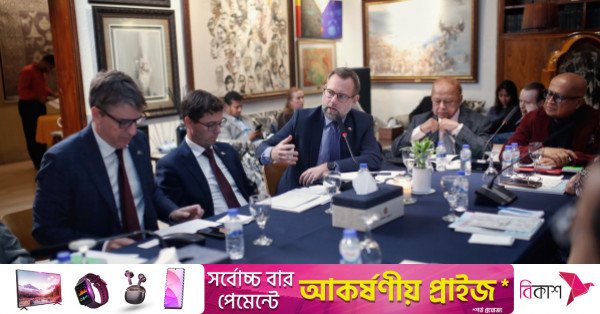
Ambassadors of Denmark, Norway, and Sweden emphasise the importance of achieving sustainable prosperity through joint efforts and strengthened collaboration.
Cosmos Foundation, the philanthropic arm of the Cosmos Group, hosted the symposium titled “Bangladesh and Nordic Countries: Prognosis for Partnership” as part of its ongoing Ambassadors’ Lecture Series. Photo: UNB
“>

Cosmos Foundation, the philanthropic arm of the Cosmos Group, hosted the symposium titled “Bangladesh and Nordic Countries: Prognosis for Partnership” as part of its ongoing Ambassadors’ Lecture Series. Photo: UNB
Denmark, Norway, and Sweden, three longstanding friends of Bangladesh, have reaffirmed their commitment to working closely with Bangladesh as it embarks on its next chapter, supporting its aspirations to become greener, more innovative, trusted, and prosperous through a stronger and more sustainable partnership that unlocks new avenues for cooperation across key sectors.
Danish Ambassador to Bangladesh Christian Brix Moller, Norwegian Ambassador to Bangladesh Hakon Arald Gulbrandsen, and Swedish Ambassador to Bangladesh Nicolas Weeks came together at a symposium yesterday (22 June) to share their perspectives, emphasising the importance of achieving sustainable prosperity through joint efforts and strengthened collaboration.
Issues such as trust, strong institutions, green growth, workers’ rights, trade, investment, technology, gradual reconciliation, and long-term post-transition stability featured in the discussion as key pillars of a partnership aimed at achieving sustainable prosperity.

Cosmos Foundation, the philanthropic arm of the Cosmos Group, hosted the symposium titled “Bangladesh and Nordic Countries: Prognosis for Partnership” as part of its ongoing Ambassadors’ Lecture Series.
Cosmos Foundation, the philanthropic arm of the Cosmos Group, hosted the symposium titled “Bangladesh and Nordic Countries: Prognosis for Partnership” as part of its ongoing Ambassadors’ Lecture Series. Photo: UNB
“>

Cosmos Foundation, the philanthropic arm of the Cosmos Group, hosted the symposium titled “Bangladesh and Nordic Countries: Prognosis for Partnership” as part of its ongoing Ambassadors’ Lecture Series. Photo: UNB
The symposium was chaired and conducted by renowned scholar and Cosmos Foundation President Iftekhar Ahmed Chowdhury. Cosmos Foundation Chairman Enayetullah Khan delivered the welcome remarks, while Catherine Grace Gardner Khan made the formal announcement of the event with her brief remarks.
Enayetullah Khan said the Nordic countries offer enormous expertise in green technology, digital governance, innovation, sustainable urban planning, renewable energy, and the circular economy. “Together we possess complementary strengths that can create shared prosperity,” he said.
Looking ahead, Khan suggested five priority areas – green energy partnerships; sustainable textile and circular fashion; digital transformation and smart governance; climate adaptation and blue economy initiatives; and innovative and knowledge partnerships – for future Bangladesh-Nordic cooperation.
“Such initiatives would not only strengthen bilateral cooperation but also contribute to addressing global challenges of climate change, sustainable development, and inclusive growth,” he said.
Iftekhar said the Bangladesh-Nordic narrative has moved from a donor-recipient hierarchy to a peer-to-peer alliance.
“As Bangladesh builds on its smart knowledge vision, the Nordics can provide the hardware of sustainability and good governance. In return, Bangladesh can open a dynamic market and a frontline perspective on climate survival,” he said, adding: “Let us seize this moment to build a partnership that is not transactional, but transformational.”
Iftekhar said the way forward is knowledge transfer. “Instead of traditional grants, we should perhaps advocate for green joint venture funds, student exchange programmes in renewable technology, and technology-sharing agreements for waste management.”
Danish Ambassador Christian Brix Moller said Bangladesh has already surprised the world, transforming itself from one of the poorest countries on earth into one of Asia’s most dynamic economies.
“The next chapter is harder, but also more exciting. Can Bangladesh become greener, more innovative, more trusted and more prosperous? I believe it can. And Denmark intends to be part of that journey – not standing on the sidelines, not preaching, but investing, building and partnering,” he said, noting that real partners invest in each other.
Cosmos Foundation, the philanthropic arm of the Cosmos Group, hosted the symposium titled “Bangladesh and Nordic Countries: Prognosis for Partnership” as part of its ongoing Ambassadors’ Lecture Series. Photo: UNB
“>

Cosmos Foundation, the philanthropic arm of the Cosmos Group, hosted the symposium titled “Bangladesh and Nordic Countries: Prognosis for Partnership” as part of its ongoing Ambassadors’ Lecture Series. Photo: UNB
The Danish Ambassador said Bangladesh’s success matters to Denmark and Denmark’s success increasingly depends on partners like Bangladesh.
“When a partner like Bangladesh succeeds, Denmark succeeds too. That is what partnership looks like. And that is what sustainable prosperity means,” he said, highlighting that the next chapter is about partnership for sustainable prosperity.
Norwegian Ambassador Hakon Arald Gulbrandsen said there are a few key things an international investor, including Nordic investors, will look for, and chief among these is competitiveness in infrastructure, skilled manpower, and bureaucratic efficiency, fairness and predictability.
He said the credibility of the state and government organs and institutions like high political offices, the judiciary, bureaucracy, financial services institutions, police, and other forces will have to be rebuilt for efficiency and impartiality.
The Ambassador said long-term post-transition stability is now essential for Bangladesh and its people for their broader well-being and development of the country, following the successful election in February this year.
“Gradually, if not rapidly, reconciliation will also be necessary. All the political and social sides should come forward for that,” he said, noting that it is, of course, up to the internal politics and politicians of Bangladesh to decide.
Highlighting relations with Bangladesh, Swedish Ambassador Nicolas Weeks said they will continue to grow in collaboration with Bangladesh.
Talking about LDC graduation, he said it brings real opportunities, although challenging. “It does bring real opportunities where Bangladesh can excel in being one of the more investor-friendly countries.”
“We need collaboration with Bangladeshi counterparts and we need to work on a system where production can be more sustainable,” he said.
The Swedish Ambassador said they should work hand in hand in achieving the diversification of the Bangladesh economy.
“We see tremendous opportunities here. You’re in a very strategic location. You have a large educated workforce. So Bangladesh should have everything going for itself,” he said, adding that they want to continue working together strategically.
Barrister Ahmad Bin Quasem Arman, MP, Director General of the Bangladesh Institute of International and Strategic Studies (BIISS) Major General A S M Ridwanur Rahman, Prime Minister’s Speechwriter S A M Mahfuzur Rahman, Dean of the Bangladesh University of Professionals (BUP) Brigadier General Muhammad Ali Talukder, Professors of International Relations at the University of Dhaka Lailufar Yasmin and Delwar Hossain, Professor of Peace and Conflict Studies (PACS) at the University of Dhaka Sazzad Siddiqui, Senior Research Director at the Bangladesh Enterprise Institute (BEI) Faiz Sobhan, and Director of Incredible Fashions Ltd (IFL) Ashna Huq, Professor, Department of Management, AIUB, Mohammad Rafiqul Islam Talukder, and Chief Executive Officer of Mars & Co, Atif Ahmed Akkhor, among others, participated in the discussion.
About The Author