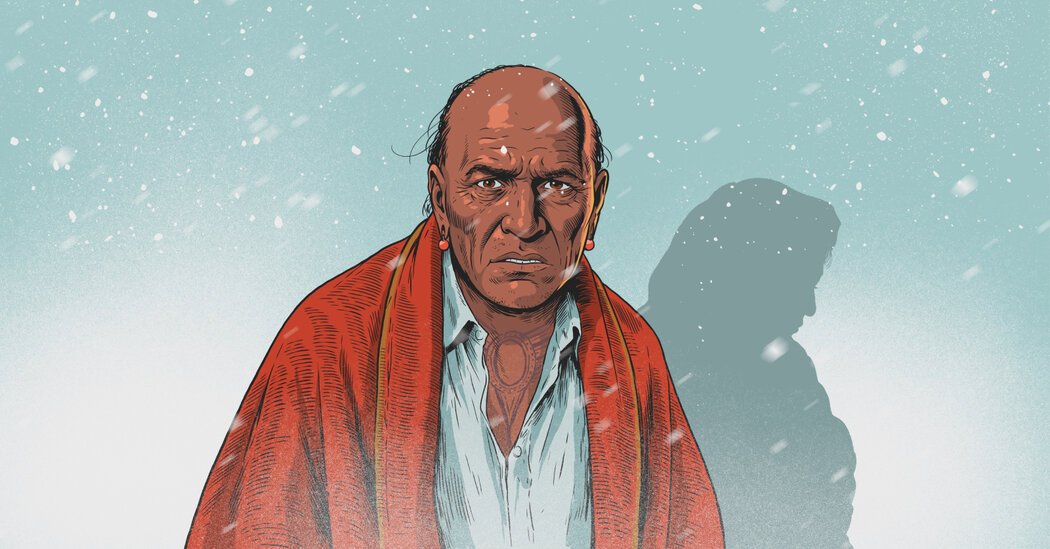
Good Peter’s journey into thickly populated New England had made clear to him that power now rested with common settlers — not with British officials, and not with Natives. Good Peter, then probably in his 40s, returned home successful in his request for a missionary to serve his town, Oquaga.
Located near present-day Binghamton, N.Y., Oquaga was in the midst of great changes. It had been founded and led by Oneidas, who were part of the Haudenosaunee (Iroquois) Confederacy, a powerful alliance with five other Native nations across New York: the Mohawk, Onondaga, Cayuga, Tuscarora and Seneca. Over the preceding decades, Oquaga had become a haven for Native peoples from as far away as North Carolina who were fleeing the results of colonial settlement: war, disease, game depletion and political strife.
Religion helped mediate the cultural differences at Oquaga. By the 1760s, most Oquagans were at least nominally Christian. Protestant Christianity had thrived there since the town received its first missionary in the 1740s. Good Peter and an older Oneida man named Isaac Dekayenensere, who had been among the first converts, were leaders in the local congregation, which had operated mostly independent of white supervision since its establishment. Good Peter was also the schoolmaster.
But tensions that echoed the conflict between Britain and its colonies were brewing between the two men. Land was one issue. In a treaty with the Crown in 1768, the Haudenosaunee accepted a settlement boundary that ran perilously close to the town. Isaac believed the British would protect Oquaga going forward. His trust in the British may have been partly due to familial connections. His daughter had married the Mohawk leader known as Joseph Brant, who was close to the British superintendent for Indian affairs, Sir William Johnson. A large number of Mohawks were moving to Oquaga, and they remained loyal to Johnson.
Another cause of tension was religious. Good Peter was more deeply affected by a general spirit of dissent that was spreading through the colonies. His visit to Connecticut had strengthened his relationship with New England’s radical Calvinists. They were critical of the Church of England, whose emphasis on ceremony smacked of Roman Catholicism, which they regarded as wicked. To Good Peter’s dismay, the Mohawks arriving at Oquaga were accustomed to Church of England practices, including more relaxed standards for baptism into the faith. While Isaac supported these standards, Good Peter was left to wonder whether other British institutions were equally hollow.
The stakes of the politico-religious conflict at Oquaga rose with the outbreak of hostilities between colonists and Britain at Lexington and Concord in 1775. The patriots already had a healthy fear of the British military. That fear tipped into panic when they considered the possibility that Britain might recruit Native allies. This raised the prospect of a second, possibly decisive front against the patriots to the west.
The Haudenosaunee initially declared neutrality, but every village, and even every individual, retained the right to follow their own judgment. Eventually, most Mohawks, Onondagas, Cayugas and Senecas would side with Britain. Good Peter would help convince the majority of Oneidas and Tuscaroras to cast their lot with the patriots.
In 1776, as the Mohawk contingent at Oquaga continued to grow, strengthening pro-British sentiment there, Good Peter decided to relocate northward to the Oneida Nation’s principal town, Kanonwalohale, near Oneida Lake. There he could work alongside the Rev. Samuel Kirkland, a staunch Calvinist who spoke the Oneida language and who had traveled to Philadelphia to consult with the Second Continental Congress on Indian affairs. The Kanonwalohale Oneidas’ support for the patriots was driven by their familiarity with neighboring communities of colonial settlers. Proximity had fostered some close personal relations, along with the knowledge that the patriots would be fierce allies — and dangerous enemies.
Good Peter’s move to Kanonwalohale enhanced his status. By August, he had been elevated to the role of speaker for the warriors of the Oneida Nation. He was past fighting age, but the warriors wished to avail themselves of his advice and eloquence. At a council that month with the patriot general Philip Schuyler, Good Peter delivered a speech on behalf of Oneida and Tuscarora warriors in which he preemptively absolved the patriots for any harm they might inflict upon Native warriors who fought them.
Oneida warriors displayed their utility as fighters the next year. Sixty Oneidas marched with the local militia in an attempt to relieve Fort Stanwix, only 12 miles from Kanonwalohale. They lost an unknown number of fighters in the ensuing Battle of Oriskany. It was one of the bloodier encounters of the war, and one of great significance. Britain’s Northern campaign that year involved a two-pronged invasion from Canada, and Oriskany contributed to the collapse of the western incursion. The month after, Oneida warriors traveled east to the Hudson River, where they harried the British Army at Saratoga and helped force the British commander, Gen. John Burgoyne, to surrender there in October 1777. Good Peter sent a congratulatory message to the victorious Gen. Horatio Gates on behalf of the Oneida warriors, and it was printed in The New-Jersey Gazette. The Oneidas continued to serve the patriots as scouts, spies and soldiers for the duration of the war, earning praise and 10 officers’ commissions from Congress.
Beginning in 1777, Joseph Brant had used Oquaga as a base from which to attack patriot settlements. The patriots retaliated in October 1778 by destroying the town. They left one house standing, which, according to a colonel’s report, belonged “to a friend Indian” — probably Good Peter. Identifying Good Peter as “a steady and sincere Friend to the thirteen united States of America,” an Indian affairs commissioner named Volkert Douw empowered him to recruit refugees from Oquaga who were sympathetic to the patriot cause, and requested protection for anyone Good Peter vouched for.
Destroying Oquaga did not stop the raids by hostile Haudenosaunee, however, and in 1779, under significant public pressure, Gen. George Washington devoted a significant portion of the Continental Army to destroying more than 40 Haudenosaunee settlements, including some inhabited by neutrals. The patriots had initially concealed their plans from the Oneidas, predicting their disapproval. The Haudenosaunee lost homes and fields and orchards to the patriot torch but suffered few casualties and took refuge at British Fort Niagara.
The patriots had intended to cow the Haudenosaunee into submission, but the campaign only deepened Haudenosaunee alienation without constraining their capacity to strike. So in January 1780, General Schuyler met in Albany with a pair of neutral Mohawks, Little Abraham and Johannes Crine. Hoping their diplomacy could achieve what patriot arms had not, Schuyler endorsed their proposal that the Haudenosaunee abandon the British in exchange for a cessation of patriot hostilities.
Little Abraham and Crine set out to carry the proposal to Fort Niagara. Stopping en route at Kanonwalohale, they met with the Oneidas, who agreed to support the effort and designated Good Peter as one of their emissaries. Good Peter said that “he did not expect to be requested to go to his Enemies,” but pledged to go and “do every thing for the good of his Country.” Along with another older chief warrior, Skenandon, Good Peter once again donned his snowshoes.
The four men endured terrible cold and snow on the 200-mile trek to Fort Niagara. Their reception proved even colder. A formal council was held several days after their arrival. Good Peter and the others delivered speeches and presented gifts, including belts made of wampum, or beads made from shells, that certified the sincerity and import of their words. Their overtures were rejected, and the belts returned with contempt.
The commander at Fort Niagara, Guy Johnson, viewed Good Peter and the other emissaries with concern. If they stayed, they might yet breed subversion; if they returned home, they could convey intelligence about the fort. Johnson ordered the four men placed in irons and confined to a space ominously called the “black hole.” Despite the objection of some of the Haudenosaunee to such harsh treatment, this imprisonment lasted up to five months. “Our Confinement was long and rigourous,” Good Peter later recalled, but he withstood it by “trusting in the Great Spirit for his Assistance.” His companions did not fare as well: One of Skenandon’s descendants recalled that “he was sore & stiff with the severities of his wretched confinement, in chains.” Little Abraham died in prison, most likely as a result of his treatment.
In 1780, Britain shifted its focus to the South. Good Peter and Skenandon were released from the black hole, but occasional raids and rumors of patriot attacks were enough to justify keeping the two men close. The British, understanding both men’s value to the patriots, saw them as bargaining chips. They remanded them to the custody of their Haudenosaunee allies.
When news of the peace terms between the British and the United States finally became known in 1783, Good Peter was vindicated in his lack of faith in Britain. The British had negotiated no protections for their Native allies. They also relinquished all their claims to territory south of Canada as far west as the Mississippi River. Appeasing the United States helped Britain’s commerce and disrupted French expectations of a preferential relationship with its wartime ally. The Haudenosaunee were stunned by Britain’s apparent diplomatic collapse. Even British officers expressed consternation at the outcome. Sir Frederick Haldimand, the governor of Quebec, wrote to a confidant: “I am heartily ashamed, and wish I was in the interior of Tartary.”
The disorganization of Congress delayed peace negotiations with the Haudenosaunee, extending the emissaries’ captivity into 1784. The United States and the Haudenosaunee finally met at Fort Stanwix in October. One of the initial demands made by the U.S. treaty commissioners was that Good Peter, Skenandon and Crine be released — almost five years after their seizure.
The U.S. commissioners angered the Haudenosaunee by asserting that the United States was “the sole sovereigns” of all the land east of the Mississippi. Most of that land had never been ceded to Britain — it had only ever been under Native control. The United States also demanded a swath of territory along the Niagara River and the relinquishment of all Haudenosaunee claims to lands to the south and west of New York.
Toward the Oneidas and the Tuscaroras, their allies, the U.S. commissioners adopted a friendlier stance. They observed that it did “not become the United States to forget those nations who preserved their faith to them,” so the Oneidas and the Tuscaroras would “be secured in the full and free enjoyment of those possessions.” The Oneida homeland seemed safe — for now.
Good Peter thought the end of the war would bring an end to the conflict between the Oneidas, the rest of the Confederacy and the settlers. He expected, in his own words, “to have sat down in Peace and enjoyed pleasant Days.” Things would not be so simple, however. The fledgling national government’s exclusive right to deal with Natives, as outlined in the Articles of Confederation and later the Constitution, were challenged by New York State and even some private citizens. The Oneidas soon found themselves confronted by competing suitors for their land, who gave them conflicting information as well as money and liquor. The result was an atmosphere of confusion and insecurity that lent itself to precipitous deal-making.
New York needed Haudenosaunee land to pay debts incurred during the war, and the state’s governor, George Clinton, exhibited few scruples in obtaining it. In June 1785, Clinton called the Oneidas to Fort Herkimer for a treaty with the state and demanded a large tract of land. Good Peter spoke for the Oneidas, countering Clinton’s demand with a proposal that reflected his desire to reconcile competing interests. The Oneidas would lease a tract to New York for the benefit of “any poor people of his State, who had no lands,” as he later recalled. There was precedent for such an arrangement in both cultures. The solution of paying to rent Native land was obvious, equitable — and immediately rejected. In the grand scheme of Native-settler relations, Good Peter’s offer represents a road not taken.
An incredulous Clinton deemed the proposal “dishonourable” because it “would make the Government of the State tributary to You.” In response, he raised the specter of a settler invasion of Oneida lands. Good Peter withdrew as the Oneidas’ negotiator, and the meeting ended with the Oneidas’ trying to appease the governor by ceding about 300,000 acres for $11,500 in the hopes that this would be the state’s “last Application for Lands.”
It would not be. In 1788, a New York assemblyman, John Livingston, misrepresented himself to the Oneidas as a state agent and talked them into leasing his New York Genesee Company of Adventurers about five million acres — nearly all their remaining territory — for a term of 999 years. Upon learning of the contract, the State Legislature promptly nullified it. Concealing that the lease had already been voided, Clinton soon called another meeting with the Oneidas at Fort Stanwix. He informed them that the only way to save their land was to lease it to the state instead. The Oneidas complied. Unbeknown to them, the treaty was actually a sale. Clinton used similar tactics to sign treaties with other Haudenosaunee nations.
Clinton’s subterfuges plunged Good Peter and the Oneidas into despair, but also alarmed President George Washington. Abusing the Haudenosaunee challenged federal supremacy in Indian affairs and spurred ongoing military resistance by Native Americans in the Ohio country who feared a similar fate. Washington’s concern spiked after Natives defeated the U.S. Army at the Battle of the Wabash in late 1791.
The visit of a Haudenosaunee delegation to the federal government in Philadelphia the next spring provided an opportunity to calm the waters. Good Peter was one of nearly 50 chiefs who were greeted in Philadelphia in March 1792 with fifes and drums. Washington delivered a welcoming address. Postmaster General Timothy Pickering sat down with Good Peter over several days to discuss the Oneidas’ land dealings, the details of which shocked him. Good Peter also sat to have his likeness taken by John Trumbull, the pre-eminent painter of the Revolution. Pickering promised more protection from his nation’s citizens in the future. To reciprocate, Good Peter set off for the Ohio country to assist at a diplomatic council at the administration’s behest.
En route, Good Peter stopped at Buffalo Creek, in the vicinity of his former captivity. There, he was swept up in an outbreak of an unspecified illness. On Aug. 25, the U.S. Indian agent Israel Chapin wrote Secretary of War Henry Knox of “the death of good Peter, for which I am extremely sorry as I think he was capable of doing much good among the Indians.” Knox relayed the news to the president. Kirkland wrote in his diary that “The whole Confederacy will feel the loss.” He was referring to the Haudenosaunee, but he might just as well have meant the United States.
Good Peter’s influence transcended his death, however. It was reflected in the U.S. treaty that Pickering completed with the Haudenosaunee Confederacy at Canandaigua in 1794. Unlike the 1784 Treaty of Fort Stanwix, Pickering’s treaty was negotiated, not dictated. It returned some lands taken at the earlier treaty and confirmed that the remaining Haudenosaunee lands could not be taken by anyone — including New York — except in treaties conducted under federal supervision. Both the Haudenosaunee and the United States recognized each other’s sovereignty within their respective domains. Haudenosaunee people continue to gather at Canandaigua every Nov. 11 to reaffirm their community and commemorate the treaty that recognized their sovereignty.
Pickering’s actions after the Canandaigua treaty honored Good Peter’s essential role. He went to Kanonwalohale and spent 10 days conducting a census of losses sustained in its wartime destruction. He observed that “the United States in the time of their distress, acknowledged their obligations to these faithful friends,” and now took action to acquit them.
Good Peter’s sacrifice and eloquence contributed to the creation of a federal treaty system that recognized Native rights to land and sovereignty. Although the grievous flaws of the system allowed it to become an instrument of dispossession, by rallying to defend their treaty rights, the Oneidas and others ultimately defied the expectations and hopes of many that they would simply disappear. Good Peter lived up to his commitments to both the Oneidas and the United States, but the interests of his people proved impossible to reconcile with the aspirations of the new nation, which was so populous and so hungry for land.
By strengthening the first administration’s willingness to recognize Native sovereignty, Good Peter held open a space — both legal and territorial — in which Native Americans could survive. It is thanks in part to him that the United States can celebrate its 250th birthday — and that it does so alongside other, older American nations.
About The Author