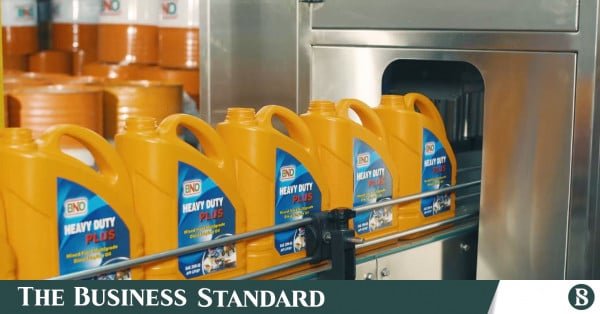
It could lead to revenue leakage and low-quality lube imports, stakeholders warn
Photo: TBS
“>

Photo: TBS
Highlights:
- Bangladesh proposes ICIS-based lubricant customs valuation replacing fixed benchmarks
- Industry says no global ICIS benchmark exists for finished lubricants
- Stakeholders warn proposal may trigger valuation disputes and misdeclaration
- Lubricant market worth Tk8,000 crores with strong local production
- Lower assessed values may reduce revenue and enable under-invoicing
- Industry urges using actual import data instead of ICIS formulas
Bangladesh’s lubricant sector is pushing back against a proposed budget measure that would replace fixed customs values for synthetic and semi-synthetic lubricants with a floating formula based on Independent Commodity Intelligence Services (ICIS) price assessments.
Industry stakeholders argue that because no internationally recognised ICIS benchmark exists for finished lubricants, the proposal risks creating valuation disputes, revenue leakage and market distortions rather than strengthening tax compliance.

In the proposed FY2026-27 budget, the National Board of Revenue (NBR) suggested replacing the existing fixed minimum customs values for imported synthetic and semi-synthetic lubricants with a floating valuation formula based on international price assessments published by ICIS, plus a minimum 30% markup.
Infograph: TBS
“>

Infograph: TBS
Currently, Bangladesh applies minimum customs values of $3,200 per tonne for semi-synthetic lubricating oil and $5,000 per tonne for synthetic lubricating oil. The budget proposal would replace those separate benchmarks with a common ICIS-based assessment method.
However, industry stakeholders argue that the proposed mechanism may fail to achieve its intended goal of revenue protection because ICIS does not provide any internationally recognised benchmark price for finished synthetic or semi-synthetic lubricant as standalone products.
They fear that instead of strengthening customs valuation, the new method could create valuation disputes, encourage misdeclaration and allow lower-quality products to enter the market.
According to the Bangladesh Lube Blenders Association, Bangladesh’s lubricant market is currently worth around Tk8,000 crores, with annual demand estimated at 1,60,000-1,70,000 tonnes. More than half of the domestic demand is now met by local blending companies.
The market has expanded rapidly due to rising demand from transport, industrial manufacturing, power generation, agriculture and construction sectors.
Major international brands including Mobil, BP, TotalEnergies, Castrol and Petronas operate in Bangladesh, while state-owned Jamuna Oil, Padma Oil and Meghna Petroleum are involved in blending and distribution. Local companies such as Lub-ref Bangladesh have also established a significant presence in the market.
Why the industry objects
In a recommendation submitted to the NBR, industry stakeholders said ICIS publishes prices for different categories of base oils but does not provide a standard international reference price for finished synthetic or semi-synthetic lubricants.
They said finished lubricants are not simply base oils; rather, they are highly engineered products produced through combinations of different base oils, additive technologies and proprietary formulations.
As a result, the industry asked which ICIS price would be used as the benchmark and whether it would be based on a particular grade, viscosity level, market or time period.
Azam J Chowdhury, managing director of MJL Bangladesh PLC, said there is no global ICIS standard for synthetic or semi-synthetic lubricants because they are blended products.
“These oils are produced using different combinations of Group I, Group II, Group III, Group IV and Group V base oils. The exact formulation is a patent and commercial secret of the manufacturers. It is not possible for customs authorities to determine the composition and calculate a uniform value,” he said.
He added that two products labelled as synthetic lubricants may have completely different formulations and production costs depending on the technology used by manufacturers.
Revenue loss, market distortion risks
Industry stakeholders fear the proposed valuation system could unintentionally reduce government revenue by creating a gap between actual import prices and customs-assessed values. They said high-quality synthetic lubricants are currently traded internationally at around $6,000 per metric tonne or higher, while the proposed ICIS-based formula could result in significantly lower assessed values in some cases.
Such a gap, they warned, may encourage under-invoicing and reduce collections from customs duties, VAT, advance tax (AT) and advance income tax (AIT). They also raised concerns that manipulated import values could increase risks of trade-based money laundering.
The industry further argues that finished lubricants cannot be valued solely based on base oil prices. The final price depends on several factors, including advanced additive packages, research and development, international manufacturer approvals, packaging and supply-chain costs. In many premium lubricants, additives account for a substantial portion of production costs and may even exceed the value of base oils.
Stakeholders say applying a uniform 30% markup on base oil-related benchmarks would fail to capture the actual value of finished lubricant products.
They also fear that an unclear valuation mechanism could create unfair competition, allowing businesses that under-declare import values to gain an advantage over compliant companies importing genuine branded products.
According to industry representatives, this could encourage the entry of low-quality lubricants into the market, posing risks for vehicles, industrial machinery, power plants and agricultural equipment. Modern engines, particularly hybrid and high-performance vehicles, require lubricants that meet strict technical specifications, and the use of unsuitable products could increase maintenance costs and reduce equipment efficiency, they added.
An NBR official told The Business Standard that the revenue authority is discussing the issue with both lubricant importers and local blending companies.
“After receiving applications from the industry, we are talking with both groups. We want to formulate a policy that does not harm any industry while ensuring proper revenue collection,” the official said.
The official added that changes could be incorporated into the final budget.
Wayez Mahmud, Director (Sales & Marketing) at United Lube Oil Limited, the distributor of Petronas lubricants in Bangladesh, said it is not the right time to introduce an ICIS-based customs valuation system for lubricant imports.
He argued that the NBR should rely on actual import data and declared transaction values rather than a pricing benchmark that does not exist for finished lubricant products.
“About 80% of the lubricant market consists of mineral oils, while synthetic and semi-synthetic oils account for a relatively small share. Synthetic lubricants are produced using different combinations of base oils from various groups, making it impossible to determine a uniform value based on ICIS references,” he told The Business Standard.
He suggested that the NBR adopt a data-driven approach based on the average import prices of different importers, supported by exporters’ declared values and recent import statistics.
About The Author